Saturday, 12 September 2026
Austria’s property investment market produced an unexpected leader during the first half of 2026. Retail accounted for approximately 31% of transaction volume, according to Colliers, placing it ahead of hotels at 25%, offices at 17% and industrial and logistics property at 13%. After years in which investors frequently favoured residential, logistics and other supposedly defensive sectors, retail has moved back into serious contention for capital. The numbers are striking, but they require careful interpretation because Austria remains a relatively subdued investment market in which several sizeable transactions can significantly influence the sector rankings.
Around €1.2 billion was invested in Austrian commercial property during the first six months of 2026 according to Colliers, approximately 17% less than during the comparable period a year earlier. Other property advisers calculate somewhat different totals because they use different methodologies, but the overall picture is consistent. Transaction activity remains relatively limited, meaning retail’s 31% share is important without necessarily proving that the entire sector is experiencing a broad recovery. Transactions including Arcade Meidling in Vienna and activity involving high-street properties contributed to the first-half result, and in a relatively thin market a handful of larger deals can make one sector appear considerably stronger than another.
Yet it would also be misleading to dismiss retail’s position as simply a statistical accident. Retail and hotels were already prominent in Austrian investment activity earlier in the year, indicating that investors had begun reconsidering assets that many institutions treated cautiously during the period of rising interest rates, weak economic growth and uncertainty surrounding consumer spending. The more important question is therefore not whether investors are returning to retail, but which parts of the sector they are prepared to buy.
Retail property is not a single investment category in any meaningful economic sense. A supermarket serving a residential neighbourhood operates under very different conditions from a fashion-led shopping centre, while a prime shop in central Vienna has little in common with a secondary retail property in a smaller regional location. Putting all of these assets into one statistical category can conceal significant differences in risk, income and future investment requirements.
Grocery and convenience-oriented properties can appeal to investors looking for comparatively defensive income. Food and everyday household purchases generate recurring customer demand and are less dependent on discretionary spending than many other retail categories. Where such properties have strong operators, established catchment areas and sustainable rents, investors can view them primarily as long-term income-producing real estate rather than as a speculative bet on consumer spending.
Retail parks offer another investment proposition. Schemes anchored by supermarkets, discount retailers, household goods and other frequently visited operators can benefit from regular customer traffic and established local catchments. Their attractiveness nevertheless depends heavily on location, competition, tenant quality, lease structure and the ability to maintain or replace occupiers. Strong assets can attract capital while weaker properties remain difficult to finance or sell.
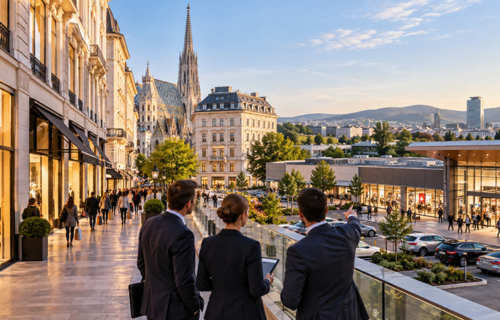
Vienna’s prime shopping streets occupy a different part of the market. Properties in established central locations combine retail income with the scarcity of city-centre real estate. Tourism, international brands and limited availability can support demand for well-positioned units, while upper floors can provide offices, residential accommodation or other uses. For investors, the value of such a property may therefore extend considerably beyond the shop occupying the ground floor.
Shopping centres require an even more selective approach. Dominant centres with strong catchment areas, established customer traffic and diversified tenant mixes can remain attractive investment propositions. Food, leisure, services and other reasons for customers to visit have become increasingly important alongside traditional fashion retail. The situation is considerably more difficult for weaker centres, where online competition, changing consumer habits and ageing buildings can require substantial investment in energy performance, common areas, tenant configurations and the overall customer environment. Investors acquiring these properties must therefore assess not only current rental income but also the capital required to keep the asset competitive.
This is why Austria’s retail revival is better understood as a selective return of capital rather than a recovery affecting every property equally. Pricing is part of that change. Years of uncertainty surrounding retail property altered the returns investors demanded from the sector, and changes in pricing and required returns have made selected assets more interesting to buyers than they were several years ago, particularly where rental income has proved more resilient than earlier fears suggested.
An investor does not need retail sales to boom for a property acquisition to make financial sense. What matters is the relationship between the purchase price, sustainable rental income, future capital expenditure and the return required for taking the risk. That distinction helps explain why capital can return to retail even while Austria’s wider economy remains relatively subdued. Financing conditions are also less severe than they were at the peak of the monetary tightening cycle. Lower benchmark interest rates have provided some relief, although the economics of individual transactions continue to depend on asset quality, leverage, loan pricing and the income available to service the debt.
Retail’s first-half prominence also needs to be considered alongside conditions in competing property sectors. Vienna’s office investment market was exceptionally quiet during the second quarter of 2026. The availability of newly developed residential investment product remains constrained, while logistics developers continue to approach speculative construction cautiously. When fewer investible assets are trading elsewhere, transactions in retail can represent a much larger proportion of the overall market.
Retail’s 31% share therefore reflects two developments at once. Capital has become more willing to consider selected retail properties, while transaction activity in several competing sectors has remained limited. That distinction will be important when judging whether the first half of 2026 represents a lasting change. If investment continues across grocery assets, retail parks, prime high streets and selected shopping centres, there will be stronger evidence that Austrian retail has moved into a broader recovery phase. If transaction volumes fall sharply once several larger assets have changed hands, the first-half sector ranking may prove less significant than it initially appears.
The composition of future transactions will consequently matter more than the ranking itself. International capital remains active in Austria, while institutional buyers continue to account for a substantial part of the investment market. Their willingness to acquire additional retail assets would provide an important test of whether the sector is becoming a durable part of investment strategies again.
Asset quality will remain decisive. Properties with weak locations, vulnerable tenants, unsustainable rents or substantial future expenditure requirements are unlikely to become attractive simply because retail represented the largest share of investment during one half-year period. The strongest assets have a clearer investment argument. Grocery-led properties can offer relatively defensive income, well-positioned retail parks can serve established local demand, prime Vienna buildings combine retail with scarce urban real estate, while selected shopping centres can offer opportunities where the underlying location and catchment remain strong. These are different investment strategies rather than evidence of one universal retail recovery.
For owners considering a sale, the next phase of the market could therefore become increasingly revealing. If buyers compete for a broader range of properties, pricing evidence will improve and more owners may decide that liquidity has returned sufficiently to bring assets to market. Greater transaction activity could then reinforce the recovery. If demand remains concentrated on a narrow group of exceptional properties, the gap between prime and secondary retail could instead widen further.
That possibility makes Austria’s retail story more interesting than the 31% headline alone suggests. The sector may be recovering, but capital is returning with far greater discrimination than during previous property cycles. Investors are increasingly asking whether a particular location remains relevant, whether tenants can sustain their rents, how much money the building will require in the future and whether the purchase price adequately compensates for those risks.
Austria’s first-half figures therefore provide an important signal rather than a definitive verdict. Retail was the country’s largest property investment sector by transaction volume during H1 2026, but that does not mean every part of the market has recovered. The real test will be whether capital continues flowing into the sector after the transactions that shaped the first-half statistics have been completed.
If it does, 2026 may ultimately be remembered as the point when Austrian retail moved beyond repricing and re-established itself as a significant institutional investment market. If it does not, the 31% share may instead prove to have captured an unusually active six months for a relatively small number of assets. For now, one conclusion is already clear: investors can no longer treat Austrian retail as a sector that sits automatically outside their acquisition strategies. For the right property, with sustainable income and a price that reflects its risks, retail is competing for capital again.
Source: CIJ.World Research & Analysis Team