Sunday, 20 September 2026
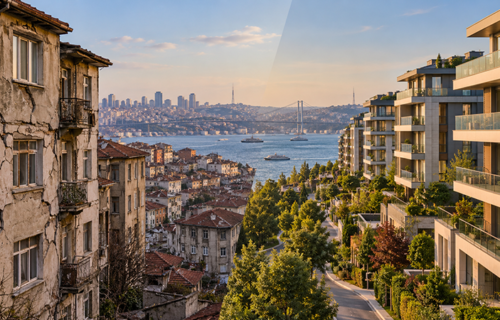
Istanbul’s earthquake exposure has influenced construction and planning policy for decades, but seismic risk is increasingly becoming visible in residential property values. Evidence published in 2026 indicates that buyers and tenants are placing greater importance on building age, location and perceived structural resilience, contributing to a widening performance gap between newer housing and older properties in areas considered more vulnerable.
An analysis covering almost 140,000 residential property appraisals across Istanbul found that, following the February 2023 earthquakes in southern Türkiye, sale prices and rents grew more slowly in neighbourhoods with greater seismic exposure than in lower-risk locations. Although Istanbul was not at the centre of the disaster, the earthquakes appear to have increased awareness of the potential consequences of a major event closer to the city.
Building age is becoming an important part of that distinction. Properties completed before the introduction of the 2007 earthquake regulations showed a greater relative disadvantage in higher-risk areas than newer housing. Age alone does not determine whether a building is safe, as structural condition also depends on engineering, construction quality, ground conditions, maintenance and subsequent alterations. However, it is increasingly being used by purchasers as one indicator when evaluating residential property.
The emerging difference does not necessarily mean that prices in higher-risk districts are falling. Istanbul’s residential market can continue recording nominal price increases while older or more exposed properties appreciate more slowly than comparable homes elsewhere. The result is a relative premium for housing perceived as more resilient and a growing disadvantage for vulnerable older stock.
The implications are significant given the scale of Istanbul’s redevelopment challenge. Government estimates indicate that around 1.5 million homes in the metropolitan area are exposed to earthquake-related risks, with approximately 600,000 regarded as particularly vulnerable. Recent reports indicate that roughly 10,000 unsafe buildings are being demolished and reconstructed annually as urban transformation programmes continue across the city.
Redevelopment is consequently changing the competitive structure of Istanbul’s housing market. Replacement projects are adding apartments constructed under more recent standards, while large quantities of ageing housing remain outside the transformation process. Where redevelopment is delayed by financing constraints, fragmented ownership or disagreements among residents, older buildings may face increasing difficulty competing with newer alternatives.
The pattern nevertheless varies considerably across Istanbul. Household income, infrastructure, accessibility, neighbourhood quality and the availability of modern housing all influence property values alongside seismic exposure. The relationship between earthquake risk and pricing can also differ according to socioeconomic conditions, making the emerging divide more complex than simply separating districts into safe and unsafe locations.
For developers and investors, seismic resilience is therefore becoming an increasingly important market consideration. Projects able to demonstrate modern engineering, construction quality and compliance with current standards may gain an advantage beyond conventional factors such as location, design and amenities. With hundreds of thousands of homes still requiring renewal, earthquake resilience is moving beyond a public-safety and engineering concern to become an increasingly measurable factor in residential pricing, redevelopment potential and investment decisions across Istanbul.
Source: CIJ.World Research & Analysis Team