Thursday, 10 September 2026
Czech President Petr Pavel has warned that the pace of public debt growth represents a greater risk to the country’s finances than the overall level of debt itself, urging policymakers to focus borrowing on investments that strengthen the long-term competitiveness of the Czech economy.
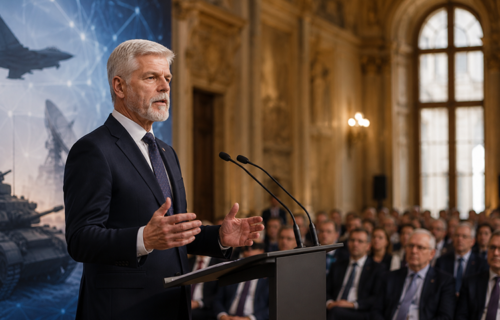
Speaking at the reVize Česka conference in Prague, Pavel said the country faces a challenging economic environment characterised by higher interest rates and growing pressure on public finances.
“We are tempted to continue living on debt, yet we are in a decade of high interest rates, and irresponsible management can become very costly,” Pavel said.
According to the latest figures, the Czech national debt increased by CZK 42.3 billion during the first quarter of 2026 to a record CZK 3.72 trillion. The approved state budget anticipates that the debt could rise to nearly CZK 4 trillion by the end of the year. The Czech National Bank expects government debt to reach 45.7 percent of GDP in 2026, up from 44.3 percent last year, before rising further to 47.2 percent in 2027.
Pavel stressed that public borrowing should be directed towards projects that generate future economic growth rather than expenditures with limited long-term returns. He argued that debt is not inherently problematic if it finances investments that improve the country’s future position and productivity.
Among the priorities identified by the president were defence-related investments, which he said should be viewed not only as spending on military equipment but also as support for technologies with both civilian and military applications.
Pavel highlighted the Czech Republic’s strengths in sectors such as clean technologies, nanotechnology and software development, adding that the defence industry could become an increasingly important driver of future economic growth.
His comments come as political debate intensifies over proposed changes to public budget rules. A legislative amendment currently under consideration in the Senate would allow the government greater flexibility to increase spending on strategic infrastructure projects and security-related measures during periods of heightened geopolitical risk. Critics argue the proposal could weaken fiscal discipline and increase long-term budgetary pressures.
The president also pointed to structural challenges facing the Czech economy, including insufficient investment in education, regional disparities in educational quality, shortages of skilled labour, slow progress in state digitalisation and fragmented management of research and innovation.
Prime Minister Andrej Babiš meanwhile reiterated concerns about meeting NATO defence spending commitments, indicating that achieving expenditure equivalent to two percent of GDP may prove difficult under current fiscal conditions.
Pavel concluded that maintaining sustainable public finances while investing in strategic sectors will be critical if the Czech Republic is to strengthen its competitiveness and economic resilience in the coming years.
Source: CTK