Thursday, 10 September 2026
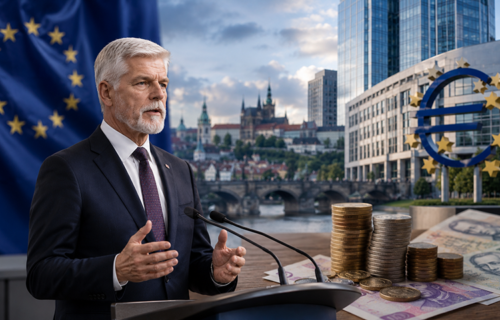
Czech President Petr Pavel has reiterated his support for adopting the euro, arguing that the Czech Republic should be prepared to abandon sentiment attached to the Czech crown if it becomes an obstacle to the country’s future development and influence within Europe.
Speaking at the reVize Česka conference in Prague, Pavel said the Czech economy’s deep integration with the eurozone makes participation in key European decision-making forums increasingly important.
“The fact that our economy is closely intertwined with the eurozone should lead us to conclude that it is better to sit at the table where decisions are made rather than remain outside and simply deal with their consequences afterwards,” Pavel said.
The president argued that euro adoption would strengthen the Czech Republic’s position within the European Union and provide greater influence over economic policies that already affect the country. He also maintained that the Czech Republic’s long-term prosperity depends on being part of a strong and integrated Europe.
Pavel’s comments stand in contrast to the position of Prime Minister Andrej Babiš and the governing coalition, which remains opposed to adopting the common European currency.
Responding after a cabinet meeting, Babiš described the euro as a further loss of national sovereignty within the European Union. He argued that major eurozone countries dominate decision-making while smaller member states have limited influence.
“The Czech Republic needs the crown,” Babiš said, despite his frequent criticism of Czech monetary policy and interest rate decisions.
The debate comes as the government has indicated it no longer intends to prepare annual reports assessing the country’s readiness to join the eurozone. Although the Czech Republic committed to adopting the euro when it joined the European Union in 2004, no target date has ever been set.
Economic opinion remains divided. Petr Dufek, Chief Economist at Banka Creditas and a member of the Czech Banking Association’s Prognostic Panel, said the euro should primarily be viewed as an economic rather than political issue.
According to Dufek, while the Czech Republic currently fulfils the technical conditions required for eventual euro adoption, retaining an independent currency continues to provide important advantages through autonomous monetary policy.
He argued that if the Czech Republic had already adopted the euro, inflation and housing prices could currently be higher than they are today.
To join the eurozone, countries must satisfy five Maastricht criteria covering inflation, long-term interest rates, public finances and exchange-rate stability. One requirement is participation in the ERM II exchange-rate mechanism for at least two years before adoption.
The euro is currently used by 21 of the European Union’s 27 member states, with Bulgaria becoming the latest country to join the currency bloc in 2026.
Pavel’s intervention is likely to reignite debate over the Czech Republic’s monetary future, particularly as questions about economic competitiveness, European integration and long-term investment continue to shape the country’s policy agenda.
Source: CZK