Monday, 21 September 2026
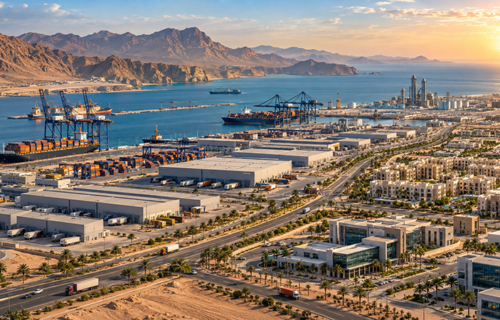
Oman’s industrial real estate market can look relatively small when measured against the country’s population, domestic consumption or the scale of neighbouring Saudi Arabia and the United Arab Emirates. That comparison may increasingly miss the point. The more important driver of future demand could be the volume of international economic activity that Oman’s ports and industrial zones succeed in bringing onto land. Sohar, Salalah and Duqm give the country three distinct maritime and industrial locations, each with different connections to manufacturing, logistics and international trade. Their importance to property investors extends well beyond port infrastructure. When cargo is stored, processed, assembled or manufactured close to a port, it creates requirements for industrial land, warehouses, supplier facilities and distribution buildings. As employment grows around those activities, demand can spread into housing, offices, hospitality, retail and other commercial property.
Geography provides Oman with an important starting advantage. Its Arabian Sea coastline gives major ports direct access towards the Indian Ocean, allowing maritime connections with Asia, Africa and other international markets without first entering the Arabian Gulf. This does not guarantee that Oman will become a major institutional logistics property market, but it gives the country a position that cannot be replicated simply by developing more warehouses elsewhere. The investment opportunity therefore depends on whether Oman can persuade companies to do more than move cargo through its ports. The greater prize is attracting businesses that use the country for manufacturing, processing, storage and regional distribution. Those activities generate much more economic value on land and have a considerably greater impact on real estate demand.
Sohar already provides evidence of how this relationship can develop. Port infrastructure operates alongside a substantial industrial and economic zone, with manufacturing, processing and logistics activity creating a broader commercial ecosystem. Its location in northern Oman also provides road connections towards the UAE and other parts of the Gulf, giving companies the possibility of combining maritime access with regional distribution. For property investors, the factories themselves are only part of the story. Manufacturers require suppliers, maintenance contractors, transport companies and storage facilities. Raw materials need to arrive, finished products need to leave and components often need to be held close to production. As the concentration of industrial businesses increases, some suppliers have an economic incentive to establish operations nearby.
This can gradually turn industrial investment into property demand. Warehouses, workshops, yards and smaller manufacturing units become part of the supply chain surrounding the original factories, while employment creates another layer of demand, initially through workforce accommodation and eventually through a broader range of housing and services. The potential therefore lies in the cluster rather than any individual development. A major industrial plant can anchor an area, but the longer-term property value may come from the network of businesses that forms around it.
Salalah offers a different proposition. Its position in southern Oman places it close to major maritime routes connecting Asian, Middle Eastern, African and European markets. The surrounding domestic economy is relatively modest compared with the scale of international shipping that can pass through the area, making conventional population-based measures of warehouse demand less useful. The crucial distinction is what happens to cargo after it reaches the port. Containers transferred directly between ships create limited requirements for property outside the terminal. Goods that are stored, processed, packaged, assembled or redistributed from Oman can generate much greater demand for land and buildings.
That makes industrial development around Salalah particularly important. The property opportunity expands when the port becomes not merely a point on a shipping route but a location where companies perform economic activities before goods continue towards their final markets. Manufacturing can strengthen that relationship. Export-oriented producers located near the port gain access to maritime connections, while the surrounding industrial area can accommodate storage, suppliers and related businesses. If more of this activity develops, Salalah’s real estate market can increasingly depend on international trade rather than the purchasing power of the local population alone.
Duqm represents a much earlier and larger-scale version of the same idea. Its special economic zone covers roughly 2,000 square kilometres and incorporates port facilities, industrial areas, logistics, energy infrastructure, residential development, tourism and commercial uses. The amount of available land provides room for industries that would be difficult to accommodate in more constrained urban markets. Yet the quantity of land is not what makes Duqm interesting. Undeveloped territory has limited commercial value if occupiers cannot connect efficiently to electricity, water, roads, port facilities and other essential infrastructure. The investment case depends on the ability to convert large areas of land into sites where companies can actually operate.
That process is advancing as industrial and energy investments move through planning, construction and operation. Large manufacturing facilities can create substantial secondary requirements because they need contractors, transport, maintenance, storage and specialist services. Some demand exists only during construction, but operating facilities can establish a more permanent economic base. This is where the real estate implications become more interesting. An industrial economy needs people as well as factories. Construction workers require accommodation, while permanent operations need technicians, managers, engineers and service employees. Different groups require different types of housing, and growing communities eventually need shops, restaurants, healthcare, recreation and hospitality.
Duqm can therefore become a test of whether industrial development is capable of creating a broader city around itself. The investment case for housing or commercial property depends heavily on the pace at which employment becomes permanent and supporting services develop. Timing will be critical because property developers can construct buildings considerably faster than major industrial clusters can mature. Warehouses, apartments or hotels delivered several years before the occupiers arrive can remain underused even when the long-term economic argument is compelling.
Investors therefore need to distinguish carefully between announced projects and developments that are actually creating demand. Financing, construction progress, infrastructure completion, utility connections, employment and operating dates provide much stronger indications of near-term property requirements than headline investment values alone. The same principle applies across Oman. A large industrial site is not automatically valuable simply because it is close to a port. The most competitive locations are likely to be those where businesses can obtain serviced land, connect to transport networks and utilities and begin operations without excessive delay.
This could create significant differences between apparently similar industrial plots. Land with functioning infrastructure and efficient access to a port can have a very different commercial proposition from cheaper sites where occupiers must wait for roads, power or other essential services. For property investors, Oman should therefore be examined as a collection of industrial corridors rather than one national warehouse market. Sohar, Salalah and Duqm have different strengths, development stages and potential occupier bases.
Sohar combines an established industrial cluster with access towards northern Oman and neighbouring Gulf markets. Salalah offers exposure to international maritime trade and connections towards the Indian Ocean and Africa. Duqm provides extensive space for energy, manufacturing and other land-intensive industries with long-term development potential. Their differences could ultimately be an advantage. Oman does not need three ports competing for identical businesses. Each location can develop around the industries and trade routes for which it is best suited.
This creates an investment proposition quite different from the major logistics markets of Dubai, Abu Dhabi or Saudi Arabia. Those markets benefit from larger metropolitan economies, substantial consumer demand and deeper pools of property capital. Oman is unlikely to compete successfully simply by replicating them. Instead, its opportunity is to develop property around economic activity that originates outside the country. A warehouse serving international manufacturers can derive its demand from global supply chains. An industrial plot can become valuable because it provides access to a particular port and manufacturing cluster, while employee accommodation can be supported by industrial employment rather than population growth alone.
This distinction changes how investors should measure the potential market. Domestic retail spending and population remain relevant, but they do not capture the full economic role of property connected to export industries and international logistics. Oman’s position could also become relevant to companies examining the resilience of their supply chains. Having port options directly facing the Arabian Sea provides an additional routing choice within the wider Gulf logistics network. That does not mean Oman will replace established regional hubs, but it can provide manufacturers and logistics operators with another location from which to organise international trade.
The real estate opportunity becomes strongest where these advantages overlap. Port connectivity alone is insufficient. Cheap land alone is insufficient. Industrial incentives alone are insufficient. The most competitive locations combine maritime access, serviced land, utilities, road infrastructure, labour and an existing or emerging concentration of occupiers. Once those elements come together, property demand can expand outward from the industrial core. Manufacturers attract suppliers, suppliers require warehouses and workshops, logistics companies establish distribution facilities, employees require housing and the resulting communities create demand for commercial services.
This progression will not occur at the same speed in every location. Sohar is further along in building an established industrial base. Salalah’s opportunity is closely linked to converting maritime connectivity into more activity on land. Duqm remains a longer-term development proposition whose eventual property market will depend heavily on the execution of major industrial investments. For investors, that means Oman requires patience and unusually detailed attention to infrastructure. The announcement of a factory or industrial zone is only the beginning. The important indicators are when roads are completed, utilities become available, factories start operating, employees arrive and suppliers begin leasing nearby premises. Those developments reveal when infrastructure is becoming a property market.
If Oman succeeds in attracting more manufacturing, processing and distribution activity, the implications could extend far beyond warehouses. Industrial land, employee housing, offices, hotels, retail and other commercial uses could all benefit from the economic ecosystems developing around the country’s ports. The scale of that opportunity should not be exaggerated. Oman remains a smaller real estate market than its largest Gulf neighbours, and substantial parts of its industrial development strategy will take years to mature. There is also no clear evidence that logistics property across Oman is universally undervalued relative to comparable Gulf assets.
The more defensible investment argument is that the country may be underestimated when its potential is judged primarily through the size of its domestic economy. Sohar, Salalah and Duqm provide Oman with something more important than three ports. Together they form a network of maritime and industrial locations positioned to connect Gulf economies with markets across the Indian Ocean, Asia and Africa. The ultimate value of that network will depend on how much international economic activity Oman can capture onshore.
If cargo merely passes through, the property impact will remain limited. If companies increasingly choose Oman to manufacture, store, process and distribute goods, demand for real estate can spread progressively inland from the ports. That is where Oman’s logistics property opportunity begins: not with the number of warehouses it can build, but with how much of the global trade moving past its coastline it can persuade to stop, invest and stay.
Source: CIJ.World Research & Analysis Team