Saturday, 24 October 2026
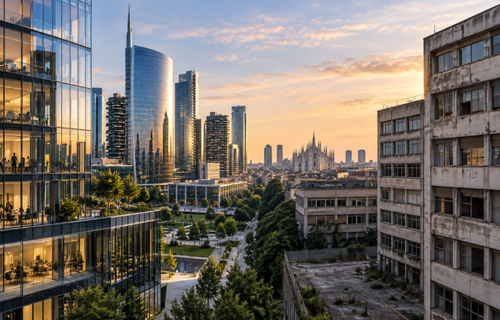
Milan’s office market is sending two very different signals in 2026. At the top end, rents have continued to rise and suitable space in the most sought-after central districts is exceptionally difficult to secure. Across the wider market, however, companies have leased less space. Rather than being contradictory, these trends point to a fundamental change in what occupiers consider an acceptable workplace.
The strongest buildings are increasingly operating within a market of their own. Prime office rents are generally being assessed at around €830 to €850 per sq m annually by major property advisers, while exceptional properties can command still higher levels. Availability in the central business district and Porta Nuova remains extremely limited. Yet overall Milan leasing activity weakened during the first half of the year.
This suggests that Milan’s problem is not simply a shortage of offices. It is a shortage of the offices that companies most want to occupy. Around two-thirds of first-half leasing was concentrated in better-performing, modern buildings, demonstrating how strongly demand has shifted towards properties offering high energy efficiency, good transport connections, modern technical systems and workplaces capable of attracting employees.
The change has important implications because Milan still contains a considerable stock of older offices. A building can be physically available without being commercially competitive. Space with outdated mechanical systems, inefficient layouts, poor energy performance or limited amenities does little to satisfy demand from companies searching for modern headquarters. The result is an unusual market in which scarcity and excess supply can exist simultaneously.
Changing working patterns have reinforced the divide. Companies that require less space because employees work remotely for part of the week can afford to become more demanding about the space they retain. The workplace increasingly has to provide something employees cannot obtain at home. Accessibility, natural light, collaborative areas, restaurants, terraces, wellness facilities and the surrounding neighbourhood all become more important when companies are trying to encourage people to spend time together.
This is also changing the economics for landlords. Owners of older properties can no longer assume that rising rents in Milan will automatically improve the performance of their buildings. Increasingly, they have to decide whether to invest substantial amounts of capital to bring those properties closer to the standard expected by today’s occupiers.
That can mean replacing heating and cooling systems, improving insulation and façades, redesigning entrances and common areas, modernising lifts, installing more efficient building technology and adapting floorplates for different working patterns. Improvements to terraces, bicycle storage, showers and shared amenities can also form part of the repositioning required to compete for larger corporate tenants.
The financial calculation can be difficult. A centrally located older building may justify substantial investment because refurbishment allows the owner to capture significantly higher rents while retaining an irreplaceable location. A similar project in a weaker submarket may not generate enough additional income to compensate for construction costs, financing and the time during which the property is partly or completely vacant.
This creates a potentially problematic middle category of Milan offices. These properties are not sufficiently outdated or inexpensive to make redevelopment straightforward, but they are no longer competitive enough to attract the strongest occupiers without significant investment. Their future values could become increasingly disconnected from the headline rents reported for the city’s best buildings.
Environmental performance adds further pressure. Corporate occupiers are increasingly assessing buildings against their own sustainability commitments, while investors and lenders are paying closer attention to future energy requirements and the capital expenditure needed to meet them. An inefficient building therefore faces more than the possibility of higher utility costs. It can encounter a smaller tenant pool, weaker financing options and greater uncertainty about its eventual resale value.
Financing could consequently accelerate the separation between buildings. Modern properties with established tenants and limited near-term capital requirements are easier for lenders and investors to assess. Older offices requiring extensive works carry additional execution risk. When these properties reach refinancing, owners may need to contribute more equity, accept different valuations or commit to substantial improvement programmes.
For investors prepared to undertake refurbishment, this could eventually create opportunities. If the price of an older building falls sufficiently, the difference between acquisition cost and the value of a successfully repositioned property can support an attractive investment case. Milan’s shortage of modern central space potentially strengthens that strategy because a completed refurbishment can enter a market where competing high-quality supply remains limited.
Not every obsolete office, however, will successfully return to the premium market. Structural limitations can make some buildings difficult to modernise. Floorplates may be too deep, ceiling heights unsuitable or façades difficult to alter. Improving energy performance can require interventions that become disproportionately expensive relative to the property’s eventual rental potential.
Conversion therefore becomes another possible route. Strong demand for housing, hotels and student accommodation means some former offices may have greater value serving another purpose. Large redevelopment sites could also support mixed-use projects combining several functions.
Changing use is not an automatic solution. Office buildings can be difficult to transform into homes or hotel rooms because of their dimensions, structural grids, access arrangements and natural-light requirements. Planning restrictions and construction costs can further reduce the number of properties for which conversion is financially realistic. Milan may therefore be left with some buildings that are no longer competitive offices but remain too expensive or technically complicated to transform.
The widening difference between buildings should eventually become more visible in investment pricing. A modern office in a central location with strong tenants can offer relatively predictable income and potentially benefit from competition for scarce space. An older property may need to be valued according to the cost and risk of making it competitive rather than according to the rent achieved by a newly refurbished building elsewhere in Milan.
This is why headline prime rents can give a misleading impression of the broader market. The highest rents demonstrate what occupiers are willing to pay for scarce, desirable properties. They do not establish the rental value of every office building in the city.
Milan could consequently experience further rental growth at the top of the market even while weaker buildings struggle to maintain occupancy. That would widen the difference not only between prime and secondary rents but also between investment values. Building condition, energy performance and the amount of future capital expenditure required could become increasingly important components of pricing.
The same process may gradually reshape Milan’s office stock. Some older properties will receive comprehensive refurbishment and return to the market at a higher standard. Others will be redeveloped or converted. A further group will remain lower-cost offices serving companies that do not require premium accommodation. The most difficult assets will be those that cannot economically move into any of these categories.
For institutional investors, the distinction is increasingly important. Buying “Milan offices” is no longer a sufficiently precise strategy. The performance of an individual asset may depend increasingly on whether companies actively want that particular building and how difficult it would be to replace its characteristics elsewhere.
Milan’s declining overall take-up therefore does not necessarily contradict the strength of its prime office market. It may instead demonstrate how concentrated demand has become. Companies are leasing less space overall while competing more intensely for the relatively small portion of the market that satisfies their requirements.
The central question for Milan is consequently shifting from how much office space the city has to how much of that space remains genuinely competitive. If the difference continues to widen, the next phase of the market will be defined not by a universal office recovery but by a growing separation between buildings that attract capital and occupiers and those that require increasingly expensive intervention simply to remain relevant.
Source: CIJ.World Research & Analysis Team