Friday, 23 October 2026
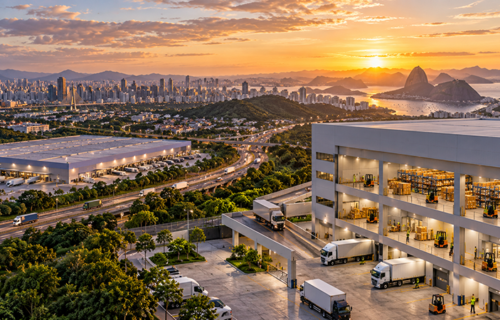
Brazil’s logistics property market is entering a new phase in which the distance between a warehouse and the customer is becoming almost as important as the size of the building itself. The expansion of online retail, faster delivery expectations and increasingly sophisticated distribution networks are encouraging occupiers to reconsider where inventory should be stored across the country’s largest metropolitan areas.
For much of Brazil’s modern logistics development cycle, the preferred model was relatively straightforward. Developers sought large sites along major highways outside metropolitan centres, where land was cheaper and sufficiently extensive to accommodate enormous single-storey distribution facilities. These locations remain essential to national supply chains, but the growth of rapid e-commerce delivery is adding another layer to the network. Brazil’s logistics sector entered 2026 with unusually limited availability. Strong leasing during the previous years absorbed much of the modern space brought onto the market, while new developments were frequently securing occupiers before completion. São Paulo, which contains the country’s largest concentration of modern warehouses, became particularly tight during the first half of the year.
This pressure is being driven partly by some of Latin America’s largest online retailers. Mercado Livre and Shopee have continued expanding their distribution networks as competition increasingly shifts from simply offering products online to delivering them quickly and reliably. The scale of these platforms means that changes in their distribution strategies can influence entire logistics submarkets. Speed changes the property calculation. A large fulfilment centre located well outside a city can efficiently store enormous quantities of merchandise, but every kilometre separating that inventory from consumers adds time and transportation expense to the final stage of delivery. For products expected within hours rather than several days, geography becomes increasingly important.
São Paulo provides the clearest demonstration of this challenge. Its metropolitan region contains more than 20 million people, creating an enormous concentration of potential deliveries. At the same time, congestion, high land prices and limited availability of suitable development sites make moving goods across the metropolitan area expensive and unpredictable. The result is not the disappearance of large peripheral logistics hubs. Locations such as Cajamar and other motorway-connected areas remain crucial because they provide the scale required for national and regional distribution. Instead, a second layer of logistics infrastructure is developing closer to the consumer.
These facilities can perform different functions. Inventory can arrive at major fulfilment centres before being transferred into smaller metropolitan properties positioned closer to densely populated neighbourhoods. Orders can then complete the final part of their journey from locations that reduce both distance and exposure to traffic congestion. The economics of this model could gradually change how investors value logistics land. A peripheral site may offer substantially cheaper land and the ability to construct a very large building. An urban or near-urban site may cost considerably more and offer less development capacity, but its location can potentially reduce transportation times across thousands of daily deliveries.
That creates a scarcity problem. Land suitable for logistics development becomes increasingly difficult to secure as development moves closer to established urban areas. Warehouses compete with residential projects, retail, offices and other commercial uses for sites, while local planning requirements and the impact of truck movements can further restrict opportunities. Developers are consequently exploring ways to produce more logistics space from limited metropolitan land. Multi-level warehouses, already familiar in densely populated Asian markets, provide one possible solution. By moving some warehouse operations vertically rather than relying exclusively on enormous horizontal buildings, developers can increase usable floor area on expensive sites.
The emergence of this format in Brazil is significant because it demonstrates how property design is adapting to changes in distribution. A warehouse designed principally around cheap land and motorway access is fundamentally different from one whose economics depend on serving millions of nearby consumers. Not every location close to a city will automatically become valuable, however. Recent leasing patterns around São Paulo demonstrate that modern building specifications remain important. Occupiers increasingly require sufficient ceiling heights, floor loading, loading docks, circulation areas, security, technology infrastructure and buildings capable of supporting automation.
This means Brazil’s logistics market is becoming more segmented rather than simply more urban. Older warehouses in relatively good locations can struggle to compete with newer buildings if they cannot accommodate modern distribution operations. Conversely, a highly specified facility farther from the city may remain attractive if its transport connections and operating efficiency compensate for the additional distance. For investors, the important distinction is therefore no longer simply prime versus secondary logistics property. Assets increasingly need to be understood according to their function within a distribution network.
Large peripheral fulfilment centres provide scale. They can hold enormous inventories, serve several regions and benefit from lower land costs. Metropolitan distribution facilities provide speed. Their value comes from positioning goods closer to the people who ultimately receive them. The most sophisticated logistics networks will increasingly require both.
This evolution is particularly visible in São Paulo because of the sheer size of its consumer market, but the same forces are likely to influence other Brazilian cities. Rio de Janeiro, Belo Horizonte, Curitiba, Porto Alegre, Brasília and major northeastern metropolitan areas all contain substantial populations whose online purchasing habits are becoming more important to distribution strategies. As e-commerce companies extend faster delivery services beyond São Paulo, logistics operators will need infrastructure capable of supporting those promises. That could create demand for metropolitan warehouse locations in cities where institutional logistics investment has historically been much thinner.
Rio presents an especially interesting opportunity because geography restricts development in parts of the metropolitan region. Suitable sites with strong road connections and access to major population concentrations could become increasingly strategic as retailers improve delivery networks. Belo Horizonte and Curitiba offer different advantages through their combination of large consumer populations, industrial activity and connections to wider regional markets. In northeastern Brazil, cities such as Recife, Fortaleza and Salvador could also require increasingly sophisticated distribution systems as e-commerce penetration grows and national retailers strengthen regional delivery capabilities.
The expansion creates an opportunity for institutional investors to build logistics portfolios around more than one type of warehouse. Instead of owning a collection of similar large distribution centres, future portfolios could combine national fulfilment hubs, regional warehouses and smaller metropolitan facilities. This diversification could also affect valuations. Properties that save occupiers significant transportation time may justify higher occupancy costs than buildings serving less time-sensitive functions. Yet Brazil does not currently have enough transparent market evidence to establish a universal premium for warehouses located close to consumers.
The investment case therefore needs to be assessed site by site. Accessibility, road congestion, labour availability, building specification, development restrictions and proximity to population all influence the economics. Distance measured in kilometres may be less important than the actual time required for a delivery vehicle to reach its customers. That distinction will become increasingly important as retailers compete on delivery performance. A warehouse that appears expensive when assessed purely according to rent per square metre may look considerably more attractive when its effect on transportation costs and delivery times is included.
Brazil’s logistics boom is consequently evolving from a race for warehouse capacity into a competition for network efficiency. The largest building is not necessarily the most valuable building, and the cheapest land does not necessarily produce the lowest distribution cost. For property investors, this could gradually redefine what constitutes a prime logistics location. Highway access and building quality will remain essential, but another factor is gaining importance: how quickly goods can move from the warehouse door to the customer’s door.
In Brazil’s increasingly competitive delivery economy, the scarce resource may ultimately be not warehouse space itself, but warehouse space in precisely the right place.
Source: CIJ.World Research & Analysis Team