Friday, 23 October 2026
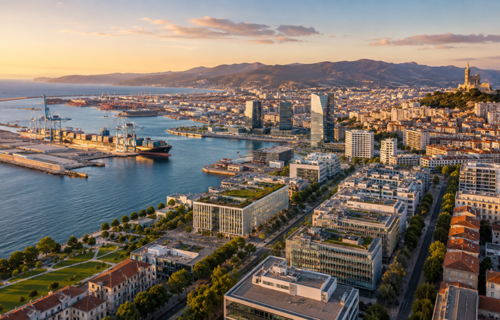
Marseille is developing a real estate story that increasingly extends beyond the conventional measures used to compare France’s regional cities. Its office and logistics markets remain considerably smaller than Paris, and current leasing figures do not indicate a widespread property boom. Yet the Marseille metropolitan area is accumulating something potentially more important for its long-term investment position: a concentration of transport, digital and electricity infrastructure capable of supporting several different forms of real estate at the same time. The city’s position on the Mediterranean has always made the port central to its economy, but what is changing is the range of infrastructure now associated with that geography. International telecommunications connections, data centres, logistics estates, electricity-network investment, industrial development and the continuing transformation of the waterfront are increasingly overlapping within the wider Marseille-Aix-Fos area. The question for investors is whether these individual strengths can eventually combine into a property market with characteristics that distinguish Marseille from a conventional French regional city.
Digital connectivity is one of the clearest reasons this question is becoming relevant. Marseille has developed into an important European entry point for submarine telecommunications cables connecting the continent with Africa, the Middle East and Asia. That international connectivity has encouraged substantial data-centre development because operators can position computing infrastructure close to the networks carrying information between these regions. This relationship gives Marseille an advantage that cannot easily be replicated through ordinary property development. An office district can be constructed in many cities and a logistics park can be built wherever suitable land and transport connections exist, but international telecommunications routes develop around geography, network architecture and infrastructure accumulated over many years. Some of Marseille’s data-centre facilities are located within the wider port environment, creating an unusual relationship between maritime and digital infrastructure. The port therefore supports more than the physical movement of containers and commodities. The same geography has also become important to the movement of international data.
The expansion of digital infrastructure introduces another requirement: electricity. Large data centres can require power connections far beyond those needed for ordinary commercial buildings, meaning the availability and timing of grid capacity can determine whether a development site is genuinely viable. Electricity-network planning is consequently becoming increasingly relevant to the Marseille property market. Around 500 MW of additional capacity is being prepared in the Plan-de-Campagne area between Marseille and Aix-en-Provence to accommodate growing digital infrastructure requirements. The wider Fos-sur-Mer industrial zone is also the focus of major electricity-network planning intended to accommodate industrial electrification and proposed energy-intensive projects.
For real estate, this potentially changes the meaning of a well-located site. Conventional property analysis concentrates heavily on land price, road access, public transport, construction rights and proximity to customers. Infrastructure-intensive development introduces another layer. A site can possess excellent motorway access and large amounts of developable land but still be unsuitable for a major data centre or industrial facility if sufficient electricity cannot be delivered. The same applies to digital connectivity. Fibre availability, network resilience and proximity to international connections can materially affect the suitability of a site for data-centre development. Locations where land, electricity, fibre and transport can all be combined are therefore likely to be considerably more difficult to reproduce than ordinary development land.
This creates the possibility of a broader infrastructure corridor stretching across Marseille, Aix and Fos. Each part of the metropolitan region provides different characteristics. Central Marseille offers density, services, transport and international connectivity. Aix has a substantial employment and commercial base. Areas between the two cities provide larger development opportunities. Further west, Fos combines port infrastructure, industrial land, logistics facilities and major electricity requirements. The Port of Marseille Fos remains fundamental to this geography. More than 3 million square metres of logistics space is located within roughly 30 kilometres of Fos, supported by major logistics areas such as Distriport and La Feuillane. These locations provide large concentrations of warehousing connected to maritime freight, road and rail infrastructure.
Further expansion and improvement of the port’s logistics capacity continues to be considered. This matters because the investment case for warehouses around Fos is closely linked to infrastructure that cannot simply be moved elsewhere. Proximity to a major port can reduce parts of the transport chain and support distribution operations serving France and wider European markets. Current property statistics nevertheless require caution. Marseille’s industrial and business-space market is not experiencing exceptional leasing growth, while the broader French logistics market has been adjusting after the rapid expansion of previous years. Infrastructure strength should therefore not be confused with immediate occupier-market strength.
The same distinction is particularly important for offices. Aix-Marseille recorded approximately 48,000 square metres of office take-up during the first half of 2026, significantly below both the corresponding period in 2025 and recent historical averages. Marseille accounted for most of that activity, but the metropolitan market remained subdued overall. These figures undermine any argument that Marseille is already experiencing a conventional commercial-property boom. They also make the city’s infrastructure story more interesting. If Marseille’s future depended entirely on office leasing, the investment case would currently look relatively modest. Instead, its longer-term potential increasingly depends on whether infrastructure investment creates additional economic activity capable of supporting several property sectors.
Euroméditerranée provides an important connection between these two worlds. The regeneration programme has transformed large areas close to the port and north of Marseille’s historic centre, introducing offices, housing, hotels, commercial space, public facilities and improved urban environments into districts historically shaped by maritime and industrial activity. Approximately 780,000 square metres of office space has already been completed within the wider regeneration area, with a longer-term objective approaching 1 million square metres. A substantial proportion of the stock is relatively modern, providing Marseille with a concentration of commercial property more suited to institutional requirements than much of the city’s older office inventory.
This proximity between regeneration and infrastructure could prove increasingly important. Port activity can support maritime, logistics and professional services. Industrial investment around Fos can generate requirements from engineering and supply-chain businesses. Digital infrastructure can support telecommunications, technology and network-related companies. Euroméditerranée provides one of the locations where businesses associated with those activities could potentially occupy modern commercial space. The connection should not be exaggerated. Data centres themselves generally create far fewer permanent jobs per square metre than conventional offices, and building additional computing capacity does not automatically produce substantial office demand. The wider economic value depends on whether related businesses, services and investment develop around that infrastructure.
The same caution applies to industrial announcements around Fos. Proposed investments should not be treated as completed factories or guaranteed sources of property demand. Major industrial and energy projects can take years to secure financing, permits, electricity connections and construction approvals. Some will proceed more slowly than originally expected and others may change substantially before completion. What matters for property investors is that the infrastructure required to support these activities is increasingly shaping development decisions today.
This is particularly visible in the competition for suitable land. Logistics developers, industrial companies, data-centre operators and energy projects can all require large sites with strong transport connections and access to substantial electricity capacity. These requirements are not identical, but they increasingly overlap. That could eventually make certain locations around Marseille and Fos strategically more valuable. The premium would not necessarily come from the amount of land alone but from what can realistically be connected to it. A large plot with motorway access, high-capacity electricity, fibre and proximity to the port has a fundamentally different development profile from an equally large site without those characteristics. Whether that difference translates into a measurable land-value premium across the Marseille region remains to be demonstrated, but infrastructure availability is increasingly likely to influence investment decisions.
This could also affect how investors assess older industrial land. Previously developed sites with existing infrastructure can become attractive if they allow new uses to be introduced without the same degree of greenfield development. Brownfield locations may therefore attract interest from logistics, industrial and digital developers where planning and environmental constraints can be resolved. Institutional investment will still require considerably more than infrastructure potential. Investors need occupiers, predictable income, transparent valuations and sufficient market liquidity. Marseille does not currently provide those conditions across every property sector to the same extent as Paris, while Lyon retains a deeper conventional regional office and investment market.
Marseille therefore does not need to compete with either city on identical terms. Paris will remain France’s dominant institutional property market because of its scale, corporate concentration and international liquidity. Lyon has an established position as one of the country’s deepest regional commercial markets. Marseille’s potential advantage is different because its investment proposition increasingly involves infrastructure that is difficult to reproduce elsewhere. A major Mediterranean port is geographically fixed. International subsea cable routes develop over decades. High-capacity electricity networks require major investment and long planning periods. Large logistics estates depend on extensive land and transport infrastructure. Euroméditerranée represents years of coordinated regeneration rather than a single development project.
Bringing these elements together could eventually produce an investment market where conventional property and infrastructure-linked real estate increasingly overlap. That could mean data centres and powered industrial land attracting one type of capital, logistics facilities another, and offices, hotels and residential property benefiting indirectly where the wider economy generates sufficient demand. The decisive issue will be execution. Additional electricity capacity has to become available rather than remain planned. Proposed data centres need to reach construction and operation. Industrial projects around Fos must move from announcements to functioning businesses. Logistics development needs occupiers. Euroméditerranée must continue attracting companies, residents and investment.
If those developments progress together, Marseille could become increasingly difficult to classify simply as another regional property market. Its investment identity would instead be built around infrastructure connecting physical trade, digital information, electricity, industry and urban development. That does not mean Marseille is about to overtake Paris or Lyon for institutional property investment. Current market evidence does not support such a conclusion. Nor does the city’s infrastructure pipeline guarantee rising rents or property values. What it does provide is a combination of long-term economic assets that few other French metropolitan areas possess in the same form.
For property investors, that changes the question. Marseille no longer needs to be assessed simply according to whether its offices are cheaper than Lyon’s or whether its logistics yields compare favourably with Paris. The more important consideration is whether the infrastructure accumulating between Marseille, Aix and Fos can support forms of economic activity and real estate that other French cities cannot easily reproduce. If it can, Marseille’s next property cycle may ultimately be determined less by the buildings already standing there than by the networks, power capacity, port infrastructure and international connections running beneath and around them.
Source: CIJ.World UK Research & Analysis Team