Friday, 23 October 2026
Vienna is emerging as an increasingly important location on Central Europe’s data-centre map, but the city’s ability to accommodate the next generation of digital infrastructure may depend less on demand than on electricity. As cloud computing, artificial intelligence and increasingly data-intensive business applications drive requirements for additional computing capacity, access to sufficient power is becoming one of the most important factors determining where new facilities can actually be built.
Austria currently has approximately 100 MW of operating data-centre capacity, according to Colliers, with around 82 MW located in Vienna. That gives the capital more than four-fifths of the country’s existing capacity and establishes it as Austria’s dominant data-centre location. The development pipeline indicates considerably greater ambitions, with around 170 MW at a relatively advanced stage across Austria and another approximately 266 MW identified among earlier-stage projects. Those pipeline figures require caution. They do not mean that another 436 MW of capacity will necessarily be constructed, nor does the entire pipeline belong to Vienna. Across Europe there is an increasingly significant difference between projects that have been proposed and facilities that can realistically obtain electricity, permissions, financing and construction capacity within a commercially acceptable timeframe.
The city nevertheless has several characteristics that make it attractive for digital infrastructure. Vienna is politically and economically stable, has substantial existing telecommunications infrastructure and occupies a useful geographic position between Western Europe and the markets of Central and Southeast Europe. Fibre connections link the city towards Frankfurt, Munich, Zurich, Prague, Bratislava and Budapest, while additional routes provide connectivity towards southeastern European markets. These advantages allow Vienna to serve more than domestic Austrian demand and potentially form part of digital networks connecting established Western European data-centre markets with growing demand further east and south.
Vienna is competing in an increasingly crowded European landscape. Frankfurt remains one of Europe’s largest and most mature data-centre centres, supported by an extensive ecosystem of operators, connectivity infrastructure and corporate demand. Warsaw has expanded rapidly and is establishing itself as one of Central and Eastern Europe’s important digital infrastructure locations, while Prague and other regional cities are also competing for investment. Vienna does not need to replace these markets to benefit from the industry’s expansion. Its opportunity is to capture part of the additional capacity required as operators diversify their networks and established European hubs encounter increasingly difficult infrastructure constraints.
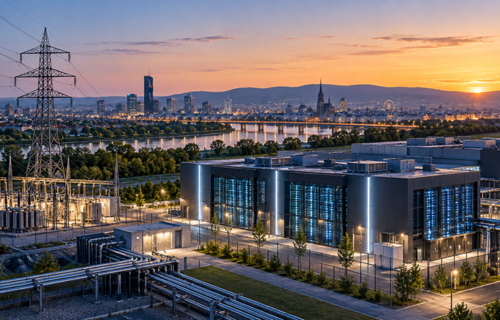
Electricity is likely to determine how much of that opportunity Vienna can secure. A modern data centre requires an unusually large and dependable electricity supply, and the challenge becomes greater as facilities designed for artificial intelligence accommodate increasingly power-intensive computing equipment. Securing land is therefore only one part of the development process. A site must also have access to sufficient grid capacity, and that electricity must be available within the timeframe required by the operator and investor.
This changes the traditional logic of industrial property development. For conventional warehouses or industrial buildings, developers have historically concentrated heavily on land price, transport access, labour availability and planning. Those factors remain important for data centres, but the availability of electricity can override almost everything else. An inexpensive development site has limited value for a large data-centre project if the required power connection cannot be delivered for many years.
As a result, two industrial plots of similar size in comparable locations may have radically different development potential if one has credible access to substantial electricity capacity and the other does not. The first could potentially accommodate high-value digital infrastructure, while the second remains conventional industrial land. This raises an important question for Vienna’s property market: could access to power eventually become embedded directly into land values?
There is evidence across European data-centre markets that power availability is becoming increasingly important in site selection and investment decisions. It would nevertheless be premature to assign a specific Vienna price premium to electricity-secured land because there is not yet sufficient transparent transaction evidence to establish how much additional value investors will consistently pay for that advantage. The direction of the market, however, suggests that a site where a developer can demonstrate a realistic route to substantial electricity capacity represents a very different development proposition from land where power availability remains uncertain.
Grid infrastructure therefore becomes part of the property investment equation. Austria’s electricity networks must accommodate not only data centres but also broader electrification, renewable generation, industrial requirements, electric mobility and changes in heating. Adding a major data centre can consequently involve much more than connecting another building. Depending on the location and scale, additional substations, transmission infrastructure or other network upgrades may be necessary.
This creates a timing problem for developers. Data-centre operators may be ready to invest, financing may be available and land may have been identified, yet a project can remain theoretical if the electricity infrastructure cannot support it within the required schedule. That is why Europe’s enormous announced data-centre pipeline needs to be interpreted carefully. Many proposed projects will face competition for electricity, land, permissions and capital before becoming operating facilities. Vienna’s growth prospects should be viewed through the same filter. The important number is not simply how many megawatts developers would like to construct, but how many can realistically be connected and delivered.
Permitting represents another important constraint. Data centres are technically complex properties that can raise questions involving energy use, noise, emergency generators, cooling systems, building scale and local infrastructure. Planning certainty can therefore become almost as important as the availability of the site itself. Local acceptance may also become increasingly relevant as facilities grow larger and consume more electricity, with municipalities weighing the economic benefits of digital infrastructure against competing demands for land and power.
This makes location selection considerably more sophisticated than purchasing inexpensive industrial land on the outskirts of a city. Developers increasingly need to understand electricity infrastructure before committing to a site. Proximity to substations, the available capacity within the local network and the timetable for obtaining additional power can determine whether a project has genuine development potential. Fibre connectivity represents the other essential component. Vienna already benefits from strong telecommunications links, but data centres require resilient connections through multiple routes to minimise the risk of disruption. Sites combining power availability with strong fibre infrastructure therefore occupy an increasingly valuable position within the digital property market.
The combination of these requirements could create a new category of industrial land. Rather than measuring a site principally by hectares and development density, investors may increasingly evaluate it according to the amount of electricity that can be delivered and the certainty surrounding that connection. In that environment, a megawatt can become almost as important to property value as a square metre.
This could have implications beyond data centres. Developers searching for large electricity connections may find themselves competing with manufacturers, battery projects, electrified logistics operations and other energy-intensive industries for the same infrastructure. Competition for grid capacity could therefore influence where different forms of industrial development occur around Vienna.
For landowners, this creates both opportunity and uncertainty. Sites near suitable electricity infrastructure may attract interest from investors that would previously have ignored them, but proximity to a transmission line or substation does not automatically mean that sufficient capacity is available. The value lies in deliverable power, not simply visible infrastructure. A site marketed as suitable for a data centre may ultimately be worth little more than conventional industrial land if the electricity connection remains speculative. Conversely, land accompanied by credible grid capacity, appropriate planning and fibre connectivity could become strategically valuable to operators attempting to secure future expansion.
The investment opportunity therefore extends beyond the data-centre buildings themselves. Infrastructure-ready development sites, existing industrial properties capable of redevelopment and land positioned near suitable power infrastructure could all attract increasing attention. Investors capable of understanding the technical relationship between property and electricity networks may gain an advantage over buyers evaluating sites through conventional real-estate metrics alone.
Vienna’s approximately 82 MW of existing capacity demonstrates that the city already has a meaningful data-centre industry, while Austria’s larger development pipeline indicates that investors and operators see potential for considerably more. Whether that potential becomes physical infrastructure will depend on execution. Vienna has the connectivity, geographic position and established market needed to compete for additional data-centre investment, but it cannot assume that every proposed project will receive the electricity and approvals required to proceed.
The next stage of Vienna’s data-centre market may therefore be decided away from the server halls themselves. It will be determined by substations, grid connections, fibre routes, planning decisions and the relatively small number of sites where all those requirements can be brought together. For property investors, that changes the definition of scarcity. Vienna may have industrial land available, but the land capable of supporting the next generation of power-intensive digital infrastructure is a much more limited resource. In that market, owning the right site may increasingly mean owning something more valuable than land: a credible route to the electricity that future development requires.
Source: CIJ.World Research & Analysis Team