Tuesday, 22 September 2026
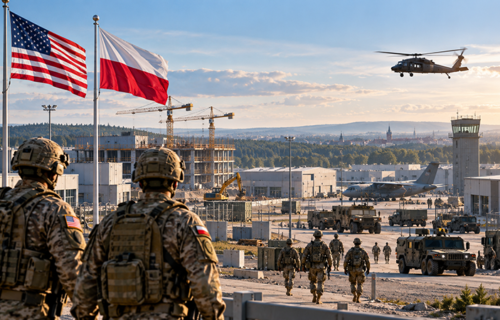
Poland could emerge with a larger role in America’s European military network even as Washington considers reducing its overall troop presence across the continent. Warsaw is pursuing a major permanent US military installation, while the Pentagon is separately examining how American forces should be distributed across Europe in the years ahead. The Polish government has formally authorised preparations covering the potential location, infrastructure, financing and practical requirements, while US officials have responded positively to the initiative. President Donald Trump added momentum in September when he indicated that progress had been made and that a location could potentially be announced relatively soon.
The negotiations come at an important moment for America’s military presence in Europe. Washington is reviewing its force structure across the continent, where tens of thousands of US personnel are either permanently based or deployed on rotation. One possibility under consideration could involve the removal of as many as 25,000 personnel, although no decision on reductions of that scale has been taken. The review is expected to provide greater clarity before the end of 2026.
Poland already hosts approximately 10,000 American military personnel, most serving through rotational deployments, alongside a smaller permanent command and support structure. US Army Garrison Poland is headquartered in Poznań, while American forces operate from a network of military locations across the country. The proposal now being discussed would therefore deepen an established military relationship rather than introduce a permanent American presence to Poland for the first time.
For Poland’s property and construction markets, the difference between rotational deployments and a much larger permanent installation could be considerable. A long-term base requires much more than military buildings. Housing, utilities, transport connections, logistics capacity and services for personnel and their families would all form part of the wider development requirements. The Polish government has already identified accommodation and supporting infrastructure among the issues that would need to be addressed.
The investment involved could reach approximately PLN 15–17 billion, according to indications from Defence Minister Władysław Kosiniak-Kamysz, although the eventual cost will depend on the scale, location and financing structure of the project. Poland already provides substantial infrastructure and logistical support for American forces under bilateral defence arrangements, while the United States carries much of the operational cost associated with deploying, training and equipping its personnel.
No location for the proposed base has officially been confirmed. The eventual choice could have significant consequences for the selected local economy, generating additional demand for residential development, construction, transport, logistics and services supporting a sizeable military community. Washington’s wider European review also does not necessarily point towards an equal reduction of American forces across every country. A smaller overall presence could be accompanied by a redistribution towards locations regarded as increasingly important to US and NATO strategy.
For Warsaw, securing a larger permanent American presence would therefore represent both a strategic and infrastructure commitment extending well beyond the construction of a military base. Poland’s position on NATO’s eastern flank, growing defence infrastructure and existing network of American facilities give the country an increasingly important role in discussions about the future US presence in Europe. The result could eventually be a smaller American military footprint across the continent, but one in which Poland occupies a larger and more permanent position.
Source: WEI