Sunday, 4 October 2026
Financial pressure on European companies increased during the second quarter of 2026, with insolvencies moving sharply higher while the creation of new businesses lost momentum. The figures point to a more difficult operating environment across parts of the European economy, although conditions vary considerably between industries.
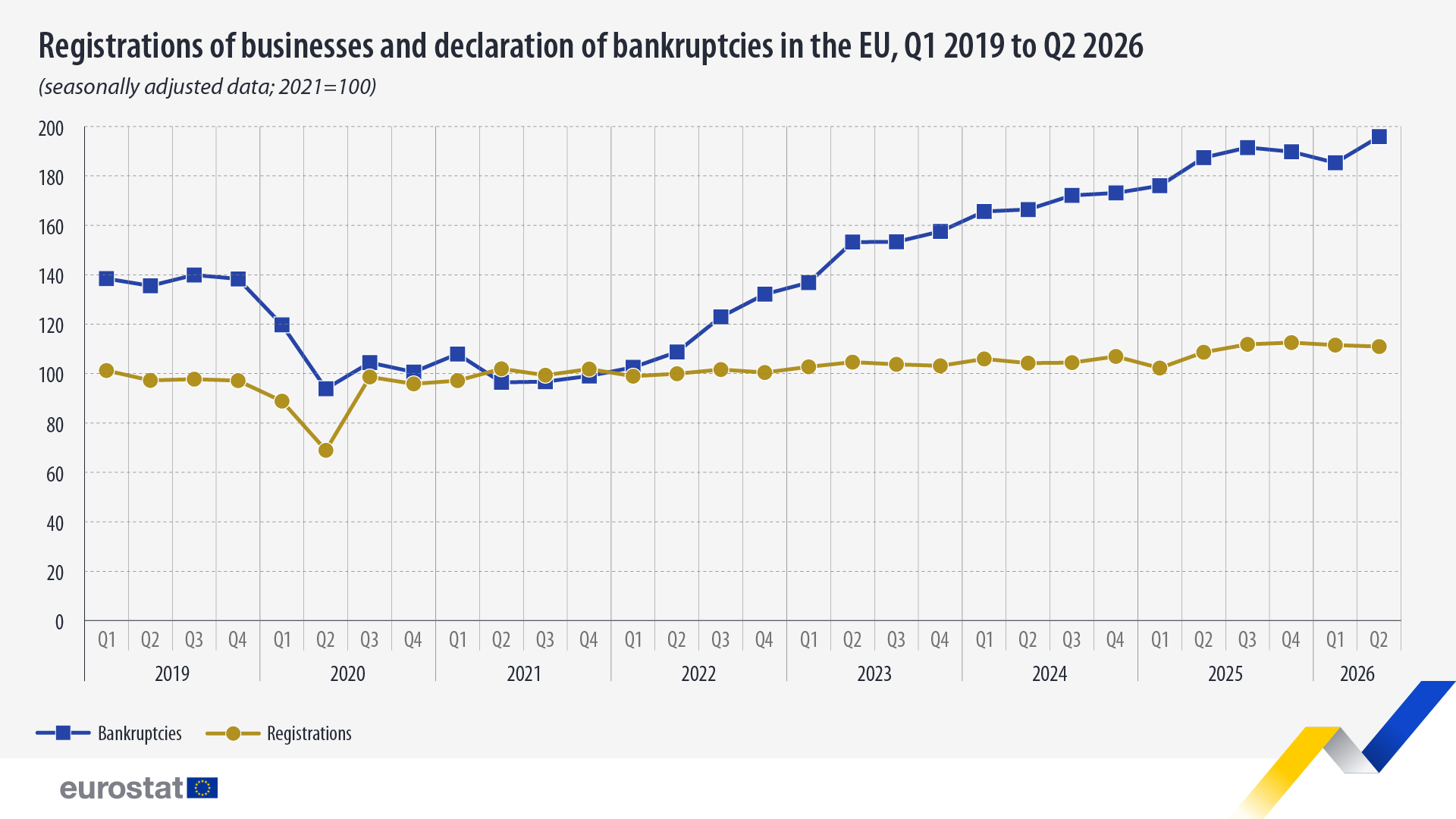
Across the EU, declarations of bankruptcy increased by 5.7% compared with the previous quarter, while new company registrations declined by 0.5%. Within the euro area, the increase in insolvencies was stronger at 6.9%, while registrations slipped by 0.1%.
The latest increase takes EU bankruptcy declarations to their highest point since the comparable Eurostat series began in the first quarter of 2019. This follows a long upward movement that began after the pandemic period, interrupted by declines in the final quarter of 2025 and the opening three months of 2026.
The business formation figures tell a somewhat different story. Registrations had generally strengthened between 2022 and 2024 and again during much of 2025. Activity has subsequently softened, with declines recorded in both the first and second quarters of this year. Despite the recent slowdown, registration levels in most industries remain above those recorded immediately before the pandemic.
The overall EU figures also conceal substantial differences between sectors.
Industry recorded the largest reduction in new business registrations during the second quarter, falling 3.6% from the previous three months. Accommodation and food services declined by 3.4%, while education and social activities were down 3.2%.
Technology-related businesses moved in the opposite direction. Registrations in information and communication increased by 8.8%, continuing the expansion seen in the sector since the second quarter of 2025. Construction also recorded growth, with registrations increasing by 1.0%, while financial services were unchanged.
The insolvency figures show an equally fragmented picture.
Bankruptcy declarations increased across five of the eight economic sectors monitored. Education and social activities recorded the largest quarterly increase at 21.1%, followed by transport at 11.4% and financial services at 6.8%.
Construction was one of the sectors moving against the wider trend, with bankruptcy declarations declining by 1.7%. Accommodation and food services recorded a 2.6% reduction, while insolvencies in trade decreased by 1.2%.
The construction figures are particularly relevant for the European property market. A year earlier, during the second quarter of 2025, construction bankruptcies had increased by 8.1% quarter-on-quarter. The latest figures therefore indicate an improvement in the direction of travel for the sector, even as corporate failures across the wider economy are increasing.
Differences between individual EU countries are also considerable. Estonia recorded a 31.8% quarterly increase in bankruptcy declarations, followed by Greece at 31.6% and Croatia at 20.5%. At the opposite end of the ranking, Malta recorded a 50% decline, Cyprus 41.7% and Slovakia 33.5%, although Eurostat cautions that relatively small numbers of cases can produce substantial percentage movements in smaller economies.
Business creation showed similarly wide geographical variations. Ireland recorded a 20.4% increase in registrations, followed by Belgium at 8.2% and Sweden at 7.6%. Luxembourg recorded the largest decline at 24.2%, followed by Lithuania at 12.4% and Denmark at 8.2%.
For the commercial property market, the figures provide another indicator of increasingly uneven occupier conditions across Europe. Rising insolvencies can translate into greater tenant risk for landlords and lenders, particularly where individual sectors are experiencing sustained financial pressure. At the same time, continued company formation in areas such as technology and construction indicates that the deterioration is far from uniform.
The contrast with the same period last year is also notable. In the second quarter of 2025, EU business registrations increased by 4.6% and bankruptcies rose by only 1.7%. One year later, the direction has changed: fewer businesses are being established while corporate failures are increasing at a faster quarterly rate.
The figures do not by themselves indicate a broad corporate downturn. Bankruptcy statistics can be influenced by national legal frameworks, delayed restructuring and sector-specific conditions, while quarterly movements can be volatile. Nevertheless, the combination of softer business creation and the highest level of insolvency declarations in the available EU series suggests that financial resilience among European companies will remain an important indicator for investors, lenders and commercial property owners during the second half of 2026.