Thursday, 8 October 2026
Costa Rica has developed one of Central America’s most successful and internationally connected economies, attracting multinational companies, tourism investment, advanced manufacturing and increasingly sophisticated real estate development. Yet travelling through the country reveals another side of that success. Expensive shopping centres, gated residential projects and prosperous business districts can sit surprisingly close to communities where household budgets are tight and public infrastructure remains under considerable pressure.
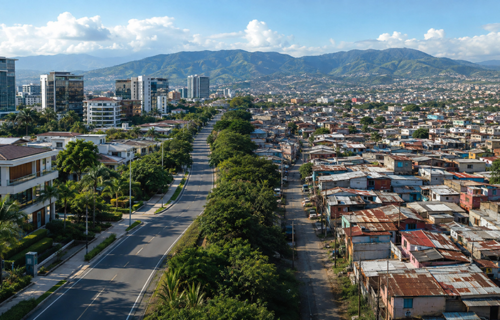
The contrast is particularly noticeable in Greater San José. Areas such as Escazú and Santa Ana have become centres for higher-income housing, international companies, private schools, healthcare, restaurants and modern retail. Elsewhere in the metropolitan area, households are considerably more dependent on public transport and municipal infrastructure, while differences in roads, drainage, pedestrian facilities and the overall quality of the urban environment can be substantial.
This does not make Costa Rica a straightforward story of rich against poor. The country has a sizeable middle-income population and has historically built much of its social stability around education, healthcare and public institutions. Poverty has also been declining. Official statistics show that the proportion of households below the national poverty threshold fell from 18 percent in 2024 to 15.2 percent in 2025, while extreme poverty declined to 3.8 percent.
However, moving above the official poverty threshold does not necessarily mean that a family has significant disposable income. Housing, food, transport and consumer goods can absorb a substantial share of earnings, while income remains unevenly distributed. Costa Rica’s Gini coefficient stood at 0.488 in 2025, demonstrating that considerable differences remain between households at opposite ends of the income scale.
Average household income reached approximately ₡1.21 million (approx. $2,657 USD) per month in 2025, but the national average conceals large variations. At the upper end of the economy are business owners, executives, professionals and internationally connected households with purchasing power capable of supporting premium property, private services and imported consumer goods. At the other end are families for whom relatively ordinary purchases can represent a significant proportion of monthly income.
This helps explain one of the more surprising aspects of Costa Rica for international visitors: the price of shopping.
Imported clothing, footwear, cosmetics, electronics and certain foods can be expensive compared with prices in larger European or North American markets. Costa Rica’s relatively small population limits the economies of scale available to retailers, while freight, customs, warehousing, local distribution and taxation all contribute to the final price. Most goods and services are also subject to the country’s 13 percent value-added tax.
International brands consequently operate within a market that is not necessarily designed around the purchasing power of the average household. Premium shopping centres can cater to higher-income Costa Ricans, tourists, expatriates and international professionals, while much of the wider population shops through supermarkets, local businesses, discount retailers, outlets, markets and promotional channels.
Employment adds another layer to the divide. Costa Rica has successfully attracted technology, medical-device, business-services and advanced-manufacturing companies offering professional employment and internationally competitive career opportunities. At the same time, approximately 824,000 people were estimated to be working informally during the first quarter of 2026, equivalent to 38.2 percent of the employed population.
The distinction matters because employment does not necessarily provide the same level of security for everyone. Formal professional employment can provide predictable salaries, access to credit and stronger social protection. Informal workers may experience greater fluctuations in income and more difficulty obtaining conventional financing, including mortgages.
Housing is where these differences become physically embedded in the country’s cities.
Higher-income households can choose modern condominiums and gated developments offering security, landscaping, recreational facilities and maintained common areas. Lower-income households face a much narrower range of choices determined by wages, land prices, mortgage availability and transport costs.
Property ownership also has consequences extending beyond housing itself. A family able to acquire property in an improving and well-connected district can accumulate wealth as land and housing values increase. Families unable to enter the ownership market do not benefit from property appreciation in the same way, potentially allowing today’s income differences to become tomorrow’s wealth differences.
The apparent infrastructure gap between neighbourhoods is similarly more complicated than simply comparing government spending between wealthy and poorer municipalities.
Costa Rica is investing public money in communities across the income spectrum. Major programmes include roads, bridges, schools, flood protection and other resilience projects, with infrastructure improvements underway in communities that would not normally be considered affluent.
However, neighbourhoods do not all begin from the same position. Some communities expanded before adequate roads, drainage, pavements and other infrastructure were available, leaving authorities with the much more difficult and expensive task of improving established urban areas.
Newer high-income developments can operate very differently. Residential developers frequently provide roads, drainage, landscaping, security and recreational facilities within their projects. Shopping centres, office developments and mixed-use schemes also create substantial amounts of privately financed infrastructure.
As a result, an affluent neighbourhood may appear to have received far greater public investment when part of the difference has actually been financed by private property owners and developers.
This creates two different experiences of the same city.
A higher-income household can live in a privately maintained condominium, travel by car, use private healthcare and education and spend leisure time in professionally managed commercial environments. A lower-income household is generally more exposed to the quality of public roads, buses, pavements, schools, parks and other government or municipal services.
Transport is therefore an important part of Costa Rica’s economic divide.
Greater San José suffers from persistent congestion and a road system that has struggled to keep pace with urban expansion and increasing vehicle ownership. For professionals with private vehicles, flexible working arrangements or the ability to live close to employment centres, congestion is primarily a financial and lifestyle inconvenience.
For workers dependent on buses and multiple connections, transport can determine which jobs are realistically accessible. Long commuting times also reduce the hours available for family life, education and other economic activity.
Costa Rica has begun addressing parts of its long-standing infrastructure backlog through major projects. Planned improvements to the San José-San Ramón corridor, for example, involve investment of around USD 770 million across approximately 55.6 kilometres, including expanded road capacity, new interchanges, bridges and facilities for pedestrians and buses.
The scale of such investment demonstrates both Costa Rica’s ambitions and the extent to which major transport improvements have accumulated over decades.
Roads are only part of the challenge. Water infrastructure, wastewater treatment, drainage, flood protection, bridges, public transport and pedestrian connections all influence where people can live and where businesses and developers are prepared to invest.
For real estate, these differences eventually become reflected in land prices. Well-connected locations with reliable infrastructure, established services and attractive surroundings command higher values. Areas requiring substantial additional investment can struggle to attract development, reinforcing geographical differences within the metropolitan area.
Education has traditionally provided Costa Rica with an important route out of this cycle. Long-term investment in education helped create the skilled workforce that eventually attracted international companies and higher-value industries.
Yet household income can still influence educational opportunity. Wealthier families can access private and international schools, language education, extracurricular activities and overseas study. Maintaining the quality of public education is therefore important not only socially but economically, because it determines whether children from lower-income households can compete for the professional jobs being created by Costa Rica’s increasingly sophisticated economy.
Outside San José, tourism and international residential investment are producing another version of the same economic tension.
Coastal destinations, particularly those attracting North American and other international purchasers, operate partly within a property market supported by foreign incomes. A home that appears reasonably priced to someone earning dollars abroad can be unaffordable to a household dependent on Costa Rican wages.
Foreign investment can provide substantial benefits. It creates construction activity, employment, restaurants, hotels, services and demand for improved infrastructure. But rapidly increasing property values can also make housing more difficult for local workers unless residential supply and local earnings increase alongside international demand.
Costa Rica therefore faces an increasingly important question over how the benefits generated by tourism, multinational investment and international property demand spread into surrounding communities.
There is also an environmental contradiction. Costa Rica has established an exceptional international reputation for conservation, biodiversity and renewable electricity, while its principal metropolitan area remains heavily dependent on cars and congested roads.
Improved public transport, more coordinated urban development and better pedestrian connections could consequently address several problems simultaneously, reducing congestion while improving access to employment and supporting the country’s environmental objectives.
Ultimately, the most important measure of Costa Rica’s economic divide is not the difference between rich and poor households at a particular moment, but the ability of people to move between income groups over their lifetime.
The country retains significant advantages. Political stability, education, healthcare, international investment and an increasingly diversified economy provide a strong foundation for social mobility. Falling poverty also shows that economic progress is reaching part of the population.
Yet substantial informal employment, unequal incomes, expensive housing and uneven infrastructure demonstrate that opportunities remain very different depending on where someone lives, their education and the resources available to their family.
Costa Rica therefore contains several economic realities within a relatively small country.
The modern offices, international retailers and premium residential developments of western Greater San José represent one. Communities where families depend much more heavily on public transport and municipal infrastructure represent another. Coastal markets influenced by tourism and international purchasing power are creating a third.
All are products of the same successful but increasingly complex economy.
For Costa Rica, the challenge ahead is no longer simply attracting investment or generating economic growth. It is ensuring that investment in housing, infrastructure, transportation, education and employment allows a broader share of the population to benefit from that growth.
For the real estate and investment sectors, this makes inequality more than a social question. It influences labour availability, housing demand, land values, development costs, infrastructure requirements and the locations in which future investment can realistically take place.
Costa Rica has demonstrated that a relatively small Central American economy can compete successfully for global investment. The next measure of that success will be how effectively the prosperity visible in its strongest business, residential and tourism markets connects with the communities around them.
Source: © CIJ.World Research & Analysis Team