Thursday, 8 October 2026
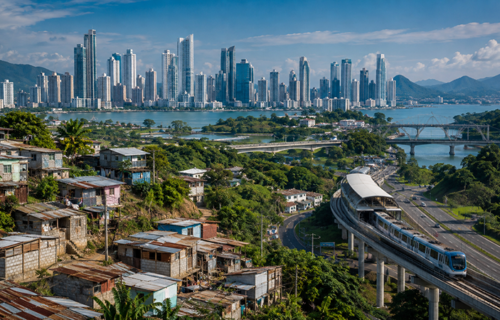
Panama has created one of Central America’s most internationally connected economies, turning its geographical position into a powerful platform for global trade, logistics, banking, aviation and investment. Panama City provides the most visible evidence of that transformation, with its high-rise residential towers, corporate offices, luxury hotels and modern shopping centres presenting an image of considerable prosperity. Beyond the skyline, however, Panama is considerably more complex. Income, employment security, housing conditions and access to infrastructure vary sharply between communities, with the differences becoming even more pronounced between metropolitan, rural and indigenous areas.
Panama’s economy expanded by around 4.4 percent in 2025 and continued growing during the opening months of 2026. Economic output per person is approaching USD 20,000, placing the country in a relatively strong position within the region. Those national averages tell only part of the story. Income remains highly concentrated, while poverty varies enormously depending on location. Recent international assessments place Panama’s income inequality among the highest in Latin America, creating a significant difference between the prosperity visible in the capital and the economic circumstances experienced by much of the wider population.
Much of Panama’s wealth is concentrated around Panama City and the Canal corridor. Banking, maritime services, logistics, multinational businesses, professional services and property development have created a sophisticated economy that is particularly visible in Punta Pacífica, Punta Paitilla, Costa del Este, Marbella and parts of San Francisco. Luxury residential towers, international schools, private hospitals, restaurants and premium retail reinforce the impression of a city operating at a relatively high income level. This purchasing power, however, should not be confused with that of the average Panamanian household.
Large working populations live in San Miguelito, Panama Este, Panama Norte and increasingly Panama Oeste, where housing options, transport requirements and disposable incomes can be considerably different. The geographical distances separating these communities from Panama City’s wealthiest districts may be relatively small, but economically they can represent very different worlds.
Employment is one of the principal reasons for this divide. Panama has developed highly productive sectors around banking, maritime services, logistics, professional services and multinational companies, creating jobs capable of supporting property ownership, private vehicles and relatively high levels of consumption. At the same time, informal employment remains extensive. Official figures for 2025 indicate that approximately 785,000 people were working informally outside agriculture, representing around 47 percent of the workers covered by the measure.
Informality is particularly significant in construction, manufacturing, hospitality, transportation and commerce. This means that two people can both be economically active while having completely different levels of financial security. A professional employed by a bank or multinational company may have a predictable salary, social protection and access to conventional credit and mortgage financing, while someone working informally can find it considerably more difficult to demonstrate stable income or accumulate long-term financial security.
Education increasingly determines who can enter the stronger side of Panama’s economy. Logistics management, financial services, aviation, technology and multinational operations require professional, technical, digital and language skills. Families able to provide stronger education, English-language training and access to technology consequently give their children an important advantage. Panama therefore faces the risk of creating sophisticated new employment without ensuring that children from lower-income communities have an equal opportunity to compete for those positions.
The divide becomes substantially greater outside metropolitan Panama. Rural poverty remains several times higher than urban poverty, while conditions in the indigenous comarcas are dramatically different. Recent international estimates indicate that close to four out of every five people in Panama’s indigenous territories were living in poverty in 2024 under an internationally comparable measure. This creates an extraordinary contrast in a country operating one of the world’s most important trade routes and possessing a globally connected financial centre.
Some communities continue to face difficulties involving water, sanitation, electricity, transportation, healthcare and education. This goes beyond differences in household income. It represents unequal access to the physical and institutional infrastructure required to participate fully in the economy. The implications are particularly serious for children because differences in education, healthcare, nutrition, internet connectivity and transportation can influence earning potential for decades.
Housing provides another visible expression of Panama’s economic structure. Panama City has developed a substantial premium residential market supported by wealthy local households, international executives, expatriates and overseas investors. Waterfront towers and large master-planned communities have become an important part of the city’s international identity. Elsewhere, informal settlements and unresolved land ownership remain part of the housing landscape, with government programmes continuing to regularise communities where families have occupied and developed land without complete formal ownership.
Legal ownership has important economic consequences. A formally owned property can generally be sold, inherited, mortgaged or potentially used as collateral. A family may physically possess a home for many years without being able to use that asset in the same way if ownership remains unresolved. Panama can therefore contain an international investor purchasing an expensive waterfront apartment and, within the same metropolitan economy, families attempting to establish legal ownership of the land beneath homes they have occupied for years.
The rapid expansion of Panama Oeste adds another dimension to housing affordability. Arraiján, La Chorrera and surrounding areas have absorbed significant residential development as households search for alternatives to more expensive central locations. Greater availability of land has allowed the metropolitan region to expand westward, but cheaper housing can create another cost through longer journeys to employment.
Thousands of residents travel between Panama Oeste and Panama City, creating pressure on the principal road connections. A household may reduce its mortgage or rental costs by moving farther from the centre while substantially increasing the amount of time spent travelling. Long commutes affect family life, employment flexibility, education and productivity, demonstrating why housing affordability cannot realistically be considered separately from transportation.
Panama is investing heavily in roads and transport infrastructure to improve these connections. Major programmes include highway expansion, bridge construction, road rehabilitation and projects across Panama Oeste and other rapidly developing parts of the country. These investments also highlight a recurring development problem: urbanisation and housing construction can progress more rapidly than the infrastructure required to support them. Communities expand and commuting patterns become established before major transport capacity arrives.
Mass transit could have a particularly important long-term impact. Expansion of Panama’s metro system can connect lower-cost residential districts with employment centres without requiring every household to own a car. Better accessibility can also encourage commercial and residential development around stations and transform previously peripheral locations into viable development areas.
For real estate, these improvements can fundamentally change land values. A location that was previously considered too distant from employment centres can become significantly more attractive once travel times improve. New infrastructure can support housing, retail and commercial development while increasing surrounding property values. However, rapidly increasing land values can eventually make improving districts less affordable for existing residents, making the management of development around transport corridors increasingly important.
The apparent infrastructure difference between affluent and poorer communities also requires careful interpretation. High-end residential developments frequently provide their own internal roads, security, drainage, landscaping, parking and recreational facilities. Large commercial projects similarly create substantial amounts of privately financed infrastructure. An affluent neighbourhood can therefore appear dramatically better maintained without the entire difference resulting from higher public expenditure.
Higher-income households can also purchase alternatives when public infrastructure is inadequate. They can use private vehicles, private schools, private healthcare and professionally managed residential environments. Lower-income households are considerably more dependent on public roads, buses, schools, healthcare facilities, drainage and municipal services. Weak public infrastructure consequently has a greater impact on households with the least ability to avoid it.
Panama is nevertheless investing public money in lower-income communities as well as affluent areas. Infrastructure programmes extend through San Miguelito, Panama Este, Panama Norte, Panama Oeste and communities outside the metropolitan region. The more significant difference is often the condition from which these neighbourhoods begin. Providing infrastructure alongside a planned new development is considerably easier than retrofitting roads, drainage, utilities and public spaces into densely populated communities established decades earlier.
Retail provides another illustration of Panama’s different economic realities. The country benefits from its position as a major trading and distribution centre, its ports, the Colón Free Zone and a dollar-based economy. Imported goods are central to its commercial system, yet premium Panama City retail can still appear expensive relative to local wages. Higher-income Panamanians are joined by expatriates, international executives, tourists and business travellers, creating demand with considerably greater purchasing power than national averages might suggest. Luxury retail can therefore prosper without being financially accessible to most households.
International capital has played a similarly important role in the property market. Panama’s dollarised economy, strategic location, financial sector and international connections have historically made it attractive to overseas investors. Foreign investment helped finance the residential transformation of Punta Pacífica, Costa del Este and other districts while supporting construction, property services and employment.
International purchasing power can nevertheless become disconnected from domestic salaries. An apartment that appears reasonably priced to someone earning in the United States, Canada or Europe can remain unattainable for a household dependent on local wages. Similar pressures can emerge in tourism and second-home destinations outside Panama City. The challenge is not whether Panama should continue attracting international investment, but whether housing, infrastructure and employment can expand alongside it so successful locations remain economically connected with the people who work there.
Government finances create another constraint. Panama requires substantial investment in roads, public transport, water, sanitation, education and housing while simultaneously managing public debt and maintaining fiscal discipline. Partnerships with private capital can help finance commercially viable infrastructure, but they cannot provide every solution. Projects serving the poorest and most remote communities frequently cannot generate sufficient financial returns for commercial investors, leaving government expenditure particularly important in precisely the places where infrastructure can have the greatest social impact.
This is especially relevant in Panama’s indigenous territories. In remote communities, a road, bridge, reliable water supply, electricity connection or digital network can fundamentally alter economic possibilities. Better connections allow children to reach schools, patients to access healthcare and producers to transport goods to markets. Infrastructure in these areas is therefore not simply about improving living standards. It can determine whether communities can participate fully in the formal economy.
Panama has already demonstrated its ability to create substantial economic value. Its strategic position has become the foundation for one of the world’s most important logistics networks, while the country has developed an international financial centre, attracted multinational companies and transformed Panama City into one of Latin America’s most recognisable skylines. Strong economic growth, however, does not automatically produce equal opportunity.
Panama effectively contains several economies within the same borders. There is the internationally connected Panama of the Canal, banking, ports, logistics, skyscrapers and foreign capital. There is metropolitan working Panama extending through San Miguelito, Panama Este and Panama Oeste, where large numbers of households provide the workforce supporting the capital while managing housing and transportation pressures. There is rural Panama, where infrastructure and employment opportunities can be considerably more limited, and there are indigenous territories where poverty and access to basic services remain dramatically different from conditions in the capital.
For the real estate and investment industry, these differences have direct consequences. Household incomes determine housing affordability, employment security influences access to mortgages, transportation determines where workers can realistically live and infrastructure affects land values and development potential. Education determines the future workforce, while public investment can transform locations previously considered too difficult or remote for substantial private development.
Panama’s next stage of development may therefore look very different from the construction boom that created its skyline. The larger opportunity lies in housing, transportation and infrastructure capable of connecting more people with the economic activity already being generated.
Panama has demonstrated that it can use its position between two oceans to connect global markets. The more difficult task ahead is ensuring that the prosperity created by that connection reaches more evenly across the country itself.
Source: © CIJ.World Research & Analysis Team