Saturday, 26 September 2026
Via Transilvanica is generating new hospitality businesses and tourism infrastructure across parts of rural Romania as increasing numbers of visitors create commercial opportunities in communities along the long-distance trail. The route now extends for more than 1,600 km and connects over 400 communities, while regional authorities estimate that around 120,000 tourists used it during 2025.
The economic effect is particularly visible among smaller businesses rather than institutional hotel investors. Romanian business media have documented residents opening guest accommodation, food outlets and cafés after communities were connected to the route. In some cases these remain supplementary sources of household income rather than standalone businesses, indicating that the trail’s economic impact is developing from the local level upwards.
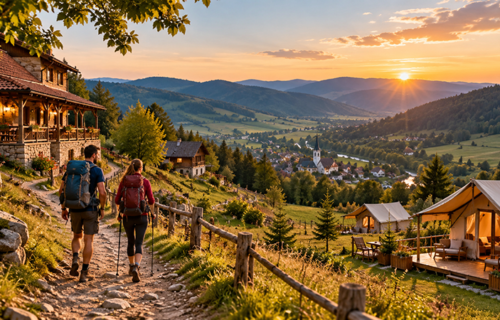
Individual investments provide further evidence. At Fundu Moldovei in Bucovina, a family that returned to Romania after living in the Netherlands invested around €80,000 in a tourism business near the route, including plans for glamping accommodation with 12 places. The operators reported increasing visitor numbers after opening, while neighbouring residents have also begun developing accommodation and food services aimed at hikers.
Accommodation shortages have emerged in some of the smallest communities. Șapartoc, a village near Sighișoara with only a few dozen permanent residents, has been receiving around 500–600 hikers annually. A local household provides rooms, camping and meals, while visitor numbers have increased substantially since the village became part of Via Transilvanica.
Tășuleasa Social has responded by developing compact accommodation units that can be placed in communities or remote sections where conventional lodging is limited. The prototype covers around 33 sqm and accommodates six to eight visitors. Plans announced previously envisaged installing about 15 units during 2026 and potentially developing a network of 100–200 over five to seven years, although the eventual rollout depends on financing. The estimated initial cost was around €65,000 per unit, with scope for lower costs if production is scaled.
Public investment is beginning to accompany this private activity. Romania’s North-West Regional Development Agency launched a programme in August with a proposed €1.4m non-refundable allocation for infrastructure supporting the extension of Via Transilvanica in the region. Eligible investment includes expansion and mapping of the route, equipment and supporting tourism infrastructure, as well as construction of a centre connected with the trail. The agency specifically identifies tourism, rural development and local economic activity among the areas expected to benefit.
The growing economic role of the route was also reflected at the inaugural Via Transilvanica Business Fest, held in Piatra Fântânele from 18 to 20 September. More than 200 representatives from business, government and civil society attended discussions covering regional economies, infrastructure, investment and access to capital. While there is not yet evidence of substantial institutional real-estate investment attributable directly to Via Transilvanica, the combination of rising visitor numbers, new accommodation, private rural businesses and dedicated public infrastructure funding shows that the trail is increasingly influencing Romania’s small-scale hospitality and tourism property market.
Source: Deloitte