Saturday, 12 September 2026
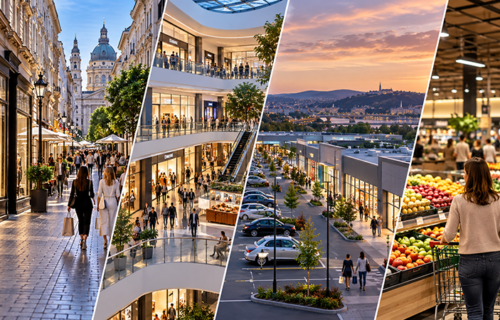
Budapest’s retail property market is strengthening, but the recovery is not producing the same results everywhere. The most expensive shopping streets, leading malls, secondary central locations and retail parks are all attracting occupiers, yet they increasingly serve different customers and operate at very different rental levels.
The clearest evidence comes from rents. Prime Budapest high-street rents increased by approximately 14.3% year on year by the second quarter of 2026, while rents in leading shopping centres rose by around 5.3%. These increases compare with forecast Hungarian retail sales growth of approximately 5.5% for the year.
Official figures show that the volume of Hungarian retail sales increased by 4.5% during the first seven months of 2026 compared with the same period a year earlier. Consumer spending is therefore recovering, but domestic consumption alone does not explain the speed at which rents have risen in Budapest’s most desirable locations.
Budapest’s prime shopping streets benefit from a combination of Hungarian consumers, international visitors and competition between retailers for a limited number of prominent stores. Váci Street and Fashion Street consequently operate within a different commercial environment from most Hungarian retail locations.
Prime rents on Váci Street have reached approximately €200 per sqm per month for smaller units, while Fashion Street is around €230 per sqm per month. On Andrássy Avenue, comparable units command roughly €80 to €100 per sqm per month. Fashion Street provides perhaps the clearest indication of how quickly conditions have changed, with prime rental levels there rising by almost half since the beginning of 2024.
This increase is difficult to understand purely through changes in Hungarian household spending. Location scarcity and international retailer demand are playing an important role. Brands looking for flagship or highly visible Budapest stores have relatively few locations capable of delivering the combination of international tourists, affluent domestic customers, strong pedestrian traffic and neighbouring premium retailers that they require.
Recent retailer activity demonstrates that Budapest remains attractive to international operators. Brands including Missoni, Longines, Messika and W.Kruk have been associated with openings around Andrássy Avenue, while Lululemon and Rituals are among the international names entering the Hungarian market. When retailers compete for a relatively small number of suitable properties, rents can increase considerably faster than overall retail sales.
Tourism provides another layer of demand. Budapest’s central shopping areas effectively import consumer spending from outside Hungary. Hotels, restaurants, attractions and retail therefore form parts of the same city-centre economy. International visitors walking through central Budapest create potential customers for stores that would otherwise depend primarily on domestic purchasing power.
Tourism performance has fluctuated during 2026, but Budapest continues to attract substantial international demand. July provided a particularly positive signal, with overnight stays in the capital increasing by approximately 4.5% compared with a year earlier.
This makes prime central retail partly dependent on a different economic cycle from suburban shopping. A supermarket serving a residential neighbourhood relies predominantly on local household expenditure. A luxury or premium store in central Budapest can sell to visitors from across Europe, North America, Asia and other international markets. The income supporting those two properties therefore comes from very different sources.
Shopping centres represent another distinct market. Budapest has approximately 784,000 sqm of modern shopping-centre stock, with relatively little major new supply entering the market. That restricted development pipeline gives established centres an advantage, particularly those already controlling large catchment areas and attracting strong international tenants.
Prime rents for smaller units in leading Budapest shopping centres are now approximately €80 to €100 per sqm per month. The strongest centres benefit from a reinforcing effect. Successful retailers attract visitors, high visitor numbers attract additional retailers, and competition for the best units helps landlords maintain rents.
Yet the story outside the dominant malls is more complicated than a simple decline of secondary retail. Several secondary Budapest shopping streets have experienced falling vacancy. Petőfi Sándor Street, Szervita Square, Fehérhajó Street and sections of the Grand Boulevard are attracting restaurants, services, drugstores, footwear retailers and value-oriented fashion operators.
These streets are not necessarily competing directly with Fashion Street. Instead, Budapest’s retail geography is becoming increasingly specialised. Premium international brands can cluster around the strongest central locations, while other streets develop around hospitality, services, convenience and more affordable retail concepts.
Retail parks are evolving along another path. Hungary’s combined retail-park and outlet stock is approaching 775,000 sqm, making the format one of the country’s most active areas of retail development. Typical rents for larger retail-park units are around €12 to €14 per sqm per month, dramatically below the levels achieved in Budapest’s prime shopping streets or leading malls.
That difference is precisely why the formats should not be compared simply through rent. Retail parks are built around accessibility, larger stores and relatively straightforward shopping trips. Their occupiers frequently include supermarkets, discount chains, furniture retailers, electronics companies, sports stores and household-goods operators. Consumers visit these properties for different reasons from those walking through central Budapest.
Retail parks also remain important to property investors. However, investment activity during the first half of 2026 demonstrates that capital is not exclusively favouring this format. Shopping centres have also changed hands, showing that investors remain willing to buy traditional malls when the location, tenant base and income justify the acquisition.
Retail represented approximately one-third of Hungarian commercial property investment during the first half of the year, making it a significant component of the transaction market. The investment story is therefore becoming increasingly asset-specific.
Investors are not simply deciding whether they believe in Hungarian retail. They are deciding which source of consumer expenditure they want to own. A central Budapest property can provide exposure to tourism and international brands. A dominant shopping centre provides access to a large established catchment. A retail park offers convenience-driven spending and larger-format retailers. Grocery-led properties provide exposure to regular household consumption.
Each carries different opportunities and different risks. Prime high streets, for example, can benefit enormously from international tourism but are consequently more exposed to changes in visitor numbers. Retail parks are less dependent on tourism but can face intense competition between locations and operators. Shopping centres require continuous investment in tenant mix, food, services and customer experience to maintain their position.
This fragmentation also means that national retail sales figures are becoming less useful as a direct indicator of property performance. An increase in Hungarian consumer spending does not flow evenly into every shop or shopping location. Consumers can spend more overall while simultaneously shifting expenditure between city centres, malls, retail parks, supermarkets and online channels.
Rental growth can therefore be substantially stronger in one segment while remaining limited elsewhere. For landlords, the challenge is to understand whether their property has a reason to capture a disproportionate share of that spending.
The best Budapest streets have scarcity and tourism. Leading shopping centres have scale and established footfall. Retail parks have accessibility and convenience. Grocery properties benefit from recurring consumer needs. Properties without a clear competitive advantage face a more difficult task.
That is why Hungary’s retail recovery should not be described simply as a return of consumer confidence. The more important property story is how spending, retailers and investment are being redistributed between different types of assets.
Budapest’s rapidly rising prime rents are the most visible sign of the recovery, but they represent only one part of the market. The real change is that Hungarian retail property is becoming increasingly specialised. Different locations are attracting different retailers, different customers and different levels of rent.
For investors and developers, knowing that retail sales are growing is therefore no longer enough. The more valuable question is where consumers are choosing to spend that growth.
Source: CIJ.World Research & Analysis Team