Tuesday, 15 September 2026
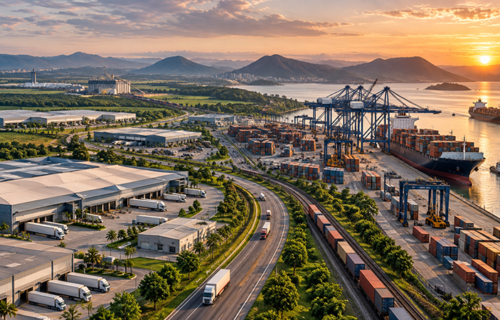
Brazil’s expanding ports are beginning to influence a much larger property market than the terminals located along the country’s coastline. As investment increases capacity at major gateways and cargo volumes place greater demands on transport networks, the effects are spreading into warehouses, container facilities, industrial sites and logistics parks positioned along the routes connecting ports with Brazil’s production and consumer centres. For property investors, this creates a different logistics proposition from the distribution centres surrounding São Paulo and other large metropolitan areas. Conventional urban logistics is primarily driven by access to consumers and the need to deliver goods quickly, while port-related logistics depends more heavily on international trade, industrial production, agricultural exports and the infrastructure required to move cargo efficiently between ships and inland markets.
The distinction matters because Brazil’s institutional warehouse market remains heavily concentrated around São Paulo. The country’s largest metropolitan economy combines an enormous consumer population with manufacturing and transport infrastructure, producing the deepest and most liquid logistics property market in Brazil. Yet the expansion of ports and their inland connections could gradually create additional investment locations where demand is supported by trade rather than population alone.
Santos provides the clearest example. Brazil’s largest port handles enormous volumes of containers, agricultural products and industrial cargo while serving São Paulo state and much of the country’s wider economy. Its importance extends far beyond the waterfront because every additional shipment moving through the port eventually requires road, rail, storage or distribution infrastructure somewhere within the wider logistics system. Land close to the port is constrained, and congestion can make immediate proximity less attractive than it initially appears. This encourages some logistics activities to move inland towards locations where larger sites can be developed while maintaining efficient connections to Santos.
Warehouses, container yards, distribution centres and industrial facilities positioned along the routes between the port and Greater São Paulo can therefore benefit from both international trade and domestic distribution. That combination gives the Santos corridor an important advantage. A warehouse does not necessarily have to depend entirely on port-related demand. The same property may serve importers, manufacturers, retailers and consumer distribution networks, creating a broader potential tenant base than facilities built around more specialised gateways.
Paranaguá presents a different but increasingly significant opportunity. The port is central to the movement of agricultural commodities and other cargo from southern and central Brazil, and substantial investment is being directed towards improving maritime and rail access. Deeper navigation capacity can accommodate larger vessels, while improvements to railway infrastructure can increase the amount of cargo arriving from inland production regions. The property implications extend beyond greater throughput at the port itself. Increasing maritime capacity without expanding storage, transport and distribution infrastructure simply transfers congestion from the waterfront to surrounding areas.
As cargo volumes grow, businesses need locations where containers can be stored and serviced, agricultural products consolidated, imported goods distributed and trucks managed before entering congested port areas. The emergence of new container facilities around Paranaguá illustrates how port investment can generate secondary property demand. These facilities may not resemble conventional institutional warehouses, but they form part of a larger logistics ecosystem that can eventually support distribution parks and industrial development farther inland.
The Curitiba-Paranaguá relationship is particularly interesting from an investment perspective. Curitiba and its surrounding industrial economy provide manufacturing and consumption demand, while Paranaguá supplies access to international markets. Locations capable of connecting the two can potentially serve both industrial occupiers and trade-related logistics companies, giving properties along the corridor a broader demand base than facilities dependent solely on port activity.
Santa Catarina offers another variation on this model. The Itajaí and Navegantes area combines important container gateways with one of southern Brazil’s strongest manufacturing and distribution economies. Industrial production across the state creates substantial import and export demand, while growing urban markets generate domestic distribution requirements. This makes the surrounding logistics market potentially attractive because its demand is diversified. Warehouses can serve port users while also supporting manufacturers, retailers and distributors operating within Santa Catarina and neighbouring states.
Improving port infrastructure could reinforce that advantage. As maritime access, terminal capacity and transport connections expand, more cargo can move through the region. But the property opportunity will depend on whether roads and inland logistics infrastructure develop quickly enough to accommodate that growth. The same pattern can be found elsewhere in Brazil. Rio Grande serves agricultural and industrial activity across the country’s south, while ports in the Northeast are becoming increasingly important to energy, industrial and agricultural supply chains. Ceará’s Pecém complex, for example, combines port infrastructure with industrial development and major energy projects, creating a property proposition that is very different from a conventional consumer warehouse market.
These locations demonstrate why the most interesting port-related property opportunities may not sit directly beside the sea. In many cases, the real investment potential lies farther inland, where land is more readily available and cargo can be consolidated before entering the port or distributed after arrival. An inland logistics park connected effectively to a major port can perform several functions. Importers can use it as a distribution base, exporters can consolidate products before shipment, logistics operators can transfer cargo between transport modes and manufacturers can store components arriving from overseas. Cold-storage facilities can serve agricultural and food exports, while container depots can reduce pressure on terminal areas.
Rail infrastructure could expand this geography significantly. Brazil’s ports handle exports originating hundreds or even thousands of kilometres inland. As rail connections improve, logistics locations positioned at intersections between railway lines, highways and port corridors can become increasingly strategic. The port effectively begins to extend inland through a network of logistics nodes. This creates an important property investment question: should a warehouse located along a major port corridor be valued in the same way as a conventional metropolitan distribution centre, or does its connection to trade infrastructure create a different risk and return profile?
The answer will depend heavily on the individual location. Simply being close to a port does not guarantee strong property performance. Some facilities depend on a narrow group of customers or particular cargo flows, creating greater exposure to changes in trade patterns. Others can serve several industries and combine port-related activity with regional distribution, providing a more resilient demand base. Infrastructure is particularly important. A modern warehouse can still perform poorly if trucks spend hours navigating congested roads or if rail connections are unreliable. Investors therefore need to assess the entire transport system rather than the property in isolation. Port capacity, highway access, railway connections and customs infrastructure can all influence the competitiveness of an industrial site.
Environmental and planning considerations add another layer. Coastal and river locations can face flooding and other climate-related risks, while land around ports may have complicated environmental restrictions. Suitable industrial sites with appropriate licences, resilient infrastructure and good transport access can consequently become difficult to reproduce. That scarcity can create value. If cargo volumes continue growing while the supply of well-connected development land remains constrained, established logistics locations could gain pricing power. Developers able to secure land before infrastructure improvements are completed may also benefit as transport corridors become more important.
However, Brazil’s port-related logistics market should not yet be treated as equivalent to its established metropolitan warehouse sector. Institutional investment remains considerably deeper around São Paulo, where investors can analyse extensive leasing evidence, rents, vacancy and transactions. Many port markets remain smaller, more specialised and less liquid. This makes them more appropriate for investors prepared to understand infrastructure and trade flows in addition to conventional property fundamentals. The opportunity may initially appeal to developers and specialist logistics investors capable of identifying locations before they become mainstream institutional markets.
The strongest opportunities are likely to emerge where several forms of demand overlap. A logistics park serving only one export commodity may carry substantial concentration risk. A location connected to a port, industrial cluster, major highway and large consumer market has a much broader economic foundation. Santos already demonstrates many of these characteristics because of its relationship with São Paulo. The Curitiba-Paranaguá corridor offers another combination of port access and industrial demand, while Itajaí and Navegantes benefit from Santa Catarina’s manufacturing and distribution economy. Other gateways could follow as infrastructure investment improves their connections with inland production centres.
The long-term property story is therefore not simply about expanding Brazilian ports. It is about what must be built behind them. Larger terminals and deeper channels can increase the amount of cargo entering and leaving the country, but that cargo still requires land, buildings and transport infrastructure before reaching its final destination. Warehouses, industrial parks, cold-storage facilities, container depots and inland logistics hubs could become increasingly valuable parts of that system.
As these networks develop, institutional investors may begin viewing port-connected property as a more distinct investment strategy rather than simply another part of the warehouse market. Brazil’s next generation of logistics locations may consequently emerge along corridors that connect maritime gateways with factories, farms and cities. The ports will remain the entry and exit points, but much of the investible real estate could be created kilometres inland. For investors looking beyond Brazil’s established metropolitan warehouse markets, that shift could provide the next stage of logistics expansion. The most valuable sites may ultimately be those that turn growing ports into efficient inland supply chains.
Source: CIJ.World Research & Analysis Team