Tuesday, 15 September 2026
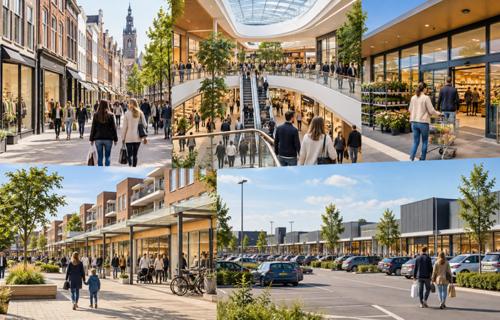
Dutch retail property has returned to investors’ attention in 2026, but the capital flowing into the sector is revealing a very different market from the one that existed before online shopping transformed the industry. Investors are buying retail again, yet they are concentrating increasingly on properties where customer demand is frequent, locations are difficult to replace and the buildings have a clear role within their communities. Around €1.2 billion was invested in Dutch retail property during the first half of 2026, almost 30% more than during the corresponding period last year. Retail represented approximately 17% of total Dutch real estate investment, its largest share since 2017. Leasing activity also accelerated, with approximately 278,600 square metres taken up during the second quarter, more than twice the level recorded a year earlier.
Those numbers could suggest a broad revival in shopping property, but the composition of investment tells a more revealing story. Around 60% of first-half retail investment was directed towards convenience-focused shopping centres, neighbourhood centres and supermarkets. Rather than making a general bet on physical retail, investors appear to be concentrating on formats connected to regular household spending and locations that people repeatedly use. Supermarkets sit at the centre of this strategy. Grocery shopping remains embedded in everyday consumption, giving well-located supermarket properties characteristics that differ substantially from more discretionary forms of retail. For investors, the attraction can include recurring customer demand, established catchment areas and leases with major operators. The quality of each property still depends on the tenant, lease structure, accessibility, competition and surrounding population, but supermarkets have increasingly become one of the clearest routes for capital seeking exposure to Dutch retail.
Neighbourhood and convenience centres extend the same investment logic. A successful local centre can combine a supermarket with pharmacies, food outlets, personal services and other businesses serving frequent household needs. Its purpose is not to persuade consumers to spend an entire day shopping. It is to become part of their normal weekly routines. That characteristic can make these properties attractive to investors seeking relatively predictable income. Their prospects can also benefit from residential growth. As Dutch cities add housing and increase density within existing urban areas, some neighbourhood centres gain additional customers without requiring a corresponding expansion in their physical footprint. Recent transactions demonstrate that this is no longer simply a theoretical investment argument. Large portfolios of Dutch neighbourhood shopping centres have attracted institutional and private capital, providing evidence that investors are prepared to commit substantial amounts to properties supported by convenience-oriented spending.
Retail parks are developing into another increasingly important category. Vacancy across Dutch retail parks stood at approximately 4.4% in June 2026, below the wider national retail-property level. Many locations have little or no immediately available space, suggesting that the strongest parks are operating within relatively tight occupier markets. More importantly, the range of businesses considering these locations is widening. Retail parks were traditionally associated heavily with furniture, home improvement and other businesses requiring large stores. They are increasingly attracting concepts connected with sport, fitness, leisure and convenience alongside their established occupiers.
This broadening tenant base could materially change the investment characteristics of the format. A retail park dependent on a narrow group of large-format retailers presents a different leasing risk from one capable of accommodating several types of businesses. More potential uses can provide owners with greater flexibility when units become available. The physical characteristics of retail parks also help explain their appeal. They commonly provide large units, straightforward road access and substantial parking. Occupancy costs can be more manageable than in prime city centres, while customers are accustomed to travelling directly to these locations for particular purchases or activities. Investor interest has followed. More than €220 million has been invested in Dutch retail parks between 2024 and 2026, while specialised investment strategies targeting the format have begun to emerge. The amounts remain modest compared with the country’s largest property sectors, but they indicate that retail parks are increasingly being considered as a distinct investment proposition rather than simply a secondary part of the retail market.
Prime high streets are following a different trajectory. The best city-centre locations remain valuable to brands seeking visibility and direct access to large concentrations of consumers, workers and visitors. Prime Dutch high-street rents increased by approximately 6.5% during the first half of 2026. The important detail is that this growth is becoming concentrated within relatively small sections of the strongest streets. That creates significant differences even within individual city centres. A property on the dominant pedestrian route can experience strong retailer demand while another only a short distance away faces a much more difficult leasing environment.
Amsterdam remains particularly important because of its international visitor base and concentration of major retailers, but the principle applies more widely. Investors cannot assess high-street property simply by looking at citywide averages. Individual streets, pedestrian patterns, surrounding occupiers and the flexibility of the building increasingly determine performance. This creates both risk and opportunity. Strong high-street properties can continue attracting international and domestic brands, while weaker streets may require lower rents, different tenants or alternative uses. Upper floors can also become important. Where planning and building configuration allow, space above shops may support housing, offices or other activities, allowing investors to extract value from more than the retail frontage.
Shopping centres require an equally selective approach. Dominant centres serving large catchment areas can remain attractive because their scale allows owners to manage tenant mix, introduce new concepts and respond to changing consumer behaviour. Successful centres increasingly combine shopping with food, leisure, services and other activities capable of generating reasons to visit beyond purchasing goods. The challenge lies with secondary centres that lack the same dominance. A shopping centre can continue producing rental income while gradually losing customers and retailer demand. If the surrounding population, competing destinations or changing consumer behaviour reduce the amount of retail space required, maintaining the entire property as shops may eventually become difficult.
Some of these properties could offer opportunities for investors prepared to undertake more complicated repositioning. Parts of a centre might eventually accommodate housing, healthcare, leisure, community services or other functions where planning and local demand support them. Such projects should not be considered a universal solution, but they provide an alternative where conventional retail no longer justifies the amount of space available. The contrast between these different formats explains why the approximately €1.2 billion invested during the first half of 2026 should not be interpreted as investors deciding that all Dutch retail has become attractive again.
Capital is differentiating sharply. A supermarket-anchored neighbourhood centre serving everyday needs has little in common with a secondary shopping centre struggling to maintain its tenant base. A successful retail park with low vacancy and an expanding range of potential occupiers represents a different proposition from a weak high-street property outside the strongest pedestrian routes. All are classified as retail, but investors are increasingly pricing them according to very different sources of demand and risk.
This separation is changing investment strategies. Buyers seeking stable income can concentrate on supermarkets, convenience centres and dominant retail locations. Investors prepared to undertake more active management can target properties where improving the tenant mix or repositioning space can increase income. Development-oriented capital can consider secondary centres and larger retail sites where alternative uses may ultimately produce greater value. The distinction also changes how investors need to think about retail risk. Lease length and tenant strength remain important, but they cannot explain whether a property will remain relevant over the next decade. Investors increasingly need to understand why consumers visit the location, how frequently they return and how easily the property can accommodate different businesses if shopping patterns continue changing.
The strongest retail assets have a clear purpose. They provide food, services, convenience, leisure, brand exposure or experiences that remain valuable despite the growth of online commerce. The weakest properties face a more difficult question about why customers and retailers need them at all. This is why the return of investment capital to Dutch retail could prove more significant than a conventional cyclical recovery. Investors are not simply returning because pricing has changed or transaction markets have improved. They are increasingly identifying particular formats that appear capable of generating sustainable demand.
The evidence is clearest in the concentration of investment. With convenience-focused centres, neighbourhood schemes and supermarkets accounting for around 60% of first-half retail transactions, capital is already indicating where it sees the strongest defensive characteristics. Retail parks are developing another institutional proposition, supported by relatively low vacancy and a broader occupier base. Prime high streets remain valuable but increasingly concentrated around the strongest locations. Dominant shopping centres can continue functioning as managed destinations, while weaker centres may require substantial repositioning.
Dutch retail is therefore not returning as a single institutional property category. It is becoming a collection of distinct investment markets, each driven by different forms of consumer demand, occupier behaviour and property economics. The most important development in 2026 may not be that €1.2 billion has returned to the sector. It is where that money is going. Investors appear increasingly willing to own Dutch retail again, but only when they can clearly understand why people will continue using the property.
Source: CIJ.World Research & Analysis Team