Thursday, 10 September 2026
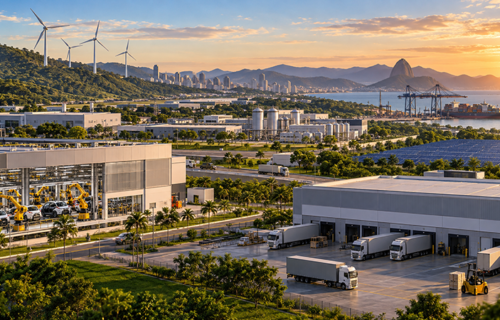
A new wave of manufacturing investment is beginning to influence Brazil’s industrial property market, but the opportunity extends far beyond the factories themselves. Automotive production, vehicle electrification, renewable-energy equipment, pharmaceuticals, food processing and advanced manufacturing are creating demand for industrial land, supplier facilities, warehouses and infrastructure across a widening group of Brazilian regions. For property investors, the important question is not simply how much manufacturers intend to spend. Large capital expenditure programmes do not automatically create investible real estate. The more significant indicator is whether new production facilities attract suppliers, logistics operators and supporting businesses around them, creating industrial clusters capable of sustaining property demand for many years.
São Paulo remains at the centre of this transformation. The state already contains Brazil’s deepest concentration of automotive production, engineering expertise, suppliers and transport infrastructure. Major manufacturers continue committing capital to their Brazilian operations, including investments designed to prepare existing production networks for hybrid and increasingly electrified vehicles. This transition could change the type of industrial property required around established automotive locations. Electric and hybrid vehicles use different components and manufacturing processes from conventional combustion-engine models. Battery systems, power electronics, software, sensors and specialised electrical components become increasingly important, potentially creating opportunities for new suppliers while forcing established manufacturers to adapt their operations.
For real estate, this means the industrial ecosystem surrounding an automotive plant can become as important as the assembly facility itself. Component manufacturers often need to locate close enough to deliver into tightly controlled production schedules. Logistics companies require warehouses, cross-docking facilities and vehicle storage areas, while engineering and technology companies may need a mixture of industrial and office accommodation. São Paulo’s established industrial corridors therefore retain a significant advantage. Existing highways, labour pools and supplier networks make them difficult for new locations to replicate. However, rising land costs and limited availability in mature industrial areas could push some secondary activity farther along transport corridors, expanding the geographical footprint of established manufacturing clusters.
Bahia represents a different industrial story. The expansion of vehicle manufacturing in the state, particularly around the former Ford complex at Camaçari, has the potential to create a new generation of automotive-related property demand. The arrival of large-scale electric and hybrid vehicle production introduces the possibility of attracting component manufacturers and logistics businesses that previously had little reason to establish significant operations in the region. The property consequences could extend beyond industrial buildings. A successful manufacturing cluster requires serviced development land, electricity, water, transport infrastructure and efficient access to ports and national distribution networks. As employment and supplier activity expand, demand can also spread into housing, retail and services in surrounding communities.
This multiplier effect is one reason large manufacturing projects can transform local property markets. The initial factory may occupy a single large site, but the businesses serving it can require many additional properties. Suppliers may prefer dedicated facilities, logistics companies need distribution buildings and transport yards, while contractors and service providers require smaller industrial units.
Minas Gerais offers another route to industrial growth. Its economy combines mining, metals, automotive production, food manufacturing, pharmaceuticals and consumer industries, giving the state a more diversified manufacturing base than regions dependent on one dominant sector. This diversity is important for property investors because it reduces reliance on the fortunes of a single manufacturer. Industrial parks capable of serving several industries can potentially maintain demand even when individual sectors weaken. Belo Horizonte and surrounding industrial locations can also function as distribution centres for one of Brazil’s largest regional consumer markets.
Food production could push the industrial property map farther away from the country’s traditional metropolitan centres. Brazil’s enormous agricultural industry creates opportunities for processing facilities located closer to crops, livestock and other raw materials. These factories can stimulate demand for cold storage, packaging facilities, refrigerated distribution, transport yards and specialised warehouses. Unlike conventional consumer logistics, which tends to gravitate towards large population centres, food-processing property can follow agricultural production. This gives smaller cities and interior regions an opportunity to develop specialised industrial clusters capable of attracting institutional capital if sufficient scale emerges.
Pharmaceuticals and healthcare manufacturing create another category of property demand. These industries often require highly controlled production environments, dependable electricity, water infrastructure, laboratories and specialised storage. Temperature-controlled distribution is particularly important for many healthcare products, creating opportunities for specialised logistics facilities alongside manufacturing plants. The growth of advanced manufacturing could therefore make infrastructure quality increasingly important when investors assess industrial land. A cheap site with inadequate electricity, telecommunications or water capacity may be less competitive than a more expensive location where the necessary infrastructure is already available.
That same principle applies to industries connected with Brazil’s energy transition. Expansion in renewable generation, electricity transmission and energy storage creates demand for transformers, electrical equipment, control systems, battery technology and other components. Brazil’s large domestic energy market could encourage more of this equipment to be manufactured locally. If that occurs, the resulting industrial geography may differ from traditional manufacturing patterns. Producers serving wind and solar developments may value proximity to ports, renewable-energy regions and major transmission projects rather than São Paulo’s consumer market.
This could strengthen industrial opportunities in northeastern Brazil. States with substantial renewable-energy resources can potentially combine electricity production, port infrastructure and available industrial land. If manufacturers begin locating closer to the projects they supply, energy investment could become a catalyst for new industrial property clusters.
Paraná represents another important part of the manufacturing map. Curitiba and surrounding industrial corridors already combine automotive production, agricultural machinery, food processing and logistics. The state’s diversified economy and transport links give it the potential to support a broad range of industrial occupiers rather than depending on one manufacturing segment. Southern Brazil also benefits from established technical skills and supplier networks. These advantages become increasingly valuable as manufacturing moves towards automation, electrification and more sophisticated production methods. Advanced factories require not only land and buildings but also engineers, technicians and specialised service companies.
The implications for industrial property extend beyond owner-occupied factories. In many cases, the main manufacturing plant itself may never become an institutional investment asset. Large corporations frequently own their production facilities because buildings are designed around highly specialised processes. The surrounding property can be much more investible. Supplier facilities, logistics centres and build-to-suit industrial buildings can generate long leases from corporate occupiers while retaining greater potential for reuse than highly specialised factories. Industrial parks containing several suppliers can also spread tenant risk across multiple businesses.
This could create opportunities for developers to position land ahead of manufacturing expansion. A site close to a major plant, with suitable infrastructure and planning, can become increasingly valuable if suppliers need to establish operations quickly. Developers capable of preparing serviced industrial parks may capture demand that manufacturers themselves do not want to accommodate within their own campuses.
Worker housing represents a less obvious consequence. Large manufacturing investments can place significant pressure on housing markets where projects are developed outside Brazil’s largest metropolitan areas. Construction workers create an immediate temporary requirement, while permanent employees and supplier workforces generate longer-term residential demand. Retail, hotels and other commercial uses can follow. Business travel increases as suppliers and engineering teams visit new plants, while growing employment supports local consumer spending. A major manufacturing project can therefore become the anchor for a much broader real-estate development cycle.
Not every announced investment will produce this outcome. Some corporate spending is directed towards machinery, automation or upgrading existing plants rather than expanding their physical footprint. A multibillion-real investment programme can consequently have a relatively modest effect on surrounding property demand. Automation introduces another complication. Modern factories can produce considerably more output without proportional increases in employment. Investors should therefore avoid assuming that every large industrial investment will generate a corresponding residential or retail boom.
The most valuable indicator is cluster formation. When several suppliers, logistics companies and service businesses begin committing to the same location, manufacturing investment starts becoming a broader property story. That is when demand moves beyond a single corporate site and becomes capable of supporting a local investment market.
Infrastructure will ultimately determine which locations can capture this opportunity. Reliable electricity, road and rail connections, water, telecommunications, port access and appropriately zoned land can matter as much as government incentives. Municipalities and states capable of delivering these fundamentals have a greater chance of converting factory investment into sustained industrial development.
Brazil’s industrial geography is therefore unlikely to be defined by one new manufacturing centre. São Paulo will remain the country’s largest and most sophisticated industrial market, but automotive investment in Bahia, diversified production in Minas Gerais and Paraná, food processing in agricultural regions and energy-related manufacturing in the Northeast can create additional centres of demand.
For property investors, the opportunity is to identify these clusters before their growth is fully reflected in land values and rents. The strongest locations will not necessarily be those receiving the largest factory announcement. They will be the places where one investment attracts another, suppliers establish permanent operations and infrastructure improves to accommodate them.
Brazil’s manufacturing expansion could consequently redraw parts of the country’s real-estate investment map. The factories may start the process, but the larger property opportunity could emerge in everything that has to be built around them.
Source: CIJ.World Research & Analysis Team