Sunday, 25 October 2026
Slovakia’s industrial property market is approaching an important supply test as developers prepare to deliver a substantial volume of new warehouse and manufacturing space during the second half of 2026.
At the end of June, the country contained approximately 4.89 million sqm of modern industrial and logistics property. Around 7.8% of that stock was vacant, leaving the market with considerably more immediately available space than during the exceptionally tight conditions of previous years.
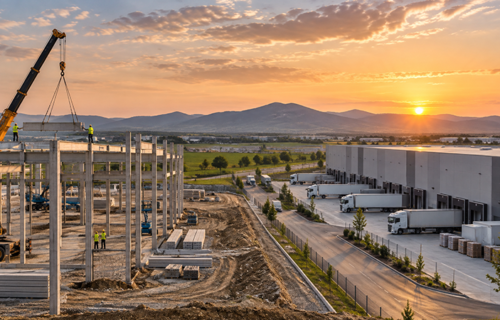
The more important figure, however, may be what is still being built. Approximately 265,800 sqm was under construction at the end of the second quarter, representing an increase of around 31% compared with three months earlier. Only approximately 25,800 sqm was completed during Q2, meaning the volume approaching delivery is substantially greater than the amount recently added to the market.
Some of this future supply is already protected by signed leases. Around 37% of the construction pipeline had secured occupiers by the end of June. That leaves approximately 167,000 sqm being developed without a pre-lease at that point.
This should not be confused with future vacancy. Companies can commit to buildings at any stage before completion, and Q2 activity demonstrates that tenants are still prepared to secure premises in advance. Agreements for buildings still being developed represented around half of leasing activity during the quarter.
Nevertheless, the amount of space still searching for occupiers creates an important test for the market. If developers secure tenants for much of this accommodation before completion, Slovakia’s current increase in warehouse availability could remain manageable. If a significant proportion reaches the market without occupiers, competition between landlords is likely to intensify.
The distinction is particularly important because Slovakia does not have one uniform industrial property market. Demand around Bratislava and Senec is strongly influenced by distribution, logistics and access to the country’s largest consumer market. Other locations depend more heavily on manufacturing and industrial production, particularly the automotive sector and its extensive supplier network.
Eastern Slovakia presents another dynamic, with Košice emerging as an increasingly important industrial location and attracting a meaningful share of recent leasing activity.
Different occupiers also require very different buildings. A manufacturer supplying a major automotive plant may need substantial electricity capacity, specialised production areas and a location close to its customer. A third-party logistics company is more likely to prioritise motorway connections, regional distribution coverage and efficient warehouse configuration.
These differences matter when assessing the construction pipeline. A development backed by an identified manufacturing requirement carries considerably less initial leasing risk than a speculative warehouse being built in a location where several landlords are competing for the same logistics tenants.
This means national vacancy alone cannot provide a complete picture of market conditions. Slovakia’s 7.8% vacancy rate already represents a significant increase from the shortage of space experienced during the strongest period of the logistics expansion. But the effect on individual properties depends heavily on location, specification and the amount of competing accommodation nearby.
So far, the increase in availability has not resulted in a major decline in rents at the top of the market. Prime industrial rents remained around €5.30 per sqm per month during Q2. That resilience will be tested as the current pipeline moves towards completion.
If supply begins to exceed near-term requirements in individual locations, landlords may initially compete through the overall financial package offered to tenants rather than through substantial reductions in advertised rents. Lease flexibility, contributions towards fitting out premises or periods of reduced occupancy costs could become more important where several buildings are chasing the same requirement. This remains a potential outcome rather than evidence that such pressure is already widespread.
For developers, the changing balance between supply and demand makes speculative construction more difficult to justify. When vacancy was exceptionally low, developers could begin projects with greater confidence that suitable occupiers would emerge. With more existing space available and another quarter-million square metres under development, location and evidence of tenant demand become much more important.
Access to electricity could become particularly significant. Slovakia’s manufacturing economy increasingly requires industrial locations capable of supporting energy-intensive production, automation and modern logistics operations. Sites with secured power capacity may therefore hold an advantage over otherwise comparable development land.
Labour availability presents another constraint. A warehouse or factory can have excellent motorway access but still prove difficult to occupy if companies cannot recruit sufficient workers within a practical commuting distance.
For investors and lenders, the same market change increases the importance of individual lease structures. A recently completed building occupied by a financially strong tenant under a long agreement presents a very different risk profile from a speculative property entering the market without an occupier. As more supply is delivered, that distinction could increasingly influence investment pricing and financing decisions.
Slovakia retains strong underlying reasons for industrial property demand. It has one of Europe’s most concentrated automotive manufacturing sectors, sits within major Central European supply chains and provides direct transport connections towards the Czech Republic, Austria, Hungary and Poland. These advantages should continue to generate requirements for logistics and production property.
But strong national fundamentals do not guarantee rapid absorption of every new development. The decisive period will come as projects currently under construction are progressively completed.
At the end of Q2, approximately 37% of the 265,800 sqm pipeline had already secured tenants. The remaining 63%, equivalent to roughly 167,000 sqm, still had time to attract occupiers before delivery.
That makes future leasing activity more important than today’s vacancy figure. If companies absorb much of that space while it remains under construction, Slovakia may simply be moving from an unusually tight warehouse market towards more balanced conditions. If substantial volumes are delivered without tenants, the market could enter a more competitive phase in which developers have to work considerably harder to fill buildings.
The real test for Slovakia’s warehouse sector is therefore not the amount of space being constructed. It is how much of that space finds an occupier before the keys are handed over.
Source: CIJ.World Research & Analysis Team