Sunday, 25 October 2026
Poland’s filling-station market is becoming increasingly concentrated among a small group of large operators, while the expansion of convenience retail, food services and electric vehicle charging is changing the commercial role of the properties themselves.
At the end of August 2026, Orlen remained by far the country’s largest network with 1,969 stations, 13 more than a year earlier. BP ranked second with 573 locations, followed closely by Moya with 549. Moya added 21 stations over the previous 12 months, representing the strongest annual expansion among Poland’s three largest operators.
The next tier consisted of MOL with 455 stations, Shell with 443, Circle K with 391 and Avia with 152. Together, the seven largest networks operated 4,532 stations. Compared with the 7,919 filling stations recorded across Poland at the end of 2025, these operators account for approximately 57% of the national network.
The direction of individual portfolios is becoming increasingly varied. Orlen, Moya and Avia expanded their networks over the year to August, while BP, MOL, Shell and Circle K operated fewer locations than 12 months earlier. The movements remain relatively modest compared with the size of the overall market, but they indicate that operators are becoming more selective about where they expand and which locations they retain.
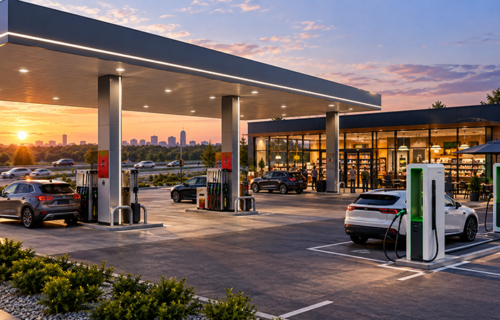
For commercial real estate, the more important question is what these thousands of properties are becoming. Fuel is increasingly only one element of the business generated by a modern roadside location. Convenience stores, coffee, food and other services have become important sources of customer spending, meaning the commercial performance of a filling station increasingly depends on its ability to function as a broader retail and mobility destination.
Orlen illustrates the scale of this evolution. At the end of 2025, 1,924 of its 1,964 Polish stations offered food services, while 1,425 operated the newer Stop Cafe 2.0 format. The group was also developing infrastructure for alternative fuels and electric vehicle charging alongside its conventional network.
Electrification introduces another property consideration. Poland finished 2025 with 11,762 publicly accessible EV charging points, while the number of high-powered charging locations continued to increase. This means access to sufficient electricity capacity could become progressively more important when operators assess existing stations or choose sites for future development.
Road visibility, traffic volumes and convenient access will remain fundamental to filling-station property, but they are increasingly being joined by electricity availability, plot size, parking capacity and the ability to accommodate multiple charging points. Locations capable of combining conventional refuelling with rapid charging, retail and food services could therefore command different economics from sites dependent predominantly on petrol and diesel sales.
Electric vehicles could also change how customers interact with the property. Filling a conventional vehicle normally requires only a short visit, whereas charging can keep motorists at a site for considerably longer. That creates an opportunity for operators to capture additional spending on food, beverages and convenience retail, potentially making the quality of the commercial offer more important to the economics of individual locations.
Ownership of the underlying real estate represents another potential investment angle. Filling stations occupy specialised sites ranging from valuable urban roadside plots to motorway junctions and regional transport corridors. As operators reshape their networks, decisions about whether to own, lease, redevelop or dispose of these properties could become increasingly significant for real estate investors and developers.
Electrification does not necessarily mean Poland’s existing filling-station network will become obsolete. Instead, it could produce a growing divide between properties capable of adapting to new mobility requirements and those constrained by limited space, insufficient electricity capacity or weaker locations.
With almost 8,000 filling stations across Poland and the seven largest operators controlling more than half of the network, the sector represents a substantial portfolio of specialised commercial real estate. The future value of these properties will increasingly depend not simply on the volume of fuel passing through their pumps, but on how successfully individual sites combine energy, retail, food and mobility services.