Sunday, 25 October 2026
Sandoz is preparing another major pharmaceutical investment in Slovenia, committing around $300 million to a new biosimilar drug-substance manufacturing facility in Ljubljana. The project will expand the company’s European production network and further strengthen the Slovenian capital’s position as a centre for pharmaceutical research and advanced manufacturing.
The facility is expected to become operational in 2029 and will add 8,000 litres of biological drug-substance capacity through four reactors. It will be designed for low- and medium-volume products and will support both clinical programmes and medicines that have progressed into commercial production.
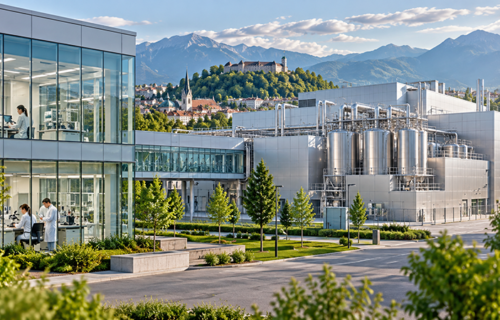
The location is particularly significant from an industrial development perspective. Sandoz plans to build the plant next to its recently opened biosimilar development centre in Ljubljana, bringing research and manufacturing activities into the same cluster. The proximity is intended to make it easier to transfer products from development into larger-scale production and give the company greater control over the process from laboratory work through to manufacturing.
The adjoining development centre, inaugurated in June, represents a separate $99 million investment. Covering approximately 10,000 sqm and employing more than 200 scientists, it substantially increased Sandoz’s in-house biosimilar research capabilities in Slovenia.
“This investment reflects our confidence in the long-term growth potential of biosimilars and our ambition to maximise the full potential of the upcoming opportunity through our Bio100 goal,” said Richard Saynor, CEO of Sandoz. He added that expanding manufacturing capacity would support the company’s future portfolio and improve its control over supply.
The latest project comes on top of an extensive Sandoz investment programme already underway in Slovenia. The company previously committed around $1.1 billion through 2029 to facilities in Ljubljana, Lendava and Brnik. Lendava is being developed as a major biosimilar drug-substance production location, while Brnik is intended for sterile manufacturing and packaging.
The concentration of these investments is significant for Slovenia’s industrial property market. Pharmaceutical and biotechnology manufacturing requires considerably more specialised infrastructure than conventional industrial development, including controlled production environments, sophisticated utilities, reliable energy and water supplies, laboratories and access to highly qualified employees. Once such infrastructure and expertise are established in a location, they can create conditions for further investment around the existing cluster.
Sandoz’s expansion also demonstrates how Central and Eastern European industrial investment is moving beyond the region’s traditional strengths in automotive production, general manufacturing and logistics. Life sciences can bring higher-value research and manufacturing functions while requiring specialised buildings that are difficult to relocate or replicate quickly.
The Ljubljana project forms part of Sandoz’s longer-term expansion in biosimilars. The company is targeting a portfolio of more than 100 biosimilars by 2040, compared with 13 currently marketed, as patents covering a substantial number of existing biological medicines expire over the coming years.
For Slovenia, the $300 million investment therefore represents more than another manufacturing plant. Combined with the new Ljubljana research centre and Sandoz’s other production investments, it is creating an increasingly integrated life sciences network connecting research, product development, drug-substance manufacturing and final production within a relatively concentrated geographic market.