Saturday, 12 September 2026
Italy’s industrial property market is beginning to face a question that extends far beyond warehouses. As European companies reconsider supply chains and governments encourage greater domestic production in strategically important industries, the buildings and land required by manufacturers could become an increasingly important part of the country’s real-estate investment market. The shift is occurring while capital is already returning to Italian industrial property. Investment in the wider industrial and logistics sector reached approximately €1.1 billion during the first half of 2026, around 43% higher than a year earlier. Large portfolio transactions contributed to that increase, but companies occupying industrial property themselves also remain active buyers, meaning investors are increasingly competing with businesses that value property according to its operational importance rather than purely according to the rent it can generate.
This distinction matters because the next generation of industrial demand will not necessarily resemble conventional logistics. A distribution warehouse can often operate from a relatively standardised building provided that transport connections, labour and location are suitable. Advanced manufacturing can require a much more complicated combination of electricity, water, security, specialist ventilation, heavy floor loading, laboratories, clean production areas and dedicated technical infrastructure. Once substantial amounts of production equipment are installed, the property can become inseparable from the industrial operation. Governments are simultaneously seeking greater control over semiconductor supply, defence production is expanding, pharmaceutical manufacturing has become strategically important and automotive companies are adapting factories and supplier networks to electrification and new technologies. Italy’s existing industrial base gives it an opportunity to capture part of this investment, but the property required will not be distributed evenly across the country.
The northern manufacturing belt represents one of Italy’s strongest potential corridors. Turin, Milan and Novara combine automotive expertise, engineering, aerospace, technology, logistics infrastructure and access to the country’s deepest pool of institutional property capital. Major semiconductor investment planned for Novara demonstrates how new technology industries can introduce property requirements very different from those of traditional warehousing. Electricity availability, highly reliable technical infrastructure and access to skilled employees can become more important than simply being close to a motorway junction. Milan’s wider region has another advantage in the density of businesses already operating there. Manufacturers rarely make location decisions in isolation, with suppliers, engineering companies, research institutions, universities, logistics operators and customers all influencing where production is placed.
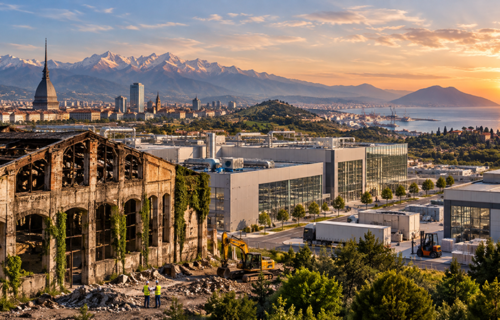
Turin presents a particularly interesting real-estate challenge because of the transformation of the automotive industry. The city and surrounding Piedmont region possess decades of manufacturing infrastructure, supplier relationships and engineering expertise. As traditional vehicle production changes, some older factories and supplier sites could require new uses. These properties may become opportunities for electric mobility, aerospace, defence, advanced engineering or other forms of manufacturing, but their future will depend heavily on the quality of the underlying sites. An old factory is not automatically a valuable redevelopment opportunity. Some industrial properties contain buildings poorly configured for modern production, while others require expensive environmental remediation. Contaminated soil, asbestos, inefficient energy systems and obsolete structures can turn apparently inexpensive sites into costly projects.
In other cases, however, the building may be less important than what already exists around it. High-capacity electricity connections, industrial zoning, road access, rail infrastructure and proximity to skilled workers can make an ageing factory site extremely difficult to replace. This could change the way investors value industrial property. Traditionally, an obsolete factory might be priced largely according to the condition of its buildings and redevelopment potential. Increasingly, investors may need to value the infrastructure hidden behind those buildings. A site with sufficient electricity and established industrial permissions could potentially be more valuable than a cleaner piece of undeveloped land where securing equivalent infrastructure would take years.
Veneto offers a different industrial ecosystem. Its network of medium-sized manufacturers, exporters and specialised suppliers provides a strong foundation for production investment. Rather than depending on a small number of enormous industrial plants, the region’s opportunity may lie in networks of factories, supplier facilities and specialised logistics properties serving interconnected manufacturing businesses. Emilia-Romagna provides another compelling example. The region already combines a powerful manufacturing economy with a strategic logistics position between Milan, Verona and Bologna. Automotive engineering, machinery, food production and other specialist industries coexist with some of Italy’s most important distribution corridors, creating the possibility of a broader industrial property market in which production, research, assembly and logistics increasingly operate within the same geographical networks.
The distinction between factory and warehouse may consequently become less clear. Modern manufacturers increasingly require buildings where components arrive, products are assembled, technology is tested and finished goods are distributed from the same site. Research and engineering teams can also operate alongside production. Investors accustomed to standard logistics properties may therefore encounter industrial assets that require much greater understanding of the tenant’s business and technical requirements.
Defence could accelerate this development. Higher European defence expenditure and efforts to expand domestic production create potential demand not only for major factories but for the suppliers surrounding them. Aerospace components, electronics, drones, communications equipment and precision engineering can require secure and highly specialised premises. A major defence investment can therefore have property consequences beyond the principal production facility as suppliers seek locations nearby. Semiconductor manufacturing takes specialised requirements further, with advanced facilities requiring exceptional levels of technical infrastructure and investments that can vastly exceed the value of the underlying land and buildings. Electricity reliability, water, environmental controls and specialised construction become fundamental, making suitable industrial sites scarce for reasons conventional property statistics may fail to capture.
Pharmaceutical production creates similar challenges. Italy already has a substantial life-sciences manufacturing base, and future expansion can require laboratories, controlled environments, specialised storage and complex regulatory approvals. An existing industrial location with suitable infrastructure and a history of regulated production may therefore possess advantages that cannot easily be recreated through speculative development. These trends can also influence logistics property because manufacturers need suppliers and distribution facilities around production sites. A new advanced factory can create demand for component storage, temperature-controlled facilities, secure logistics and specialised distribution, meaning the property impact of a manufacturing investment can extend well beyond the boundaries of the factory itself.
Southern Italy adds another dimension to the investment map. Government efforts to attract foreign investment and industrial projects increasingly include the Mezzogiorno, while Naples and Bari provide access to ports, large labour markets and transport networks. Land costs can also be considerably lower than in the northern industrial belt, creating opportunities for larger production sites. The challenge is whether those advantages can overcome differences in infrastructure, supplier density and skilled-labour availability. Manufacturers making large capital commitments need confidence that power, transport and permitting will support decades of operation. Financial incentives can help attract a project, but they cannot compensate indefinitely for inadequate infrastructure.
Bari could become particularly interesting where manufacturing intersects with logistics and Adriatic trade. The city and wider Puglia region provide access towards the Balkans and eastern Mediterranean while offering larger industrial sites than many northern markets. Naples and Campania similarly combine port infrastructure, aerospace and automotive experience with a substantial population base. Their ability to attract additional advanced manufacturing could determine whether Italy’s industrial-property expansion remains overwhelmingly northern or becomes more geographically balanced. For investors, this creates a different way of thinking about southern industrial property. Rather than asking whether Naples or Bari can compete directly with Milan as warehouse markets, the question is whether individual locations can develop specialised manufacturing clusters supported by logistics, infrastructure and government investment.
Brownfield redevelopment could be central to the national opportunity. Italy has a long industrial history and consequently a large stock of former factories, manufacturing land and underused production facilities. Reusing these sites can reduce pressure to develop undeveloped land while taking advantage of infrastructure already installed. Yet the economics must work. Demolition, soil remediation, structural alterations and energy upgrades can consume large amounts of capital before new production equipment is installed. Investors therefore need to compare the cost of recovering an old industrial site with the cost and time required to develop a new one. Where grid connections and permits are particularly difficult to secure, the brownfield option may become attractive even when substantial remediation is required.
This is where industrial property could begin following some of the same patterns emerging in Europe’s data-centre market. The value of land is increasingly influenced by whether essential infrastructure can actually be delivered. For advanced manufacturing, the relevant infrastructure extends beyond electricity to water, transport, labour, planning and connections to supplier networks. The change could also produce a new category of institutional investment. Traditional property funds have generally preferred warehouses because the buildings are relatively standardised and can often be leased to another occupier if the original tenant leaves. Specialised factories present greater risk because buildings designed around one production process can be difficult to re-let.
Long leases, strong corporate tenants and strategically important locations can nevertheless compensate for some of that risk. Investors may become more willing to finance specialised industrial assets when the tenant is committing substantial capital to the site and intends to remain for many years. Sale-and-leaseback transactions could also allow manufacturers to release capital tied up in property while continuing to operate from strategically important facilities. Owner-occupiers will remain an important competitor because a manufacturer investing heavily in machinery may decide that owning the underlying property provides greater security than leasing. Some of Italy’s most strategically valuable industrial sites could therefore attract bids from both real-estate investors and companies intending to use them directly.
The eventual result could be a more complicated industrial property map than the one defined primarily by warehouse corridors. Milan, Bologna and Verona will remain important because of their logistics connections, but manufacturing demand introduces additional considerations. Turin’s engineering base, Novara’s technology investment, Veneto’s supplier networks, Emilia-Romagna’s advanced manufacturing clusters and the potential expansion of Naples and Bari can all create different forms of industrial property opportunity. Not every region will attract semiconductor plants or major defence factories, nor will every obsolete industrial site find a second life. The more important change is that Europe’s industrial strategy is making the physical requirements of production relevant to property investors again.
For decades, the growth story in industrial real estate was largely about moving goods efficiently. The next phase may increasingly involve making those goods closer to European customers and securing the supply of strategically important products. Italy is unusually well placed to participate because manufacturing never disappeared from its economy. What may change is the property surrounding it. Old factories, industrial land, power connections and supplier parks could acquire new value as companies search for locations capable of supporting more technologically demanding production.
The next generation of Italian industrial property may therefore not look like another row of identical distribution warehouses beside a motorway. It could emerge from former automotive plants, brownfield manufacturing sites, technology campuses and specialised supplier clusters stretching from Piedmont and Lombardy through Veneto and Emilia-Romagna and, increasingly, towards southern industrial centres. For investors, identifying those locations will require looking beyond conventional measures of warehouse rents and yields. The most valuable industrial sites may be those where electricity, skilled labour, transport, permits and manufacturing infrastructure already come together. In a European economy placing renewed importance on where products are made, yesterday’s factory sites could become some of Italy’s most strategically important real estate.
Source: CIJ.World Research & Analysis Team