Friday, 23 October 2026
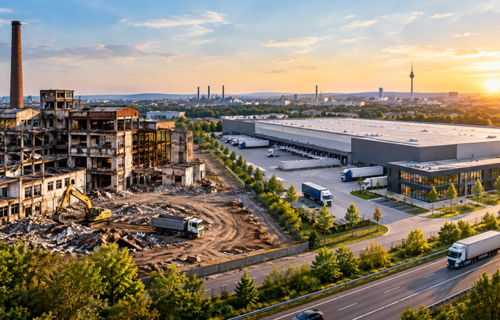
Germany’s next generation of logistics properties may increasingly be built where factories, workshops and industrial complexes once stood. As competition for undeveloped land intensifies and planning authorities place greater emphasis on reusing existing commercial areas, former industrial sites are becoming an increasingly important source of development opportunities. Previously developed sites accounted for approximately 45% of German logistics construction completed during 2025. In half of the country’s 24 principal logistics regions, redevelopment projects represented the majority of new supply, while several markets recorded shares significantly above that level. Around seven million square metres of additional logistics projects are currently planned on previously used land. This suggests that redevelopment is moving from a specialist strategy into the mainstream of Germany’s industrial and logistics property market.
The shift is particularly important because Germany remains one of Europe’s largest logistics markets while suitable development land around its strongest transport corridors is becoming increasingly difficult to secure. Warehouses compete with housing, manufacturing, data centres, energy infrastructure and environmental objectives for a limited supply of land. Municipalities also have competing priorities. Logistics development can create employment and local tax income, but large distribution facilities generate truck movements and consume significant amounts of land while often employing fewer people per square metre than manufacturing or other commercial activities. Consequently, gaining approval for entirely new logistics locations can be difficult, particularly around major metropolitan areas.
Existing industrial land offers an alternative. Germany has spent more than a century building manufacturing infrastructure across regions such as the Ruhr, Lower Saxony, Baden-Württemberg, Bavaria and parts of eastern Germany. As traditional industries restructure, some of those sites are becoming available for new uses. For logistics developers, the attraction can extend far beyond the land itself. A former factory may already have motorway connections, heavy-duty access roads, electricity infrastructure, drainage, water connections and established commercial planning status. Some properties also have rail access or are located close to inland ports. Creating the same infrastructure on undeveloped land can take years.
The Ruhr region demonstrates how this transition can work. The area combines one of Germany’s largest concentrations of former industrial property with exceptional access to population, motorways, railways and inland waterways. Large redevelopment projects are already turning former industrial land into modern logistics and commercial space. In Dortmund-Dorstfeld, a major redevelopment covering approximately 278,000 square metres is transforming an established industrial location into a new logistics and commercial district. Around 130,000 square metres of logistics, business and light-industrial space is ultimately planned for the site. The project’s importance lies not only in its size but also in what it represents. Rather than extending logistics development farther onto undeveloped land, substantial new capacity is being created inside an existing industrial area with established transport connections.
Smaller projects are following the same principle. In Herne, previously used commercial land that had remained idle for several years is being returned to productive use through new logistics development. Evidence from leasing markets also shows that these projects are attracting occupiers. Across parts of North Rhine-Westphalia, newly constructed buildings on redeveloped land accounted for a meaningful share of industrial and logistics take-up during the first half of 2026. In Düsseldorf, such properties represented more than a quarter of recorded activity, while newly constructed space on previously undeveloped sites contributed virtually nothing during the period. The pattern suggests that the redevelopment model is not being driven solely by environmental objectives. Occupiers are willing to lease these properties because they are often located exactly where logistics businesses want to operate.
Location remains the fundamental advantage. Many older industrial areas were established close to major cities because factories needed workers, transport infrastructure and access to customers. Decades later, those same characteristics are extremely valuable to logistics operators. A nineteenth- or twentieth-century industrial district can therefore possess surprisingly modern location advantages.
The challenge is that redevelopment is rarely simple. Previously used industrial land can contain contaminated soil, underground fuel tanks, foundations, obsolete utilities and hazardous building materials. Decades of manufacturing activity can leave environmental liabilities that are difficult to quantify before detailed investigation begins. Remediation costs can therefore materially change the economics of a project. An apparently inexpensive industrial property can become considerably more expensive once demolition, soil treatment and infrastructure replacement are included.
Environmental responsibility can also complicate transactions. Developers need to understand what contamination exists, who is legally responsible for remediation and what environmental standard will apply to the proposed new use. The cost of clearing existing structures creates another challenge. Large factories were frequently constructed for specialised production processes. Reinforced foundations, underground infrastructure and heavy industrial equipment can be expensive to remove. Some buildings may also contain materials requiring specialist treatment. For this reason, the purchase price alone provides a poor indication of whether an old industrial property represents an attractive redevelopment opportunity. Investors increasingly need to calculate the total cost of creating a usable development site.
Yet the same property may contain infrastructure that would be extremely expensive to reproduce elsewhere. Electricity is becoming particularly important. Modern logistics buildings increasingly require greater power capacity as operators introduce automation, robotics, refrigeration systems and electric vehicle charging. Distribution centres that once required relatively modest electricity connections can now have much larger energy requirements. Securing additional grid capacity for a new development can be difficult and slow.
Former industrial sites can therefore possess a hidden advantage. Factories historically required substantial electricity supplies, and sites retaining large grid connections may be particularly attractive to modern occupiers. The value of the electricity connection could eventually rival the value of some of the buildings standing on the property.
Planning status may become equally important. Land that has already been used for industrial or commercial activity can offer developers greater certainty than an undeveloped site requiring a fundamental change of use. Redevelopment still requires planning approval and environmental assessment, but an established employment location can have an important advantage. This could gradually change how industrial land is valued.
Traditionally, developers have focused heavily on land price per square metre. In a more constrained market, the more important calculation may become how quickly and reliably that land can actually be developed. A cheaper site that requires several years of planning negotiations may ultimately be less attractive than a more expensive industrial property where commercial use is already established.
Time has financial value. Every year spent waiting for permission generates financing costs, professional fees and uncertainty. Development assumptions can also change while a project moves through the planning system. A site offering greater certainty can therefore justify a higher acquisition price even when demolition or remediation is required.
There is not yet sufficient evidence to establish a uniform price premium for German logistics redevelopment land. The market varies too widely between regions and individual properties. But the ingredients for such a premium are becoming increasingly visible. Suitable industrial land is scarce in many established logistics locations. Planning new developments can be difficult. Grid connections are increasingly important. Infrastructure is expensive to reproduce. At the same time, Germany has a substantial stock of ageing manufacturing property entering a period of structural change.
These trends could make existing industrial development rights progressively more valuable. The transformation of Germany’s automotive and manufacturing industries could accelerate the process. Factory closures and corporate restructuring may release large industrial sites over the coming years. Some will remain manufacturing locations, potentially attracting defence, robotics, battery or advanced-engineering companies. Others could become logistics developments.
The decision will increasingly depend on which use generates the greatest value from the site’s existing infrastructure. A former automotive supplier facility close to a motorway, for example, could attract competing interest from warehouse developers, manufacturers, data-centre operators and other infrastructure-intensive businesses. That competition could eventually raise values for the strongest industrial locations.
It also means that logistics developers cannot assume they will automatically acquire every redundant factory. Sites with unusually strong electricity connections may be more valuable to data centres or energy-intensive manufacturers. Properties containing specialised engineering infrastructure may be attractive to defence or advanced manufacturing businesses. Some sites may also be unsuitable for large distribution centres because they are too close to residential areas or lack adequate access for heavy truck traffic.
The future of former industrial land will therefore be determined site by site. The strongest logistics candidates are likely to combine large plots, motorway access, suitable commercial planning status, strong electricity capacity and proximity to major population centres. Properties offering rail connections or access to inland waterways could command additional interest. The weakest sites will be those where extensive contamination, demolition costs and poor transport connections outweigh the advantage of existing industrial use.
Sustainability considerations could further strengthen the redevelopment model. Reusing industrial land reduces pressure to develop agricultural or natural areas and can result in the remediation of contamination left by previous occupiers. Municipalities can therefore gain environmental benefits while bringing unused property back into economic activity. However, demolition itself carries an environmental cost. Removing large buildings and replacing them with new structures consumes materials and creates significant carbon emissions. Developers may therefore increasingly examine whether parts of existing industrial buildings can be retained.
Some former factories could be converted into urban logistics facilities, workshops or smaller industrial units rather than being completely demolished. This could produce a new generation of mixed industrial estates. Instead of replacing one factory with one enormous warehouse, developers could divide large campuses into multiple buildings serving logistics, light manufacturing, engineering and service businesses. Such developments could also be more attractive to municipalities because they create a broader employment base and reduce dependence on a single occupier.
The Dortmund redevelopment provides an early indication of this direction, combining logistics with commercial and light-industrial space rather than relying entirely on conventional large-box warehousing. For investors, this creates a strategy that is very different from acquiring an already leased distribution centre. Redevelopment requires expertise in environmental remediation, demolition, infrastructure, planning and construction. Projects can take several years and involve considerably greater uncertainty.
But the potential reward is access to locations where conventional development opportunities are increasingly scarce. Germany’s industrial history has created an enormous inventory of land in places that remain strategically important today. The factories may no longer be required for their original purpose, but the motorways, railways, power infrastructure and cities around them have not disappeared.
That is what could make these sites increasingly valuable. The next German logistics development cycle may therefore be defined less by how much undeveloped land can be acquired and more by how effectively existing industrial property can be recycled. As land becomes harder to secure, investors may gradually place greater value on something that cannot easily be manufactured: an established industrial location where infrastructure and the ability to redevelop already exist.
Germany’s warehouse pipeline could increasingly emerge from the remains of its manufacturing past. For developers capable of managing contamination, demolition and planning complexity, yesterday’s industrial land may become one of the most important sources of tomorrow’s logistics property.
Source: CIJ.World Research & Analysis Team