Thursday, 8 October 2026
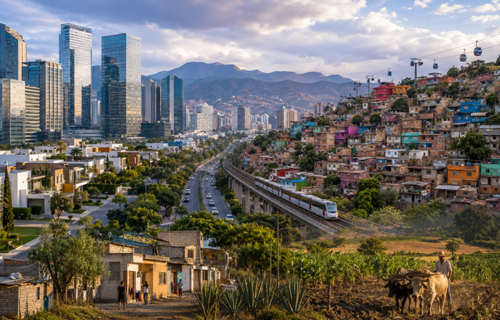
Mexico has become one of the most important industrial, manufacturing and consumer economies in the Americas. Its close relationship with the United States, extensive manufacturing base, large domestic market and growing position within international supply chains have created substantial investment and transformed cities across the country. Yet the benefits of this development remain distributed very differently depending on income, employment, education and, perhaps most importantly, geography. The contrast is visible in Mexico City, where some of Latin America’s most expensive residential districts and sophisticated commercial developments coexist with densely populated communities whose residents can spend hours travelling to work. It can also be seen nationally, between industrial cities benefiting from international manufacturing investment and southern states where poverty and limited infrastructure remain much more widespread.
Mexico generated economic output of approximately USD 1.8 trillion in 2025, making it one of the world’s larger economies. With a population exceeding 130 million, however, national averages conceal enormous differences between households and regions. Income inequality has improved gradually, with Mexico’s official statistics recording a Gini coefficient of 0.420 in 2024, compared with 0.431 two years earlier. Household incomes at the bottom of the distribution have also increased substantially over recent years, although the distance between the poorest and wealthiest households remains considerable.
In 2024, households within the lowest tenth of the income distribution received an average of approximately MXN 16,800 (approx. $991) over three months, while those in the highest tenth averaged around MXN 236,000 (approx. $13,918) during the same period. Even this comparison understates the difference between ordinary households and Mexico’s genuinely wealthy population because the highest income category includes both successful professional families and households possessing substantially greater business, property and financial wealth.
Employment provides another important explanation for the divide. Mexico maintains relatively low headline unemployment, but employment does not necessarily mean financial security. More than half of the country’s workers operate under some form of informal employment. During the first quarter of 2026, approximately 32.6 million people were estimated to be working informally, while around 17.6 million worked directly within businesses and activities considered part of the informal sector.
Mexico has engineers, managers, technology specialists, bankers and professionals working for international manufacturers and large domestic companies. These jobs can provide regular salaries, social protection, pensions and access to conventional mortgages. At the same time, millions of people earn their living through small businesses, street commerce, construction, domestic work, agriculture and independent services. Their incomes can be sufficient to support households but may be irregular or difficult to demonstrate to financial institutions. Two workers can therefore both be fully employed while having completely different opportunities to purchase property, obtain credit or accumulate retirement savings.
Education increasingly determines which side of this economy people can enter. International manufacturing, engineering, finance, technology and professional services require increasingly sophisticated skills. English-language ability, technical qualifications and digital knowledge can significantly increase access to better-paid employment. Families able to provide private education, additional language teaching, technology and professional networks consequently give their children advantages extending well beyond current household income.
The geographical divide is even more significant. Northern Mexico and parts of the Bajío have developed powerful industrial economies closely connected with the United States. Monterrey has become one of Latin America’s leading manufacturing and corporate centres, while Tijuana, Ciudad Juárez, Saltillo, Querétaro, Guanajuato and other cities support extensive automotive, electronics, aerospace, logistics and advanced-manufacturing industries. Southern Mexico presents a considerably different picture.
Recent measurements of household earnings show substantial differences between states. At the end of 2024, the proportion of people whose household employment income was insufficient to cover basic food requirements was approximately 13 percent in Baja California Sur and around 20 percent in Nuevo León. In Chiapas it exceeded 60 percent, with Oaxaca and Guerrero recording similarly high levels. A household in an industrial city in northern Mexico may therefore have access to formal manufacturing employment, modern infrastructure and international companies, while a household with similar skills in a remote southern community may face a much smaller employment market and significantly weaker connections to the country’s most productive economic sectors.
Mexico City contains many of these contrasts within a single metropolitan region. Polanco, Lomas de Chapultepec, Bosques de las Lomas, Santa Fe and other affluent areas contain premium housing, international offices, luxury retail, private hospitals and expensive restaurants. Property and consumer markets in these districts can resemble those of substantially wealthier international cities. Yet millions of workers supporting the metropolitan economy live considerably farther from the principal employment centres.
Housing costs may be lower on parts of the metropolitan periphery, but the difference can effectively be paid through travel rather than rent or mortgage payments. Long journeys between home and employment consume time and money and can reduce access to opportunities. A higher-income professional may be able to live closer to work, drive, work partly from home or choose employment according to location. A lower-income worker dependent on public transportation has far fewer alternatives.
Public transport investment can therefore have an economic effect far beyond moving passengers. Mexico City’s cable-car systems provide an example, with new connections developed in densely populated districts including Iztapalapa to improve links between communities located on difficult terrain and the wider metropolitan transport network. Reducing travel time can expand the number of jobs realistically accessible to residents while improving access to schools, healthcare and commercial centres. Transport infrastructure can consequently alter both economic opportunity and property values.
Housing presents another major challenge. Mexico does not simply suffer from insufficient housing. The more difficult problem is providing homes at prices people can afford in locations connected to employment and infrastructure. The federal government is pursuing a major housing programme intended to deliver around 1.8 million new homes during the presidential term, together with a similar number of housing improvement measures and approximately one million property-title actions. By mid-2026, hundreds of thousands of homes were reported to have entered construction or contracting stages.
The scale is significant, but Mexico’s previous experience demonstrates why the location of new housing is as important as the number of units delivered. Large amounts of inexpensive housing have historically been developed on peripheral land where acquisition costs were lower. In some cases, employment, schools, transportation and other infrastructure did not develop at the same speed. A home can therefore be affordable according to its purchase price while becoming expensive in practical terms if residents spend several hours and substantial transport costs reaching work.
Mexico also has a distinctive tradition of households building and improving their homes gradually. Rather than purchasing a completed property from a conventional developer, families may acquire land or an existing structure and expand it over many years as income becomes available. This creates another housing economy alongside the formal developer market. At one end are premium residential developments in Mexico City, Monterrey, Guadalajara and international tourism destinations. In the middle are households purchasing through formal mortgage systems. At the lower end are families progressively constructing or improving their homes, sometimes with limited access to conventional financing.
Property ownership consequently plays an important role in determining long-term wealth. Families who already own property in successful urban markets may have benefited from years of appreciation in land and housing values. Younger households entering those markets must purchase at today’s prices without having accumulated the same assets. Income inequality can therefore decline while differences in accumulated property wealth continue to grow.
Retail demonstrates another side of Mexico’s economic scale. Unlike Costa Rica and Panama, Mexico has an enormous domestic consumer market and substantial manufacturing capacity. More than 130 million consumers provide retailers with distribution volumes unavailable in smaller Central American economies, while domestic production reduces dependence on imports across many categories. Everyday goods can consequently be considerably more affordable than in smaller regional markets.
Premium retail operates according to a different economic logic. Luxury shopping centres and international brands in wealthy areas of Mexico City, Monterrey and major tourism destinations serve a relatively small but financially powerful group of consumers. International visitors and expatriates add further purchasing power in selected locations. Mexico therefore supports both an enormous mass consumer economy and a sophisticated luxury market.
International investment is creating another transformation. The restructuring of North American supply chains has increased interest in manufacturing locations close to the United States. Mexico’s established industrial base, trade relationships and geographical position have made it a major beneficiary of this process. Nearshoring has increased demand for industrial buildings, logistics facilities and development land across northern Mexico and the Bajío.
Factories, however, cannot operate independently of the communities around them. Fast-growing industrial markets require electricity, water, roads, housing, schools and skilled workers. Where these systems fail to expand alongside investment, infrastructure itself can become a constraint on economic growth. This means that the success of Mexico’s industrial property markets increasingly depends on infrastructure outside the boundaries of individual industrial parks.
Water is becoming particularly important. Several of Mexico’s strongest industrial markets are located in regions facing pressure on water resources. Growing cities must accommodate residential demand at the same time as manufacturing facilities require reliable supplies. Water availability is therefore increasingly becoming a real estate and investment consideration rather than simply an environmental issue.
Mexico City faces a different but equally difficult water challenge. The metropolitan region must maintain supply for one of the world’s largest urban populations while dealing with groundwater extraction, ageing networks, drainage requirements and land subsidence. These issues demonstrate how infrastructure can affect households differently.
Higher-income residents can partially protect themselves against weaknesses in public services through private vehicles, private schools, healthcare, security and better-equipped residential developments. Lower-income households are considerably more exposed to the quality of public transportation, roads, schools, healthcare, water and municipal infrastructure. Wealth therefore provides not only greater purchasing power but a greater ability to avoid infrastructure deficiencies.
Tourism produces another version of the divide. Los Cabos, Cancún, the Riviera Maya and other international destinations attract visitors and property buyers whose purchasing power can be substantially greater than local wages. Foreign demand creates hotels, construction employment, restaurants, retail and residential investment, but it can also increase land and housing costs.
This can produce striking contrasts where luxury resorts and expensive second homes exist close to communities occupied by the workers required to operate them. The challenge is ensuring that tourism development generates sufficient housing, infrastructure and economic opportunities for surrounding populations rather than creating isolated pockets of international prosperity.
Mexico nevertheless possesses an advantage unavailable to many smaller tourism-dependent economies: the enormous scale and diversity of its domestic economy. Manufacturing, technology, finance, professional services, retail, agriculture, tourism and entrepreneurship provide multiple potential routes toward higher household incomes. The central challenge is connecting more people with these opportunities.
Infrastructure investment is therefore closely connected with social mobility. Better transportation expands the geographical area in which people can realistically work. Reliable water and electricity allow businesses and housing to develop. Better schools improve access to higher-value employment, while appropriately located housing reduces the economic burden created by long commuting times.
This makes Mexico’s inequality increasingly relevant to the property industry. Industrial developers require workers who can find housing near factories. Office investors require transportation networks connecting employees with business districts. Tourism developers require communities capable of housing hospitality workers. Residential developers depend on mortgage accessibility, while all property sectors require reliable water, electricity and transport infrastructure.
The strongest Mexican property markets are therefore likely to be those where investment and infrastructure develop together. Markets experiencing rapid industrial or tourism expansion without adequate housing, transportation, water or public services risk eventually finding that these shortages constrain further growth.
Mexico’s economic divide should consequently not be understood simply as wealthy households living beside poorer ones. It is simultaneously a geographical, educational, employment, housing and infrastructure divide.
There is the internationally connected Mexico of manufacturing plants, corporate headquarters, technology businesses, luxury property and global tourism. There is the enormous middle and working economy that manufactures goods, operates businesses and supports the country’s cities. There is an informal economy employing tens of millions of people who participate actively in economic life but frequently remain outside conventional financial systems. There are also rural and southern communities where access to the country’s strongest employment markets remains considerably more limited.
Mexico has already demonstrated that it can compete successfully for international manufacturing, tourism and investment. Its next development challenge is ensuring that housing, transportation, education, water and urban infrastructure expand quickly enough to connect a much broader population with the economic opportunities being created.
For real estate investors and developers, this is likely to become one of the defining issues of the Mexican market. Future growth will depend not simply on where international companies want to invest, but on whether the cities receiving that investment can provide the housing, workers, water, transportation and infrastructure required to sustain it.
Mexico’s greatest economic advantage may be its enormous scale. Its greatest challenge is ensuring that the opportunities created by that scale become more accessible across a country where the place someone is born, lives and works can still determine dramatically different economic futures.
Source: © CIJ.World Research & Analysis Team