Sunday, 4 October 2026
Poland’s economy continues to expand, but the pattern of growth is becoming increasingly uneven. The latest regional data show that investment, employment, innovation and population movements are becoming concentrated around the country’s strongest metropolitan economies, while a number of smaller regions face the combined challenge of ageing populations, outward migration and weaker economic activity.
The divide has important implications for real estate. Rather than treating Poland as a single growth market, developers and investors increasingly need to examine the economic and demographic conditions of individual cities and regions when assessing residential, office, logistics and industrial opportunities.
According to Statistics Poland’s latest regional assessment, Poland generated GDP of approximately PLN 3.65 trillion in 2024, equivalent to PLN 97,357 per inhabitant. However, performance varied considerably around the country. Wielkopolskie recorded GDP per capita of PLN 102,129, while Śląskie reached PLN 97,509 and Małopolskie PLN 87,269.
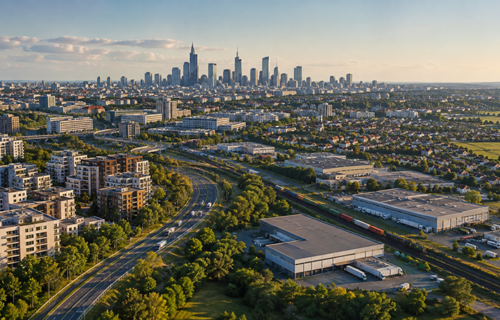
Warsaw remains in a category of its own. The capital and its surrounding economic area have developed into Poland’s dominant concentration of corporate activity, higher-value employment and investment. At the same time, regional centres including Kraków, Wrocław, Poznań and the Tricity continue to strengthen their roles as employment and business destinations.
This concentration is increasingly significant because Poland is simultaneously dealing with a long-term demographic challenge. Population decline at national level does not translate uniformly across the country. Major cities continue to attract people from smaller towns and regions, while international migration is providing an additional source of workers and residents in some of the strongest urban economies.
As a result, the property consequences of Poland’s demographic decline are considerably more complex than the national population figures might suggest.
Migration is reshaping local demand
The distinction is particularly visible in migration patterns. Major employment and university centres are better positioned to compensate for natural population decline by attracting people from elsewhere in Poland and abroad.
This has direct consequences for residential markets. Cities capable of generating employment and attracting younger workers can continue to experience demand for housing despite a shrinking national population. Conversely, markets experiencing both natural population decline and outward migration may face a progressively more difficult environment for large-scale residential development.
Housing construction already reflects some of these differences. Around 208,300 homes were completed across Poland in 2025, equivalent to 5.6 dwellings per 1,000 inhabitants. Małopolskie alone accounted for approximately 20,300 completions, with its construction rate exceeding the national average.
For developers, this means that national demographic forecasts provide only part of the information needed when evaluating development land. Employment growth, transport connections, universities, internal migration and the ability of individual cities to attract foreign workers can be equally important indicators of future housing requirements.
Labour is becoming increasingly important for industrial investment
The same demographic changes are beginning to influence the industrial and logistics market.
Poland has spent much of the past two decades expanding its position as a European manufacturing and distribution location. Infrastructure improvements, access to the EU single market and a substantial workforce have supported the development of logistics corridors and industrial clusters across the country.
Future expansion, however, will increasingly depend on the availability of workers in individual locations.
Poland’s employment rate stood at 56.8% in 2025, while unemployment was approximately 3.1%, according to Statistics Poland. The regional picture varies, meaning that investors considering manufacturing plants, distribution centres or other labour-intensive operations increasingly need to assess local workforce availability alongside land prices and motorway access.
This may favour established metropolitan and industrial regions capable of attracting workers from larger surrounding areas. It could also strengthen the importance of transport connections that allow employers to recruit from beyond the immediate municipality in which a project is located.
For logistics developers, labour availability may consequently become almost as important as proximity to motorway junctions and consumer markets when selecting future development locations.
Innovation is creating another layer of regional concentration
Poland’s research and technology economy shows an even stronger geographical concentration.
National expenditure on research and development reached approximately PLN 51.5 billion in 2024, equivalent to PLN 1,370 per inhabitant and around 1.41% of GDP. Małopolskie accounted for approximately PLN 7.4 billion, or PLN 2,156 per resident, substantially above the national average.
Mazowieckie recorded approximately PLN 3,368 of research and development expenditure per inhabitant, demonstrating the concentration of research institutions, technology companies and higher-value corporate activity around Warsaw.
These figures have implications for commercial property beyond conventional offices. Growth in technology, research and advanced manufacturing can generate demand for specialised laboratories, research facilities, data infrastructure and modern industrial space, while simultaneously supporting residential demand from skilled employees.
Universities also play an important role. Cities capable of retaining graduates and connecting academic institutions with private-sector investment have a stronger foundation for developing higher-value economic clusters.
Warsaw’s influence extends beyond the capital
The economic strength of Warsaw also demonstrates why regional analysis cannot be based solely on administrative boundaries.
Investment and employment generated by the capital increasingly extend into surrounding municipalities through residential development, logistics parks, data centres, business services and transport infrastructure.
This metropolitan expansion creates opportunities outside the traditional urban core. Rising land costs and limited development sites within major cities can push residential and commercial development towards surrounding municipalities, particularly where rail and road infrastructure provides efficient access to employment centres.
Similar patterns are emerging around other major Polish cities. The result is a gradual expansion of metropolitan investment zones rather than growth being restricted to administrative city boundaries.
Residential development faces two very different markets
For the housing sector, Poland’s regional divergence is creating increasingly different development conditions.
In expanding metropolitan areas, developers must respond to demand generated by employment, household formation and migration while dealing with higher land costs and planning constraints. In shrinking locations, the challenge is different: developers must demonstrate that sufficient local demand exists before adding substantial new housing supply.
Poland already had more than 16.16 million dwellings in its housing stock in 2025, with an average usable area of 75.7 sqm per dwelling.
The question for the next development cycle is therefore becoming less about the country’s overall housing shortage and more about whether the right type of housing exists in the places where population and employment are concentrating.
That distinction could become increasingly important as smaller households, migration and ageing change the composition of housing demand.
Regional differences will matter more to investors
Poland remains one of Central and Eastern Europe’s largest real estate investment and development markets, but national economic growth alone will become a less reliable guide to future property performance.
The strongest locations increasingly combine several advantages: employment creation, positive migration, transport infrastructure, universities, investment activity and the ability to attract skilled workers. Locations missing several of these elements may find it progressively harder to maintain the same pace of development.
This does not mean investment will be confined to Warsaw and the largest regional capitals. Smaller cities can still benefit substantially from new factories, logistics infrastructure, energy projects, tourism or major public investment. But such markets are likely to depend more heavily on identifiable local economic drivers.
For property investors, developers and occupiers, Poland is therefore becoming a more geographically selective market. The country’s economic expansion continues, but the opportunities created by that growth are not being distributed evenly.
The next phase of Poland’s real estate development is likely to follow the movement of people and employment increasingly closely. Where companies invest, skilled workers settle and infrastructure improves, property demand should follow, making regional and metropolitan fundamentals increasingly important to investment decisions.
Source: Statistics Poland