Sunday, 4 October 2026
Poland’s new-build residential market is being driven primarily by people buying homes for their own use, while investment purchases have become more selective and foreign buyers remain a secondary source of demand. Developers are also reporting stronger interest in larger apartments, although compact two- and three-room units continue to account for a substantial part of sales.
A survey of residential developers prepared by property service Dompress indicates that the composition of demand has changed from the period when inexpensive financing and rapidly rising prices encouraged greater investment activity. Buyers now place more emphasis on usable space, total purchase cost, transport connections and access to everyday services.
At Develia, owner-occupiers currently account for around 70-75% of transactions, including both first-time buyers and households moving to larger homes. Investors represent approximately 25-30% of purchases, despite rental yields being lower than several years ago. Two-room apartments remain particularly popular among this group.
The developer also reports that foreign nationals now represent around 10% of its transactions, suggesting that international migration is beginning to have a measurable impact on some parts of the primary residential market.
The picture varies considerably between companies and cities, however. Ronson Development estimates that foreign purchasers account for only several percent of its sales, while Archicom does not currently see international migration as a major influence on its demand.
One of the clearer themes emerging from developers’ responses is increasing interest in apartments intended as longer-term homes rather than temporary or purely investment properties.
Atal reports particularly good sales of three- and four-room apartments. In Kraków, the company has also observed demand for apartments of around 100 sqm or more, with buyers indicating that relatively few properties of this size are available.
Alides Poland has experienced a similar pattern at its two Warsaw developments. At WestoWola on Jana Kazimierza Street, more than half of purchasers already live in the surrounding part of Warsaw and are buying primarily to improve their housing conditions. Demand for larger units has been strong enough that the developer is offering some buyers the possibility of combining smaller apartments.
At the premium ReVola project on Karolkowa Street, purchases for personal occupation also dominate, including existing homeowners looking for a higher residential standard. Another group consists of parents purchasing apartments for children moving to Warsaw, including those beginning university studies.
Grupo Lar Polska similarly reports fewer investment transactions and a growing proportion of purchases by end users, contributing to an increase in the average size of apartments sold.
The trend does not mean that smaller properties have lost their position in the market. BPI Real Estate Poland, Robyg, Profit Development, MS Waryński Development, Matejek Group and Alter Investment all identify functional two- and three-room apartments as an important part of current demand.
Depending on the developer and city, the most active segment generally falls between approximately 40 sqm and 70 sqm. These properties can accommodate first-time buyers, couples and smaller families while remaining relatively liquid on both the resale and rental markets.
Archicom reports that two-room apartments continue to generate the largest share of its sales, but three-room properties are increasingly achieving comparable results. Where household finances permit, buyers are often choosing an additional room to provide greater flexibility.
Investment demand has not disappeared, particularly in Warsaw, central Wrocław and other large urban markets, but developers generally describe today’s investor as more cautious than during the period of very low interest rates.
Rental income alone is no longer necessarily sufficient to justify a purchase. Investors are increasingly assessing operating costs, location quality, potential tenant demand and prospects for longer-term capital appreciation.
This helps explain the continued preference among investment buyers for smaller two-room apartments, where the total acquisition price is lower and the potential tenant base is relatively broad.
Cash investors are also becoming more price-sensitive. MS Waryński Development reports that such buyers are increasingly prepared to wait for attractive pricing rather than entering the market regardless of valuation.
For the wider development market, this shift means that sales are becoming more closely connected to the financial position of Polish households. Grupo Lar identifies mortgage capacity as an important driver, while Robyg points to economic conditions, credit availability and domestic housing requirements as stronger influences on overall demand than international migration.
Developers also describe a more nuanced approach to location.
In Poland’s most expensive metropolitan markets, buyers are increasingly prepared to consider districts outside the central core where larger apartments can be obtained within their budgets. What matters is whether those locations provide efficient public transport, schools, shops, services and access to green space.
BPI Real Estate Poland describes this as broadly consistent with the 15-minute-city approach, where residents can meet most everyday requirements within a relatively small area.
Profit Development reports strongest demand for first homes, particularly functional two- and three-room apartments of approximately 50-70 sqm. MS Waryński identifies a similar preference for 45-60 sqm units outside the most expensive central districts but with good access to the city centre.
In Kraków, Matejek Group sees particularly strong interest in apartments of around 50-70 sqm. Such layouts can accommodate families as well as people working remotely or on hybrid schedules who require an additional room for working from home.
Migration presents a more complicated picture.
Several developers report increasing numbers of foreign purchasers, particularly Ukrainians as well as professionals from countries including India and Turkey.
Atal says foreign nationals, including Ukrainian and Indian buyers establishing longer-term lives in Poland, are becoming a more visible group among purchasers of larger apartments. Alides has meanwhile recorded enquiries at its Warsaw premium project from buyers originating from markets including the United States and the United Arab Emirates.
Other developers argue that international migration has a much greater effect on rental demand than direct residential sales. BPI Real Estate Poland and Grupo Lar both point to this distinction, while Archicom considers domestic migration into the country’s major cities more important to new-home purchasing than international migration.
Internal migration can generate several forms of demand simultaneously. Buyers moving from smaller towns may acquire properties ahead of a future relocation, as accommodation for children studying in major cities, as second homes or as longer-term investments.
Taken together, the developers’ responses suggest that Poland’s new-build market is currently more dependent on underlying housing requirements than speculative investment demand.
The strongest common themes are purchases for personal occupation, first-time buyers and households seeking more space. Investment capital remains present but appears more selective, while international buyers provide additional demand without yet becoming the dominant force across the market.
The changing buyer profile could also influence what developers bring forward. While compact two- and three-room apartments remain central to sales, demand for larger family properties appears stronger than in previous periods, particularly in Warsaw, Kraków and other major employment centres.
For developers, this places greater emphasis on the structure of individual projects. Apartment size, efficient layouts, transport accessibility, surrounding services and green space are increasingly being considered together rather than price per square metre alone.
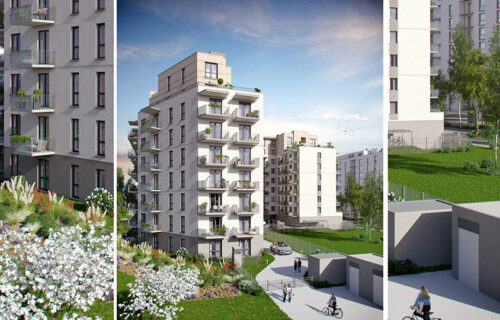
Photo: Moja Oszmianska, Grupo Lar Polska
Source: dompress.pl