Sunday, 4 October 2026
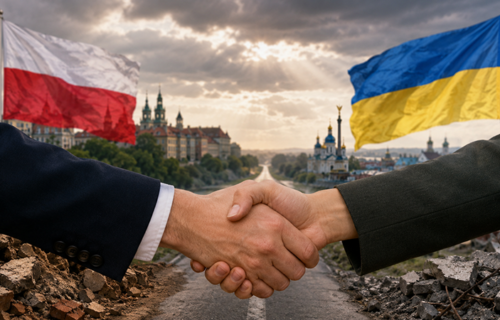
Relations between Poland and Ukraine have entered a period of renewed tension after a series of political decisions revived longstanding disagreements over the legacy of the Second World War, prompting concerns that historical disputes could undermine cooperation at a critical stage of Russia’s war against Ukraine.
The latest disagreement followed Kyiv’s decision to grant a Ukrainian special operations unit an honorary title associated with the Ukrainian Insurgent Army (UPA), a nationalist force whose role during World War II remains deeply controversial. While many Ukrainians view the organisation as part of the country’s struggle for independence, Poland remembers the UPA primarily for the mass killings of Polish civilians in Volhynia and Eastern Galicia during 1943 and 1944.
The move triggered a sharp response from Polish President Karol Nawrocki, who revoked the Order of the White Eagle previously awarded to Ukrainian President Volodymyr Zelenskyy. Zelenskyy later announced that he had returned the decoration, while several Ukrainian public figures also relinquished Polish honours in protest.
The dispute has highlighted the continued sensitivity of wartime history between two countries that have otherwise developed one of Europe’s closest strategic partnerships since Russia launched its full-scale invasion of Ukraine in 2022.
For Warsaw, recognition of the victims of the Volhynia massacres remains a fundamental historical issue. Polish authorities regard the killings as genocide, with historians estimating that tens of thousands of Polish civilians lost their lives during the campaign carried out by UPA forces. At the same time, scholars note that retaliatory violence against Ukrainian civilians also occurred as ethnic tensions escalated across the region.
Historical assessments of the UPA remain complex. Although elements of the wider Ukrainian nationalist movement cooperated with Nazi Germany during parts of the war, the organisation also fought both German and Soviet forces as the conflict evolved. This complicated legacy continues to divide historians and politicians across Central and Eastern Europe.
The renewed disagreement comes at a time when Poland remains one of Ukraine’s most important strategic partners. Much of the military assistance, humanitarian aid and commercial supplies reaching Ukraine continues to pass through Polish territory, making bilateral cooperation central to Kyiv’s ability to sustain its defence effort. Poland also holds a significant voice in Ukraine’s long-term ambition to join the European Union, where accession requires unanimous approval from all member states.
Polish Prime Minister Donald Tusk has urged both sides to avoid allowing historical disputes to damage present-day cooperation, warning that any deterioration in relations would ultimately benefit Russia’s geopolitical objectives.
The dispute also reflects domestic political pressures in both countries. In Poland, debates surrounding national history have become increasingly prominent ahead of future parliamentary elections, while in Ukraine, symbols linked to historic resistance movements have gained greater visibility during the ongoing war as the country seeks to reinforce national identity under continued Russian aggression.
Historians generally agree that acknowledging the full complexity of the past remains essential. While Ukraine continues to honour those who fought for independence, many scholars argue that recognition of wartime atrocities committed against civilians is equally important in preserving historical credibility and maintaining trust with neighbouring states.
Despite the latest diplomatic tensions, analysts broadly expect both governments to continue cooperating on security and defence, given the strategic importance of their partnership and the continuing threat posed by Russia.
Source: CIJ.World Research & Analysis Team