Friday, 4 September 2026
Bohdan Pniewski remains one of the most influential figures in shaping Warsaw’s institutional architecture, with a body of work that spans the interwar period, wartime interruption and post-war reconstruction. His legacy is not defined by adherence to a single architectural movement, but by a consistent ability to translate political, cultural and institutional ambition into built form.
Emerging in the 1920s as Poland re-established itself as an independent state, Pniewski quickly positioned himself among a group of architects tasked with giving physical expression to national identity. While modernist thinking dominated much of Europe at the time, his work took a more calibrated direction. He adopted contemporary construction methods, but resisted purely functional solutions, instead placing emphasis on proportion, materiality and spatial sequencing.
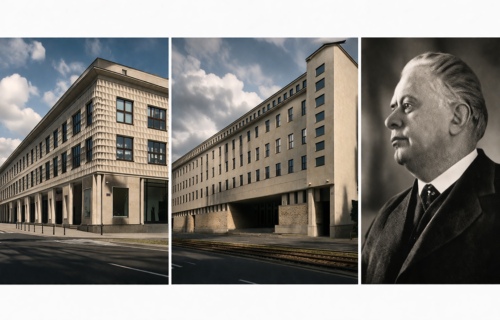
This approach came into sharper focus in the 1930s, as his commissions increased in scale and importance. The Grodzkie Courts complex in Warsaw, delivered between 1935 and 1939, stands as one of the most significant examples of institutional architecture from the interwar period. Developed as a major judicial centre, the project reflects a deliberate balance between modern planning and architectural gravitas. Its restrained façade, defined by repetition and scale rather than ornament, conveys authority without reliance on historic imitation. At the time of completion, it ranked among the largest judicial buildings in Europe and played a key role in shaping the visual identity of the Polish legal system.
The outbreak of the Second World War halted further development and left Warsaw extensively damaged. Like many of his contemporaries, Pniewski’s role shifted from active construction to conceptual work and education. However, his position within the architectural landscape remained intact, allowing him to re-engage directly in the rebuilding process after 1945.
Post-war Poland presented a fundamentally different operating environment, with architecture increasingly influenced by centralised planning and ideological frameworks. Despite these constraints, Pniewski retained a degree of authorship in his work. His contribution to the expansion of the parliamentary complex in Warsaw illustrates a strategic response to these conditions. Rather than imposing a dominant monumental structure, he introduced a composition of lower-scale buildings integrated into a landscaped setting, reinforcing institutional presence through spatial organisation rather than scale alone.
A comparable level of control is evident in the Ballet School on Moliera Street, completed in the early 1950s. Delivered during a period often associated with more rigid architectural expression, the project adopts a notably disciplined approach. The façade is structured through a consistent rhythm of openings, while the internal layout is directly aligned with the functional requirements of dance education. The result is a building that remains focused on performance and movement, avoiding unnecessary formal complexity while maintaining a strong architectural identity.
Pniewski also played a central role in the reconstruction of the Grand Theatre in Warsaw, one of the city’s most important cultural institutions. Rather than replicating the pre-war structure, the project combined preservation with expansion, introducing new spatial capacity and technical infrastructure while retaining the building’s historical presence. This approach reflects a broader reconstruction strategy seen across Warsaw, where architectural continuity was achieved through reinterpretation rather than direct replication.
Across these projects, Pniewski’s work demonstrates a consistent understanding of architecture as a tool of institutional communication. Whether designing for the judiciary, government or cultural sector, he prioritised clarity, order and material presence. His buildings are characterised by controlled proportions, disciplined detailing and a careful response to context, allowing them to remain relevant across changing political and economic conditions.
Today, his projects continue to form a key part of Warsaw’s institutional framework. The Grodzkie Courts and the Ballet School, developed in distinct historical periods, illustrate the continuity of his approach despite shifting external pressures. Both buildings remain operational and embedded within the city’s urban fabric, underscoring the durability of his architectural thinking.
In a Central and Eastern European context, where political transitions have repeatedly reshaped the built environment, Pniewski’s work offers a case study in adaptability. His ability to navigate different regimes while maintaining a coherent architectural language positions him as a defining figure in the evolution of Warsaw’s public architecture.
Source: CIJ EUROPE Analysis Team