Sunday, 4 October 2026
Environmental performance is becoming more closely connected with the economics of logistics property, as developers combine lower-energy buildings with new financing structures and increasingly demanding certification standards. 7R’s latest sustainability results provide an example of how that transition is developing across the Central European industrial property sector.
The logistics and industrial developer reduced its combined greenhouse gas emissions by 29.1% in 2025 compared with its 2022 starting point. The result moves the company closer to its target of cutting direct emissions and those associated with purchased energy by 42% by 2030.
Electricity-related emissions recorded the largest improvement. On a market-based calculation, these were 56.1% below the 2022 level, while renewable-energy guarantees covered 47.5% of electricity used in properties managed by the company. Emissions connected with its vehicle fleet also declined, falling 4.2% from the previous year.
The figures form part of 7R’s third sustainability report. Although the company was not obliged to produce the report for 2025, it chose to continue reporting with reference to European sustainability disclosure requirements and the EU framework for identifying environmentally sustainable economic activities.
The results also show how environmental targets are increasingly being connected with capital markets.
During 2025, 7R completed three environmentally linked bond issues with a combined value of EUR 80.5 million. The company reported that 96% of the net proceeds had been directed towards projects meeting the eligibility criteria established under its financing framework. That framework was introduced in 2024 and subsequently updated in 2025.
Building quality is another area where the company has raised its requirements. All new 7R developments are assessed under BREEAM, with Excellent now serving as the minimum objective for projects entering the pipeline. Three buildings secured Excellent ratings during 2025 and another three reached Outstanding, the system’s higher certification level. Two projects completed under earlier specifications achieved Very Good ratings.
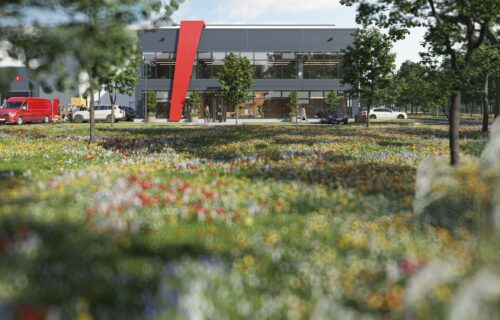
Among the highest-rated developments were two phases of 7R Park Gdańsk IV and the company’s build-to-suit project at Przylesie. The second Gdańsk phase comprises more than 40,000 sqm and uses a combination of heat pumps, photovoltaic generation, heat-recovery ventilation, enhanced insulation and digital controls for lighting and building systems.
For occupiers, such measures are increasingly relevant because the environmental specification of a warehouse can influence its operating expenses. Energy efficiency, on-site generation and better control of building systems can reduce exposure to energy costs, while owners are also facing growing expectations from lenders and investors concerning the future performance of their assets.
7R is developing this approach through its Green Saver concept. Buildings developed under the specification are intended to use substantially less primary energy and produce lower operational emissions than properties built only to minimum Polish technical requirements. The company is targeting reductions of at least 50% and is working towards specifications that could eventually allow new developments to operate without building-related carbon emissions.
Resource consumption is also being addressed during construction. Water use across the company’s building sites fell 44.3% year on year in 2025 to 2,264 cubic metres. Biodiversity plans were prepared for each of the six new projects included in the reporting period, while none was developed within a Natura 2000 protected area. No hazardous construction waste was reported during the year.
The report extends beyond buildings to employment and corporate management. Permanent employment agreements covered 91% of the workforce at the end of 2025, while women represented 69.2% of employees and 50% of senior management. Participation in the company’s staff satisfaction survey reached 91%, with its employee recommendation indicator standing at +31.
Looking towards 2026, 7R plans to introduce a common environmental policy across the group covering carbon reduction, water, biodiversity and the reuse of materials and resources. Environmental, health and safety requirements for contractors are also planned as part of the next stage of the programme.
The company says 98.55% of its turnover falls within activities covered by the EU Taxonomy. This represents eligibility rather than confirmation that the same share of revenue already satisfies all of the conditions required to qualify as environmentally sustainable under the European classification system.
The direction is significant for a logistics market in which sustainability is increasingly connected to asset competitiveness. Developers are being pushed to consider not only construction costs and rents but also future energy consumption, financing conditions, regulatory requirements and the ability of properties to remain attractive to institutional capital.
7R has delivered more than 2 million sqm of logistics and industrial space and operates in Poland, Czechia and Germany. Its pipeline currently stands at approximately 3.9 million sqm, including around 1.3 million sqm of projects described as ready to enter construction.
As this pipeline progresses, the company’s 2025 results illustrate a wider shift in logistics development: environmental measures are moving from an additional building feature towards becoming part of the financial and operational specification of the asset itself.