Moldova Heads to the Polls in a High-Stakes Parliamentary Election

Moldovan voters will go to the polls on September 28 in a parliamentary election that could reshape the country’s direction between closer integration with the European Union and renewed alignment with Russia. The outcome is expected to hinge on a handful of smaller parties whose performance could tip the balance of power.

The pro-European Party of Action and Solidarity, closely tied to President Maia Sandu, is seeking another mandate after a term focused on judicial reform, fighting corruption, and opening negotiations with Brussels. Its leaders argue that EU membership is the only path to long-term stability, investment, and security. The party promises to stay the course on energy diversification and infrastructure modernization while keeping fiscal policy under control.

Challenging them is a left-leaning Patriotic Bloc built around the Socialists and allied groups, which argues that Moldova’s future lies in strengthening ties with Russia. It presents cheaper energy deals, social spending, and price controls as immediate answers to rising living costs. The bloc portrays itself as a defender of neutrality and warns against what it calls the risks of moving too quickly toward Brussels.

A newer player, the “Alternative” alliance, has gained attention by positioning itself between the two poles. Backed by Chișinău mayor Ion Ceban and several former senior officials, the group says Moldova should continue working toward EU membership but at a more pragmatic pace. It emphasizes social spending, wage growth, and job creation while pledging to improve governance at the local level.

Another factor is Renato Usatîi’s “Our Party,” a populist force that focuses less on geopolitics and more on municipal improvements and tackling corruption. While smaller, its support could prove decisive in post-election negotiations.

Notably absent from the ballot are parties linked to Ilan Șor, the fugitive businessman whose organizations were banned for alleged attempts to destabilize the country. Many of his supporters remain active, however, and their votes will be redistributed among the remaining options.

The stakes are high because Moldova’s 101-seat parliament is elected entirely through a nationwide vote, with a five percent threshold for parties and seven percent for blocs. This makes the performance of smaller parties critical: if they cross the line, they can determine who governs; if they fall short, the leading party gains a large seat bonus.

Recent surveys suggest the pro-EU and pro-Russian blocs are running close, making coalition building inevitable. A government led by the ruling party could push ahead with EU reforms, likely with support from Alternative or Our Party. A left-wing coalition, by contrast, would prioritize cheaper energy from Moscow and a slower approach to Brussels, though it would also need the backing of smaller centrist or populist groups.

Voter concerns are dominated by high living costs, jobs, and corruption, alongside the shadow of Russia’s war in neighboring Ukraine. Diaspora participation, traditionally a boost for pro-European forces, may once again play a crucial role.

For Moldova, the election will not only decide who holds power in parliament but also how the country navigates its most important choice since independence: whether to anchor itself more firmly within Europe or to re-engage with Russia.

Shrinkflation Debate Intensifies Across Central and Eastern Europe

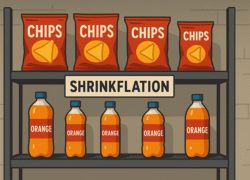
The practice of selling goods in smaller sizes while keeping prices and packaging unchanged is under growing scrutiny across Central and Eastern Europe. Regulators and lawmakers are confronting the question of how much transparency should be required from producers and retailers, while consumers increasingly focus on value for money.

In Poland, there is broad awareness of the issue, but no dedicated rule obliging companies to disclose downsizing. The competition authority has studied consumer reactions and found that many shoppers do not notice when packages shrink. Enforcement remains limited to general provisions against misleading practices, and as long as quantities and unit prices are displayed, traders are usually considered compliant.

The Czech Republic takes a similar approach, though courts have begun to play a stronger role. Earlier this year, a Prague court confirmed a fine imposed on a dishwasher tablet manufacturer whose identical outer boxes contained different amounts. The case underlined that even if labelling is technically accurate, packaging that creates a deceptive overall impression can be judged unlawful. Consumer groups continue to push for clearer rules, but no special legislation has been passed.

Slovakia updated its consumer protection framework in July 2024 with a new law that broadens the obligations of traders and strengthens rules against misleading practices. The act requires unit prices to be shown and expands information duties, which could make it easier to challenge undisclosed downsizing. So far, however, there have been no published cases directly targeting shrinkflation, leaving the scope of the law untested.

Other countries in the region have gone further. Hungary introduced rules at the start of 2024 requiring retailers to alert customers when the quantity of a pre-packed item is reduced without a corresponding drop in price. Romania followed later in the year with similar obligations, mandating full and accurate disclosure whenever the size or weight of a product is reduced. These measures place clear responsibility on businesses to inform consumers at the point of sale.

France adopted a comparable system in mid-2024, requiring supermarkets to post notices for two months when products are downsized. Italy also introduced a labelling obligation, but in March 2025 the European Commission opened proceedings against Rome, arguing that obliging companies to place individual notices on every item might go beyond what is proportionate under EU law. The challenge highlights a growing tension between national consumer-protection efforts and EU single-market rules.

Across Central and Eastern Europe, the picture is therefore uneven. Downsizing itself is not prohibited, but expectations around transparency are rising. Where no dedicated rules exist, inspectors and courts decide whether practices mislead the average consumer. Where new obligations have been introduced, businesses must adapt their processes to flag changes more visibly. For producers and retailers, the safest course is to make reductions in content clear, as both regulators and consumers are showing less tolerance for packaging that conceals less product for the same price.

Confidence in Czech Economy Edges Higher in September

Overall confidence in the Czech economy rose slightly in September, according to the Czech Statistical Office. The composite confidence indicator increased by 0.8 points month-on-month to 101.9, with both business and consumer sentiment contributing to the improvement. Compared to a year earlier, all major indicators were at higher levels.

Business confidence grew modestly, up 0.1 points to 101.6, while consumer confidence posted a stronger rise, climbing 4.5 points to 103.5.

In the industrial sector, confidence improved by 2.0 points to 95.5. Companies expressed more optimism about production activity in the coming three months, although assessments of current demand remained unchanged. Inventories were stable, and slightly more firms expected to raise prices.

The construction sector showed notable strength, with confidence rising 3.0 points to 125.4. Fewer firms reported weak demand, while more anticipated hiring staff and raising prices. Compared with last year, confidence in construction remained significantly higher.

Trade sector sentiment also advanced, up 1.2 points to 99.6. Entrepreneurs reported weaker improvements in their recent business situation but expressed slightly greater optimism for the months ahead. Warehouse inventories declined, while price expectations remained steady.

By contrast, selected service sectors—including finance—saw a drop in confidence. The indicator fell 2.3 points to 105.6, as fewer entrepreneurs rated their current situation and demand positively. Expectations for demand also weakened slightly.

On the consumer side, optimism improved markedly. The confidence indicator rose to 103.5 as fewer households expected the national economy or their own financial situation to worsen over the next year. More households reported better conditions than a year ago, though plans for major purchases remained unchanged. Fears of unemployment and rising prices also eased slightly.

The survey highlights a mixed picture: while households and most business sectors showed growing optimism, services registered a decline. Still, overall sentiment remained stronger than in September 2024.

SQUARE PARKS Targets Urban Business Parks in DACH Region with €300m Pipeline

Hamburg-based SQUARE PARKS, a newly established sister company of the long-standing Adolf Weber Group, has announced plans to develop a network of light industrial estates and business parks across German-speaking Europe. The firm, launched as an autonomous platform, is positioning itself to serve small and medium enterprises, skilled trades, start-ups, and light industrial tenants through joint-venture structures with institutional investors and family offices.

The Adolf Weber Group, which has operated in Germany for over a century, currently manages a portfolio exceeding 250,000 square metres of light industrial space. Building on this base, SQUARE PARKS has outlined a property development pipeline valued at approximately €300 million, with additional land acquisitions under negotiation. The medium-term plan foresees up to 20 new business and light industrial parks within five years across Germany, Austria, and Switzerland.

Projects under the SQUARE PARKS brand are designed with flexibility in mind, offering units between 500 and 2,000 square metres of warehouse space, typically including an office component. The company has also signalled that it will oversee asset management, leasing, and property services following project completion.

The market fundamentals appear supportive. Research from Colliers shows that demand for smaller industrial and warehouse units in Germany has grown steadily, even in a challenging economic climate. In the first half of 2025, spaces under 3,000 square metres accounted for around 61% of all lease activity in Germany’s top eight markets. Analysts note that these urban business parks appeal to tenants due to their adaptability, diversified usage potential, and compliance with ESG standards.

For investors, the segment has been gaining traction as a resilient alternative real estate class. With stable cash flows and opportunities for early participation in development projects, business parks are increasingly viewed as a portfolio diversifier.

SQUARE PARKS’ launch reflects a broader trend in Germany’s logistics and light industrial property market, where urban regeneration and modular, ESG-compliant developments are attracting both occupiers and capital despite wider market uncertainty.

Romania’s Road Freight Outpaces EU Growth, Industrial Space Nears 8 Million sqm

Romania has recorded the fastest growth in road freight transport across the European Union over the past decade, according to Eurostat data cited by Colliers. In 2023, transport and logistics companies carried almost 29 billion tonne-kilometres by road, an increase of 69 percent compared with 2013. By contrast, EU-wide road freight volumes grew by around 20 percent over the same period.

Despite this rapid expansion, Romania’s freight activity remains moderate compared with regional peers. The country’s volumes are broadly in line with Hungary’s, but remain well below Poland’s, which exceeds 170 billion tonne-kilometres annually. Analysts note that the gap reflects not only infrastructure constraints but also differences in export intensity.

The growth of road transport has gone hand in hand with the expansion of Romania’s modern logistics market. The country’s industrial and logistics stock has grown nearly fivefold since 2013. By the end of 2024, leasable space stood at approximately 7.4 million square metres, with current pipelines expected to lift the figure to about 8 million square metres in 2025.

Even with strong supply growth, leasing activity has remained resilient. Take-up in 2024 reached around 620,000 square metres, which was 20 percent lower than the previous year but still well above pre-pandemic averages.

Infrastructure remains the key challenge. Romania has delivered record motorway openings in recent years, but the pace of new projects is set to slow in 2025 and 2026. Colliers warns that this could temper logistics expansion, given the continued shortage of modern motorways and rail links.

While Romania’s logistics market has entered an accelerated development cycle, analysts stress that sustained investment in infrastructure will be critical for narrowing the gap with larger regional economies and supporting the next wave of growth.

Romania’s Biggest New Schemes Are Rising on Old Factory Land, but the Pipeline Is Uneven

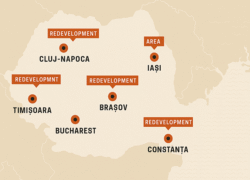
A fresh review from Cushman & Wakefield Echinox confirms what has become a defining theme of Romania’s real estate cycle: the largest ongoing developments are increasingly anchored to former industrial platforms—first and foremost in Bucharest, but with notable momentum in regional hubs as well. The consultancy places the capital at the center of this wave thanks to the sheer depth of its market and the number of legacy sites suitable for conversion, with most major in-city land deals still clustering around ex-industrial plots and typically targeting mixed-use outcomes.

Specific platforms frequently cited by market trackers over the past few years include Rocar, Roca Preciziei, Helitube in Colentina, Muntenia near Parcul Carol, Antrefrig, Titan Mar on Șoseaua Progresului and Atlas in Pipera. These sites have been assembled for large-scale pipelines rather than piecemeal infill, underscoring the appeal of multi-hectare footprints with urban infrastructure already in place.

The investor roster behind this regeneration push spans domestic and international capital. Prime Kapital features prominently in regional cities—most visibly in Iași, where Mall Moldova opened in April 2025 as the largest shopping center outside Bucharest and forms part of a broader plan that includes the Silk District on a historic factory site. The scheme is presented by the developer as an urban regeneration anchored to former industrial land; independent trade press has echoed both the opening and the “largest outside Bucharest” framing.

Cluj-Napoca offers a snapshot of the next wave. The Rivus project is reworking roughly 14–17 hectares of the former Carbochim platform into a mixed-use district with retail, culture, offices and parkland, backed by a financing package billed as the largest loan to a Romanian real-estate development this year. A separate seven-hectare acquisition of the Tehnofrig site by Hexagon adds another conversion to the city’s pipeline. Together, these moves validate the view that ex-industrial land is driving today’s flagship schemes.

Elsewhere, the Tractorul platform in Brașov remains the emblem of scale—roughly 100 hectares progressively transformed over the past decade—while Constanța has become the new headline. Iulius has launched what it bills as Europe’s largest private bioremediation to clean up 38 hectares of the former Oil Terminal site ahead of an €800m-plus urban project designed by Foster + Partners. Reports confirm the scope, the remediation spend and the site history.

Underlying occupier demand helps explain the push. Industrial and logistics leasing surged by more than 30% year-on-year in early 2025 to nearly 260,000 sqm, with net take-up accounting for 70%—a sign of genuine growth rather than churn. The national stock is on track to reach eight million sqm if current development pace holds. Those dynamics help explain why well-located former platforms are being re-priced as mixed-use districts rather than replaced like-for-like with warehouses.

Not every claim travels equally far. Reports frequently state that many Timișoara platforms have already been repurposed and that Spumotim and 1 Iunie could yield new landmarks next. These are flagged as active or expected sites, but “most” being fully transformed is difficult to verify. Likewise, the observation that Craiova and Arad are drawing increased attention is presented more as an outlook statement from brokerage commentary than as evidence of closed transactions.

Two caveats belong alongside the opportunity set. First, conversion costs can be significant: remediation, utility upgrades and permitting add time and capital expenditure, as Constanța’s Oil Terminal clean-up illustrates. Second, while central or peri-urban locations and large land banks are advantages, local planning rules and community engagement can shape both product mix and phasing.

Bottom line: evidence from brokers, developer disclosures and independent reporting all point in the same direction—Romania’s most ambitious new quarters are rising where factories once stood. Bucharest still leads on volume, but Iași, Cluj-Napoca, Brașov and Constanța now anchor a broader map of regeneration. The opportunity is real; the execution depends on planning, remediation and capital discipline.

Romania’s Biggest New Schemes Are Rising on Old Factory Land, but the Pipeline Is Uneven

A fresh review from Cushman & Wakefield Echinox confirms what has become a defining theme of Romania’s real estate cycle: the largest ongoing developments are increasingly anchored to former industrial platforms—first and foremost in Bucharest, but with notable momentum in regional hubs as well. The consultancy places the capital at the center of this wave thanks to the sheer depth of its market and the number of legacy sites suitable for conversion, with most major in-city land deals still clustering around ex-industrial plots and typically targeting mixed-use outcomes.

Specific platforms frequently cited by market trackers over the past few years include Rocar, Roca Preciziei, Helitube in Colentina, Muntenia near Parcul Carol, Antrefrig, Titan Mar on Șoseaua Progresului and Atlas in Pipera. These sites have been assembled for large-scale pipelines rather than piecemeal infill, underscoring the appeal of multi-hectare footprints with urban infrastructure already in place.

The investor roster behind this regeneration push spans domestic and international capital. Prime Kapital features prominently in regional cities—most visibly in Iași, where Mall Moldova opened in April 2025 as the largest shopping center outside Bucharest and forms part of a broader plan that includes the Silk District on a historic factory site. The scheme is presented by the developer as an urban regeneration anchored to former industrial land; independent trade press has echoed both the opening and the “largest outside Bucharest” framing.

Cluj-Napoca offers a snapshot of the next wave. The Rivus project is reworking roughly 14–17 hectares of the former Carbochim platform into a mixed-use district with retail, culture, offices and parkland, backed by a financing package billed as the largest loan to a Romanian real-estate development this year. A separate seven-hectare acquisition of the Tehnofrig site by Hexagon adds another conversion to the city’s pipeline. Together, these moves validate the view that ex-industrial land is driving today’s flagship schemes.

Elsewhere, the Tractorul platform in Brașov remains the emblem of scale—roughly 100 hectares progressively transformed over the past decade—while Constanța has become the new headline. Iulius has launched what it bills as Europe’s largest private bioremediation to clean up 38 hectares of the former Oil Terminal site ahead of an €800m-plus urban project designed by Foster + Partners. Reports confirm the scope, the remediation spend and the site history.

Underlying occupier demand helps explain the push. Industrial and logistics leasing surged by more than 30% year-on-year in early 2025 to nearly 260,000 sqm, with net take-up accounting for 70%—a sign of genuine growth rather than churn. The national stock is on track to reach eight million sqm if current development pace holds. Those dynamics help explain why well-located former platforms are being re-priced as mixed-use districts rather than replaced like-for-like with warehouses.

Not every claim travels equally far. Reports frequently state that many Timișoara platforms have already been repurposed and that Spumotim and 1 Iunie could yield new landmarks next. These are flagged as active or expected sites, but “most” being fully transformed is difficult to verify. Likewise, the observation that Craiova and Arad are drawing increased attention is presented more as an outlook statement from brokerage commentary than as evidence of closed transactions.

Two caveats belong alongside the opportunity set. First, conversion costs can be significant: remediation, utility upgrades and permitting add time and capital expenditure, as Constanța’s Oil Terminal clean-up illustrates. Second, while central or peri-urban locations and large land banks are advantages, local planning rules and community engagement can shape both product mix and phasing.

Bottom line: evidence from brokers, developer disclosures and independent reporting all point in the same direction—Romania’s most ambitious new quarters are rising where factories once stood. Bucharest still leads on volume, but Iași, Cluj-Napoca, Brașov and Constanța now anchor a broader map of regeneration. The opportunity is real; the execution depends on planning, remediation and capital discipline.

World Leaders Converged in New York as UN General Assembly Opened Its 80th Session

The United Nations General Assembly marked its 80th year this week with a full agenda and the familiar ritual of world leaders outlining their priorities on the global stage.

The annual General Debate began on 23 September in New York, following opening addresses by UN Secretary-General António Guterres and Assembly President Annalena Baerbock. As tradition dictated, Brazil was the first country to speak, with President Luiz Inácio Lula da Silva calling for greater international cooperation. He was followed by U.S. President Donald Trump, who set out Washington’s stance on global challenges.

The first day also included speeches from leaders of Indonesia, Turkey, Peru, Jordan, and South Korea. Each highlighted domestic achievements while also staking out positions on issues ranging from climate action to regional security.

Over the course of the week, more than 190 countries delivered statements. The European Union took its turn later in the programme, while Ukrainian President Volodymyr Zelenskyy drew attention to Russia’s war. Observers noted that Syria and other conflict-affected states also used the forum to press their cases.

The debate was accompanied by a series of special commemorations. Delegates marked the UN’s 80th anniversary, reviewed progress on the Sustainable Development Goals, reflected on the 30th anniversary of the Beijing women’s conference, and debated the future of the Middle East peace process.

The session unfolded against a backdrop of mounting global uncertainty. Trade frictions, armed conflicts, and climate-related risks dominated the corridors as much as the speeches. While the General Debate once again served as a stage for set-piece diplomacy, it also offered a window into shifting alliances and emerging priorities.

What resonated most across the week were recurring themes: the urgency of addressing climate change, the search for peace in ongoing conflicts, and the struggle to safeguard global economic stability. Many leaders voiced frustration at slow progress on reforming multilateral institutions, while others called for stronger partnerships with the Global South. Together, these strands underscored the reality that the 80th session of the General Assembly was not simply a ceremonial milestone but a reflection of a world grappling with profound and unresolved challenges.

CIJ Europe Launches Montenegro Edition of CIJ Awards

CIJ Europe has announced the inaugural CIJ Awards Montenegro, broadening its legacy in the Central and Southeastern European property awards landscape. This new national edition is designed to recognise outstanding projects, firms and leaders in Montenegro’s commercial real estate sector, while connecting them to a wider regional platform. The winners will gain access to the Best of the Best Hall of Fame Awards 2026, where they will compete against leading entries from multiple SEE and CEE countries.

Nominations are open from July through November 2025, free of charge, and eligible projects must have been executed between January and December 2025. Participants may submit up to five nominations, including detailed supporting materials of their achievements. The award categories span development types (residential, office, retail, warehouse/industrial, green development), transactions and management (commercial investment deals, local and international real estate agencies), leadership and overall developer excellence.

The selection process comprises two stages: first, a Digital Jury Voting Committee evaluates the entries, followed by deliberations among an in-person Jury Committee of up to 32 seasoned real estate professionals. To uphold integrity, any jury member whose company or project is nominated in a given category will abstain from voting in that category. All ballots are processed by an external audit firm to ensure transparency and fairness.

The winners will be revealed at a gala event in May 2026 at the Radisson Blu in Bucharest. The evening will feature red-carpet networking, a formal dinner, the awards presentation, and post-ceremony entertainment. Awardees will receive a trophy, diploma and usage rights to CIJ Awards branding, and their achievements will be promoted through CIJ Europe’s online platform and print magazine.

Robert Fletcher, CEO & Editor-in-Chief of CIJ Europe, said: “Montenegro represents an emerging yet dynamic market in the SEE real estate space. With the launch of the CIJ Awards Montenegro, we aim to shine a spotlight on the very best in design, investment and innovation locally, while providing a pathway for these winners to be recognised regionally. Our goal is to foster higher visibility, encourage best practices, and give Montenegrin developers, agencies and visionaries a platform they truly deserve.”

The launch of CIJ Awards Montenegro demonstrates CIJ Europe’s dedication to nurturing real estate markets across Southeast Europe. For Montenegro’s industry players, the awards offer more than recognition—they provide an opportunity for networking, benchmarking, increased credibility, and entry into the regional stage of property excellence.

Jaguar Land Rover Extends Nitra Plant Shutdown Amid Cyber Incident

Production at Jaguar Land Rover’s factory in Nitra remains halted as the company continues to grapple with the fallout from a major cyberattack earlier this month. The shutdown, which began in early September, has now been extended into October, leaving roughly 5,000 employees facing weeks of uncertainty.

The disruption stems from a global IT systems failure linked to the cyber incident that affected the automaker’s operations worldwide. JLR has said its priority is restoring systems safely, working alongside cybersecurity experts, the UK’s National Cyber Security Centre, and law enforcement agencies. The company indicated it is preparing a phased restart of production but has not provided a firm date.

For workers, the stoppage means either using annual leave or receiving partial wage compensation. Under agreements with unions, those placed on employer-side downtime are entitled to 75 percent of their average pay through October. Union leaders, however, stress that families are worried about longer-term security, especially in cases where both partners are employed at the plant.

The possibility of applying Slovakia’s short-time work scheme, known as Kurzarbeit, has been raised by government officials. If approved, it would allow employees to receive 80 percent of their wages during downtime, with the state covering part of the cost. However, unions warn the process is complicated, pointing to past experiences during the pandemic when not all applications for compensation were recognised, leaving workers exposed to financial risks.

The Nitra facility, which opened in 2018, produces models including the Land Rover Defender and is regarded as one of the most significant foreign investments in Slovakia’s automotive sector. Analysts estimate the cyberattack is costing JLR tens of millions of euros in lost output each day, with ripple effects on the company’s network of suppliers across the region.

The extended shutdown comes as Slovakia’s car industry — a key pillar of its economy — faces broader challenges tied to technological transformation and competitiveness. Government officials have pledged to support the sector’s transition while unions insist workers should not bear the brunt of crises beyond their control.

LATEST NEWS