Swiss Life Asset Managers expands logistics portfolio with 77,000 sqm new development near Hanover

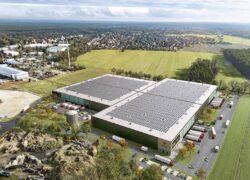
Swiss Life Asset Managers is broadening its development portfolio with the acquisition of a 77,000-square-metre site near Hanover, the capital of Lower Saxony. The company plans to develop a cutting-edge logistics property on the site, offering over 44,000 square metres of rental space.

The newly acquired site is located in Wietze, northwest of Hanover, at Steinacher Strasse. The project, named Hanover North I, will be built on 77,500 square metres and is set to begin development in 2025. The property will feature a state-of-the-art logistics facility designed to meet modern industry standards.

“The Hanover region is a vital logistics hub for Germany and Europe, making it an ideal location for this project,” said Ingo Steves, Managing Partner Logistics at Swiss Life Asset Managers. “With Hanover North I, we strengthen our Europe-wide logistics pipeline, ‘Roots,’ by adding a high-quality and sustainable property. This aligns with our strategy of delivering long-term value in central European regions.”

Situated in Celle district, the site benefits from its strategic location within the northern German logistics triangle formed by Hanover, Bremen, and Hamburg. The area offers excellent connectivity to the A7 motorway and access to key multimodal infrastructure, including the Hanover-Lehrte freight transport centre, Hanover-Langenhagen cargo airport, and the Hanover container terminal.

The development will offer a total rental area of 44,182 square metres, divided into four units that can accommodate single or multiple tenants. This includes 37,882 square metres of warehouse space, 1,800 square metres of office and social facilities, and 4,500 square metres of mezzanine space. The site will feature four ground-level driveways for easy access.

Alexander Schmid, Head of Development Logistics at Swiss Life Asset Managers, highlighted the project’s adaptability: “With its high sustainability standards and flexible usability, this property is designed to cater to a variety of customer needs, reflecting our customer-centric approach.”

Sustainability is a key focus of the project, with plans to install heat pumps and a photovoltaic roof system for renewable energy generation. The property will aim for a BREEAM “Very Good” certification, further underscoring its commitment to environmental standards.

By integrating modern logistics solutions with sustainable design, Swiss Life Asset Managers continues to strengthen its footprint in Europe’s logistics sector while meeting evolving market demands. Development of Hanover North I is expected to play a pivotal role in advancing the company’s long-term growth strategy.

Photo: ”Hanover North I” – © Swiss Life Asset Managers
Slovak construction sector rebounds in November 2024 after six months of decline

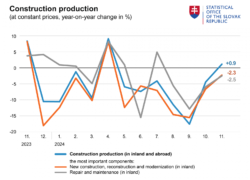
After a prolonged period of contraction, the construction sector in November 2024 achieved comparable year-on-year results, marking a significant turnaround. The improvement was largely driven by increased output from international projects and robust growth in smaller components of domestic production.

Construction output for November reached €827.5 million, reflecting a year-on-year increase of 0.9%. This marked the first positive year-on-year result after six consecutive months of decline. Month-on-month, the sector also showed notable improvement, with construction production rising by 5.4%.

Despite the overall improvement, key components of domestic construction production remained in negative territory. New construction declined by 2.3%, while repairs and maintenance dropped by 2.5%. However, these declines were the smallest recorded since the beginning of 2024. The only domestic segment to show significant growth was “other construction works,” which increased by nearly one-third, though its contribution to overall domestic production remains relatively minor. Domestic construction production continues to account for nearly 90% of the industry’s total performance.

By construction type, building construction showed a positive trend, rising by 7.6% year-on-year. In contrast, engineering construction, including infrastructure projects such as highways, saw a further slowdown, with output decreasing by 11% compared to November 2023.

A major contributor to the sector’s recovery was the strong performance of construction companies operating abroad. International construction output increased by 18.7% year-on-year, raising its share in the total sector output to over 10%.

For the first 11 months of 2024, the total value of construction production reached €6.7 billion, representing a year-on-year decline of 5.9%. All components of domestic production experienced slowdowns, with new construction falling by 7.7% and repairs and maintenance declining by 3.5%. By focus area, building construction decreased by 3.2%, while engineering construction dropped more sharply, by 12.8%. In contrast, international construction output remained stable compared to the same period in 2023.

The November recovery offers a glimmer of optimism for the construction sector, though challenges remain in key domestic segments. The strong growth in international projects underscores the importance of diversification in driving overall industry performance.

Source: Statistical Office of the SR

Polish government to advance project for faster Swiss Franc loan case hearings in courts by Q2 2025

The Polish government aims to adopt a draft law in the second quarter of 2025 to expedite the resolution of court cases involving loans denominated or indexed to the Swiss franc. The initiative, outlined in the legislative and programmatic agenda of the Council of Ministers, seeks to address the backlog of such cases and improve judicial efficiency.

The proposed legislation, titled the Draft Law on Special Arrangements for the Examination of Matters Related to Contracts Concluded with Consumers of Credit Agreements Denominated or Indexed to the Swiss Franc, includes measures designed to:
• Alleviate congestion in courts caused by the influx of Swiss franc loan cases.
• Safeguard citizens’ constitutional right to a timely hearing of their cases.
• Introduce procedural mechanisms to streamline court operations in such cases.
• Reduce the volume of court disputes by encouraging out-of-court resolutions.

Key mechanisms in the proposal include procedural simplifications and dispute resolution tools. For instance, judicial processes will be accelerated by measures such as suspending consumers’ obligations to fulfill loan agreements upon filing claims against banks, allowing written testimony in franc cases, and enabling applications for counterclaim settlements.

The draft also aims to limit the number of cases reaching courts by offering fiscal benefits to parties who withdraw legal remedies and introducing incentives for mediation and court settlements. At the same time, the law emphasizes protecting consumers’ rights and strengthening their position in disputes with financial institutions.

Additionally, the proposal promotes out-of-court dispute resolution to further reduce the strain on the judicial system.

The Ministry of Justice is responsible for preparing the draft, with the Council of Ministers expected to adopt it in Q2 2025. This initiative underscores the government’s commitment to addressing the challenges posed by Swiss franc loan cases, ensuring both efficiency in court proceedings and fairness for consumers.

Source: ISBnews

Czechia: 13,000 participants joined electricity sharing in its first year of operation

Over 13,000 participants joined the electricity-sharing program in the Czech Republic last year, collectively sharing more than 1,000 megawatt-hours (MWh) of electricity from September to December 2024, according to the Electricity Data Centre (EDC). The center, which marks its first year of operation, began accepting registrations in August, with full-scale electricity sharing starting in September.

Electricity sharing was introduced through last year’s amendment to the Energy Act, enabling participants to share electricity within communities or across different points of consumption. For instance, energy generated at a cottage can now be shared with an apartment. The Czech Republic currently has over 3.7 million electricity consumption points.

“The EDC was built from the ground up,” said Petr Kusý, Chairman of the EDC Board. “In the first half of the year, we assembled a team, launched a public website, established a call center, and developed an IT system capable of processing large volumes of data in minutes.” The centralized system eliminates the need for individual network operators to create their own sharing mechanisms, significantly reducing costs.

By the end of 2024, the EDC had received 14,246 applications for electricity sharing, with 13,009 finalized contracts. The system registered 6,742 production points and 9,810 consumption points. Most participants share electricity across their own properties, with 5,492 such arrangements recorded. Additionally, 297 apartment buildings have joined the program. Kusý noted growing interest among public administration entities, companies, and larger groups, which have started forming the first “energy communities.”

Approximately 20 energy communities have registered with the Energy Regulatory Office (ERÚ). These communities enable groups of active customers and electricity producers to collaborate on energy sharing. ERÚ Chairman Jan Šefránek highlighted the resources available to support new communities:
“To ease the transition for new energy communities, we’ve provided essential information and tips on our website. We will expand these resources further this year and continue hosting professional workshops to guide participants.”

Currently, the EDC operates in a temporary mode, supporting electricity sharing among active customers, producers, and communities. Full-scale operations, including services for electricity storage and aggregation, are expected to launch by mid-2026. This milestone will further enhance the efficiency and flexibility of the Czech Republic’s energy-sharing model, offering broader opportunities for sustainable energy management.

Source: EDC and CTK

Renting remains more affordable than buying an apartment in the Czech Republic

Renting a home continues to be more affordable for Czechs than purchasing an apartment with a mortgage, particularly in major cities like Prague and Brno, according to data from real estate platforms and findings by the Czech News Agency. While homeownership remains a strong aspiration for many Czechs, rising property prices and high mortgage costs are making it increasingly unattainable.

A recent analysis by real estate platform UlovDomov.cz highlights the stark financial disparity between renting and buying. For a standard 2+kk apartment (60 square meters) in good condition, the average monthly mortgage payment exceeds rental costs by CZK 12,000 in Brno and CZK 16,000 in Prague, including utilities. In Ostrava, however, the difference is much smaller, with mortgage repayments only CZK 600 higher than rental expenses.

Despite this, rental affordability varies across cities. In Prague and Brno, renting such an apartment typically costs less than 60% of the average net monthly wage, while in Ostrava and Ústí nad Labem—where property prices are among the lowest in the country—the proportion is even smaller. However, prices in these cities are rising more quickly than in other regions.

The gap between mortgage repayments and rental costs is also evident in premium rental properties. According to BTR Consulting, which specializes in the build-to-rent segment, rents for partially or fully equipped apartments with additional services are typically a third cheaper than comparable mortgage payments. For instance, a premium rental property might cost CZK 27,000 per month, compared to a mortgage payment of CZK 40,000 for a similar home.

At the start of January, the average mortgage rate decreased slightly by 0.09 percentage points, according to Swiss Life Hypoindex. For a CZK 3.5 million mortgage loan covering up to 80% of a property’s value (LTV) with a 25-year term, the average monthly payment is CZK 20,730. In comparison, the average monthly rent for a 65-square-meter apartment at the end of 2024 was CZK 22,387, according to Bezrealitky’s analysis.

A report by the Ministry of Regional Development (MoRD) published last November underscores the growing challenges of housing affordability in the Czech Republic. Property prices have surged by 112% since 2015, while average incomes have only increased by 65%. High mortgage rates further exacerbate the issue, making homeownership increasingly out of reach for many households.

At the same time, rental housing is also becoming less accessible due to rising demand. This demand is driven not only by the difficulty of purchasing a home but also by the impact of short-term rental platforms like Airbnb, which reduce the availability of long-term rental properties in major cities.

The combination of rising property prices, high mortgage rates, and increasing rents presents significant challenges for both buyers and renters in the Czech Republic. While renting remains the more affordable option for now, the growing demand for rental housing continues to drive prices upward, leaving many households struggling to find affordable housing solutions.

Source: ČTK

CNB withdraws Business Credit Union’s license and proposes liquidation

The Czech National Bank (CNB) has revoked the Business Cooperative Credit Union’s (PDZ) license to operate as a savings and credit cooperative due to persistent and serious operational deficiencies. The decision, which takes legal effect today, has prompted the CNB to petition the court for the dissolution of PDZ, the initiation of its liquidation, and the appointment of a liquidator, the bank announced in a press release.

Effective immediately, PDZ is prohibited from accepting deposits, issuing loans, or conducting any activities beyond those necessary to settle its obligations and claims. These restrictions have been in place since March 15, 2024, following a preliminary injunction by the CNB. The injunction limited PDZ’s ability to manage assets and liabilities, including restrictions on cash operations.

The CNB’s decision stems from a review conducted between August 2023 and April 2024, which uncovered significant and ongoing issues. PDZ failed to meet basic standards for managing credit and operational risks and demonstrated poor governance. Moreover, the credit union was found to have systematically violated laws related to preventing money laundering and the financing of terrorism.

PDZ is a small entity within the Czech financial sector. As of December 31, 2024, it had fewer than 50 members, client deposits amounting to less than CZK 1 million, and a total balance sheet of CZK 65 million. By comparison, the Czech credit union sector, comprising five entities, had 12,000 members, CZK 6.8 billion in client deposits, and a total balance sheet of CZK 9.3 billion as of September 30, 2024.

In December 2024, PDZ proposed appointing Petr Koritsch as Chairman of its Board of Directors, seeking CNB approval to retain its license. Koritsch, a former executive with UBS Bank’s Czech branch, was nominated to replace the late Chairman Robert Zelenka, who led PDZ since 2021 until his passing in June 2024. Despite these efforts, the CNB proceeded with the license withdrawal.

PDZ’s membership has declined sharply, from 139 members in December 2023 to just 44 by the end of 2024. The credit union’s small size, with assets under CZK 150 million, means its potential collapse poses no risk to the broader stability of the Czech financial market, according to the CNB.

From June 2015 to November 2020, Prime Minister Petr Fiala (ODS) held a deposit of CZK 950,000 in PDZ, which constituted a membership share. Fiala did not disclose this in his asset declaration, explaining that he had not realized his deposit automatically conferred membership in the cooperative.

The CNB’s decision to revoke PDZ’s license underscores its commitment to maintaining the integrity and stability of the Czech financial system. The credit union’s dissolution and liquidation proceedings now await judicial approval.

Source: CTK

Revitalization of Pardubice’s urban brownfield enters final hhase: New Tesla to be completed in 2025

The redevelopment of the former Tesla Pardubice site into a modern urban district is nearing completion. The transformation, which began in 2021, will provide housing for up to 750 residents, offering apartments for private and cooperative ownership, terraced houses, and amenities for the public. The final stage involves constructing three new buildings and is scheduled for completion by the end of 2025. Overseen by Linkcity and general contractor VCES, this project spans a 2.5-hectare site, representing a total investment exceeding CZK 1 billion.

“When we started building New Tesla three years ago, the site was inaccessible and filled with derelict buildings abandoned since the late 1990s. Today, the area has been transformed into a vibrant, open community,” said Kristýna Zavrtálková, CEO of Linkcity. “The final phase will fulfill our vision of a sustainable, multifunctional district that integrates environmentally friendly features like recycled materials, low-carbon concrete, and green energy systems.”

The New Tesla site, located in Pardubice’s fourth district, combines modern design with sustainability. The project includes two apartment buildings with 36 cooperative housing units and a three-story wooden apartment building with 11 private ownership units, among the first of their kind in the region. The site also incorporates green roofs, rainwater retention systems, and rooftop photovoltaics, generating renewable energy for residents.

Since 2021, the first two phases have delivered 196 apartments, 11 townhouses, and a Penny Market retail space with parking. The third phase completes the site’s transformation with the addition of new residential buildings and a public square. Architect Lukáš Pavlík of Med + Pavlík architekti emphasized how the design shapes the district’s urban character, noting that the new buildings along Zelená Street will create pedestrian-friendly public spaces and integrate seamlessly with the surrounding street network.

One of the standout features of the project is the use of innovative materials. Approximately 1,100 cubic meters of low-carbon concrete were used in earlier phases, reducing greenhouse gas emissions by 27% compared to standard concrete. The timber-framed apartment building in the final phase, designed by Prodesi/Domesi, further pushes sustainability boundaries, cutting the carbon footprint by up to 20%.

“The wooden apartment building is a testament to the emerging trend of sustainable wooden architecture. Built with solid CLT panels, it offers high strength, fire resistance, and a unique aesthetic that showcases the material’s natural qualities,” explained architect Pavel Horák, managing director of Prodesi/Domesi.

The Nová Tesla district has become a flagship project for Linkcity, showcasing its expertise in transforming industrial brownfields into thriving urban spaces. In partnership with the City of Pardubice, the company has revitalized the neglected site into a vibrant community hub, aligning urban development with residents’ needs while preserving the area’s historic character.

Upon completion, the project will feature over 200 homes, sustainable amenities, and public green spaces, redefining modern urban living in Pardubice.

P3 Logistic Parks achieves first BREEAM Outstanding certification in the Czech Republic

P3 Logistic Parks, a leading European developer and owner of industrial real estate, has been awarded BREEAM Outstanding certification for its Hall DC5 at P3 Prague D11. This marks the first time P3 has received the highest level of BREEAM certification in the Czech Republic, highlighting its dedication to sustainability and innovation in industrial real estate.

The certified hall, leased by QSL, a logistics specialist for chilled and frozen goods, incorporates several pioneering solutions. A key feature is its innovative heating system, which repurposes waste heat from refrigeration and freezing equipment to warm the dry warehouse and office spaces, eliminating the need for a gas connection. Additionally, the hall hosts a 340 kWp photovoltaic plant on its roof, which supplies electricity to surrounding facilities through a local distribution system (LDS). Rainwater retention tanks installed at the park are used for flushing toilets and maintaining green spaces, further contributing to sustainability.

“Achieving BREEAM Outstanding certification for Hall DC5 at P3 Prague D11 is a significant milestone for us,” said Ondřej Hráský, Head of Construction for P3 Czech Republic. “We extend our gratitude to Goldbeck Bau, the general contractor, for their precise execution, and to QSL, whose specific requirements helped make this project possible.”

Since 2022, P3 has been constructing new halls to meet BREEAM Excellent standards. However, DC5 at P3 Prague D11 stands out as the first P3 facility to achieve the coveted BREEAM Outstanding certification, setting a new benchmark for sustainable industrial development in the region.

Photo: Ondřej Hráský, Head of Construction for P3 Czech Republic

SCB: Social media influences purchases for 36% of Poles

Social media influences the purchasing decisions of 36% of Poles, while over half (52%) consider recommendations from friends and family their primary source of shopping inspiration, according to a survey conducted by the Institute of Market and Social Research (IBRiS) for Santander Consumer Bank (SCB). Among younger respondents aged 18-29, social media plays an even greater role, affecting the purchasing decisions of 59%.

The study revealed that personal connections remain the most trusted source of recommendations, with 52% of respondents indicating that advice from people they know personally holds the highest credibility. This is followed by independent reviewers and testers, trusted by 26% of respondents due to their expertise and impartiality. One in five respondents relies on feedback from strangers who use the same products or services but have no affiliation with the brand. Influencers rank fourth overall, with 17% of respondents valuing their recommendations, although their influence rises significantly to 35% among younger consumers aged 18-29. Celebrities and well-known personalities influence 14% of Poles, while 12% follow recommendations from brand ambassadors.

The impact of social media varies significantly across age groups. While it has a notable influence on younger consumers, shopping directly through social platforms is most popular among those aged 40-49, with 36% of respondents in this group reporting this behavior. The influence diminishes with age, with over half of respondents aged 50 and above indicating they do not rely on social media recommendations for purchases. Patryk Perliński, Director of Sales and Relationship Relations at Santander Consumer Bank, noted, “Our research shows a generational shift, where younger demographics are heavily influenced by social media, while older consumers remain more resistant to such trends.”

Women are more likely than men to make purchases based on social media recommendations, with 45% of women acknowledging this influence compared to 26% of men. The study also highlighted the types of products most frequently purchased under the influence of social media. Cosmetics and personal care products topped the list, followed by clothing and accessories. Books, films, and games ranked third, closely followed by electronics. Fewer respondents cited food products and sports equipment as purchases driven by online recommendations.

Perliński further commented, “Social media has evolved into a modern marketplace where friends and experts offer valuable advice. As the New Year shopping season coincides with resolutions requiring financial commitments, we expect this trend to grow even further.”

The survey was conducted via telephone interviews using a standardized, computer-aided questionnaire (CATI) between November 10 and 14, 2024. It included a representative sample of 1,000 adult Poles who shop online.

Source: SCB and ISBnews

Smartwings Slovakia carried 657,000 passengers in 2024, flights increased by 25%

Smartwings Slovakia reported carrying 657,000 passengers on regular and charter flights from Slovak airports in 2024, marking a 23% increase in passenger numbers year-on-year. The airline also noted a 25% rise in the number of flights operated from and to Slovakia.

Last year, Smartwings operated flights from three Slovak airports—Bratislava, Košice, and Poprad-Tatry—to a total of 43 destinations. Among these, the Turkish resort city of Antalya was the most popular destination for passengers.

During the current winter season, the airline is running regular flights from Bratislava to Dubai and charter flights to destinations including Bahrain, Qatar, Oman, and Zanzibar.

For the upcoming summer season, Smartwings plans to expand its offerings with flights to 34 destinations from Bratislava, 13 from Košice, and 2 from Poprad-Tatry.

Smartwings operates flights from several countries, including Slovakia, the Czech Republic, Poland, Hungary, Germany, and the Canary Islands. In total, the airline carried 6.5 million passengers in 2024, a 20.1% increase compared to the previous year, surpassing pre-pandemic passenger numbers from 2019.

The Smartwings Group conducted 53,338 flights in 2024, landing at 318 airports worldwide. This highlights the airline’s significant role in international air travel and its recovery from the pandemic.

Source: SME and Smartwings Slovakia

LATEST NEWS