Romania’s banking sector maintains low exposure to commercial real estate

The Romanian banking sector’s exposure to the commercial real estate (CRE) market, excluding residential properties, surpassed RON 100 billion as of September 2024. This represents approximately half of the sector’s total exposure to non-financial corporations, according to data from Cushman & Wakefield Echinox based on National Bank of Romania (BNR) reports.

The increase is largely attributed to the use of commercial properties as collateral for loans. Nearly 60% of these loans are secured by real estate assets, while the remainder consists of direct exposure to companies in the sector. In 2024, direct bank exposure to real estate businesses rose by 10%, compared to a 6% increase in indirect exposure.

Romania’s banking sector exposure to construction and real estate companies stands at 21%, one of the lowest in Europe and Central and Eastern Europe. In comparison, exposure levels in the Czech Republic (35%), Poland (24%), and Hungary (22%) are notably higher. Nordic countries such as Sweden (62%), Norway (49%), and Denmark (47%) have significantly greater exposure, while Southern European nations, including Greece (10%), Malta (14%), and Italy (15%), report lower levels.

Vlad Saftoiu, Head of Research at Cushman & Wakefield Echinox, noted that Romania’s relatively low banking exposure to construction and real estate suggests a balanced approach that supports both stability and investment potential. “This exposure level allows room for growth and development while maintaining financial prudence,” Saftoiu stated.

Although the quality of the CRE loan portfolio remains lower than that of overall loans to non-financial corporations, it has shown improvement in recent years. The non-performing loan (NPL) ratio for construction and real estate companies stood at 4.3% in September 2024, reflecting a slight decline from the previous year (4.4%) and a significant reduction from 2019 (8.8%). Similarly, the NPL ratio for loans secured by real estate collateral (excluding those granted to construction and real estate firms) fell from 6.1% in 2023 to 4.9% in 2024.

Most commercial real estate loans (86%) have a debt service coverage ratio above 2, indicating that borrowing companies can cover at least twice their annual debt service payments. Recent assessments suggest that vulnerabilities in Romania’s commercial real estate sector remain manageable, with signs of gradual improvement as the market recovers.

The construction and real estate sectors are key contributors to Romania’s economic stability due to their size and connections to the financial system. In the second quarter of 2024, these sectors accounted for 15.3% of Romania’s GDP, up from 13.8% in Q2 2022. This level is higher than the EU average of 14.9% and exceeds the contributions of peer economies such as Bulgaria (10.8%) and Poland (11.2%).

As of 2023, Romania had approximately 126,000 construction and real estate companies, making up 15% of all non-financial corporations. These businesses employed around 486,000 people, or 12% of the national workforce, and held 20% of total corporate assets.

While companies in the sector have higher debt levels compared to the broader non-financial sector, their overall indebtedness has been declining. The debt-to-equity ratio for construction and real estate firms was 181.7% in 2023, down from 210.6% in 2022, though still higher than the 158.2% average for all non-financial corporations.

Despite challenges, Romania’s commercial real estate market remains on a stable trajectory, with prudent banking exposure and improving loan quality indicating a measured approach to sectoral growth.

Growing demand for alternative financing in the European real estate market

A new study by the Empira Group highlights an increasing need for alternative real estate financing as the European market faces a significant refinancing gap. A large number of commercial real estate loans are set to mature in the coming years, creating challenges for borrowers and opportunities for non-bank lenders.

In 2025, approximately €130 billion in commercial real estate loans across Europe will reach maturity, with an even larger volume of €185 billion following in 2026. Office properties represent the largest share of refinancing needs, with loans worth around €50 billion due in 2025 and €65 billion in 2026. The residential and logistics sectors are also affected, with annual maturity volumes in the double-digit billions. Many of these loans were secured during a period of low interest rates and now require refinancing at significantly higher costs. Between 2014 and 2024, the average interest rate for loans with a 1–5 year fixed term rose from 1.90% to over 4.01%.

The study estimates that by the third quarter of 2024, the financing gap in Europe will reach €86 billion, accounting for 13% of all commercial real estate loans maturing between 2025 and 2027. As a result, alternative lenders are expected to play a greater role in bridging this gap.

The Rise of Private Debt in Real Estate Financing

The market for non-bank real estate financing has grown significantly. In Germany, the value of loans provided by non-bank financial intermediaries increased from $5.072 trillion in 2014 to $8.237 trillion in 2023, a 62% rise. Investment funds dominate the private debt sector, holding an 89.5% market share. Globally, capital raised for real estate financing by non-bank institutions also increased, reaching €210 billion in 2021, up from €70 billion in 2014.

Traditional banks face increasing challenges in expanding their loan volumes due to higher interest rates and stricter regulatory requirements under Basel III and IV. The required equity backing for commercial real estate loans is expected to increase by around 10% in the medium term, with variations depending on risk class and loan term. These factors have made alternative financing options more essential to maintaining investment activity.

Opportunities in the Mid-Market Segment

While large institutional investors focus on high-value transactions, mid-sized projects requiring financing between €30 million and €75 million are often overlooked. This segment presents opportunities for alternative lenders to provide tailored financing solutions that traditional banks may not offer.

Back Leverage and Capital Efficiency

Private debt investments offer a more stable return compared to traditional equity investments, typically ranging from six to twelve percent. They also involve lower market risks and shorter capital commitments. The use of back leverage—borrowing at the fund level—improves capital efficiency by allowing additional loans without an immediate increase in equity. This flexibility helps funds respond more effectively to market changes.

As the refinancing gap continues to grow, alternative lenders are positioned to play a key role in maintaining liquidity and stability in the real estate market.

Garbe Industrial and Hagedorn to revitalise brownfield site in Nuremberg

Garbe Industrial Real Estate GmbH and the Hagedorn Group have acquired a 17,300-square-meter brownfield site in Nuremberg’s Schafhof industrial estate. The project, located on Otto-Kraus-Straße, is a joint venture aimed at transforming the former metal processing site into a modern commercial property covering approximately 9,100 square meters. The total investment in the development is estimated at €16 million.

The Hagedorn Group, which specialises in brownfield redevelopment, will handle the demolition of existing structures and remediate any contaminated areas. Once the site is prepared, Garbe Industrial Real Estate will begin construction on the new facility. The completed property will include a 7,900-square-meter hall, 650 square meters of office space, and an additional 550 square meters on intermediate levels. The design will incorporate eight dock levellers, four ground-level sectional doors, and parking for around 70 vehicles. The project is scheduled for completion in the fourth quarter of 2026.

The location is intended to serve companies in production-related and logistics sectors, particularly those involved in last-mile delivery services. Its proximity to the A3 motorway provides easy access to Würzburg and Frankfurt to the northwest and Regensburg and Passau to the southeast. The Nürnberg-Ost junction, approximately three kilometers away, can be reached via the B2 main road without passing through residential areas. Public transport connections also link the site to Nuremberg’s city center.

The development will incorporate sustainability features in line with international ESG standards. The roof will be prepared for photovoltaic installations, heating will be powered by a heat pump system, and green roofing will be integrated into intermediate-level areas. Additional environmental measures include installing breeding and nesting boxes for birds and bats in the outdoor area. The joint venture aims to obtain Gold Standard certification from the German Sustainable Building Council, along with compliance with EU taxonomy requirements.

Legal advisory services for the property acquisition were provided by Görg, Zenk, and Norton Rose Fulbright.

Herzog office and commercial building completed in Cologne’s Schildergasse

The Herzog office and commercial building in Cologne’s Schildergasse has been completed. Union Investment acquired the property in 2022 through a forward funding agreement for its UniImmo: Deutschland real estate fund. Developed by Bauwens, the project delivers approximately 7,000 square meters of office and retail space on one of Cologne’s busiest shopping streets, with 5,500 square meters designated for offices and 1,500 square meters for retail.

Discussions are underway with potential tenants for the office space, which has been designed with flexibility and sustainability in mind. The retail space has already been leased on a long-term basis to shoe retailer Deichmann. Sven Lintl, Head of Asset Management Germany at Union Investment, noted that high-quality office spaces in prime locations remain important in attracting employees back to the office.

The building features a natural stone façade with bronze-colored framing and metallic accents. It also includes a roof terrace with views of Cologne Cathedral. The location offers easy access to public transportation, the Rhine, shopping facilities, and restaurants.

Is the housing loan subsidy programme necessary?

The government’s new support programme for homebuyers raises questions about its necessity and effectiveness. Would investing in municipal and social housing be a better approach, or is there an alternative solution for Poland’s housing market?

Mateusz Bromboszcz, Vice-President of the Management Board of Atal
One of the key reasons for the slowdown in the housing market is not the lack of this or that government programme, but above all the record high cost of financing a purchase compared to other EU countries. This is an obstacle for some customers, and the industry has been forced to operate in this unfavourable environment for a long time. The development of housing is also not favoured by supply-side phenomena, including the high cost of land and its deficit in large cities, as well as the long time it takes for the administration to process investments.

An additional factor negatively affecting the housing market is the bureaucracy and the multitude of administrative procedures related to housing construction. This has a direct impact on prices, because the longer and more complicated the process of obtaining the necessary approvals, the more expensive the apartments are.

Zuzanna Należyta, Commercial Director at Eco Classic
The state should not interfere in the free market in any way. As the introduction of the BK2% programme has shown, with increased demand and low supply, housing prices have risen. For a year now, we have been promised the introduction of a new programme, and as a result, developers have increased the number of investments launched, which, combined with the current level of interest rates, has caused the current stagnation.

The constant assurances about planned programmes are having a destructive effect on the market. A new programme will not help solve the problem of housing availability. What is needed is the creation of a long-term housing policy, and this also includes cooperative housing, social housing associations, REITs and council housing. These are solutions for people who cannot afford a loan and whose income is too high for council housing. A system of tax breaks is needed, for example, for the purchase of a first home or for contributions to a housing association. A holistic approach, rather than just throwing money at the problem, can bring good results.

Tomasz Kaleta, Managing Director of Sales and Marketing at Develia
Over the past year, there has been a lot of confusion and ambiguity surrounding the government’s housing support programme. Initially, it was supposed to support the purchase of a flat by subsidising the loan, but the project proposed by the Ministry of Development and Technology is different from the original assumptions. I am afraid that in its current form it may not improve the housing situation of Poles, which is far from Western European standards.

Expanding the stock of municipal and social housing is an important element of the state’s housing policy, but it is no substitute for measures to support people who want to buy their own home. It is crucial to develop solutions that will contribute to the long-term development of the housing market in Poland.

Anita Makowska, Senior Business Analyst at Archicom
The Key to Housing programme raises many questions, both about the mode of its introduction and about the real needs of the market. The long-term work on the programme’s shape and the lack of transparency in this process caused a significant stagnation in transactions, holding back the purchasing decisions of potential property buyers. Today, with the market partially stabilised, the initiative itself does not seem to fully address the key challenges of the housing market. Focusing support exclusively on the secondary market excludes developers, thus limiting the new supply of housing and failing to stimulate the economy. Price caps in large cities limit housing availability, and eligible individuals can often only buy properties that require renovation.
Price caps severely limit the availability of housing in larger cities, and the focus on loan subsidies does not help people who cannot access this source of financing. In theory, a more effective solution would be to direct funds to social and municipal housing, especially since the government has announced a significant increase in spending in this area. In the long term, a viable response to the market’s problems would be systemic support, e.g. through subsidies for down payments, the development of social housing rental, or support for housing investments. Such programmes should be a permanent element of housing policy, not ad hoc measures. Only then will they have a real impact on improving housing availability.

Mariusz Gajżewski, Head of Sales, Marketing and Communication BPI Real Estate Poland
Any stable and predictable support for homebuyers has a positive impact on the market, but uncertainty about the details and timing of the introduction of a new programme does indeed make people cautious about making purchasing decisions. The key is to find a balance between subsidies and long-term investments in social and municipal housing. Investments in these segments are important, but they do not replace the need for support for people who want to buy their own homes. A stable regulatory environment and consistent housing policy could stimulate the market more effectively and increase the availability of housing.

Andrzej Gutowski, Sales Director at Ronson Development
The overall assessment of the measures taken is a complex issue. As far as the very process of introducing the new programme is concerned, the lack of detailed information and the fragmentary announcements regarding the final shape of the programme have a negative impact on the market situation. On the other hand, the programme does not solve all problems, especially when it comes to the health of the market, which largely depends on interest rates.

We believe that such support programmes would have to be combined with the development of the social housing sector. It is worth considering the possibility of acting through REITs, which could stimulate the real estate market in the long term. However, we believe that the above solutions must be part of more intensive measures for the real estate market. Without a broad strategy including, among others, streamlining the processes of obtaining building permits, freeing up land for new investments, or investing in municipal construction itself, it is difficult to count on a significant improvement in the situation on the housing market in Poland.

Eyal Keltsh, CEO of Robyg and Vantage
In Poland, due to rising property prices and high mortgage costs, subsidy programmes can indeed play a stabilising role and help people in more difficult financial situations. However, it is worth considering whether there are not more sustainable methods that could influence the long-term development of the housing market without creating a dependency on subsidies.

Investments in municipal and social housing can be a good solution, especially in the context of ensuring the long-term availability of housing. This type of construction can fill a gap in the market by providing housing for people who are unable to purchase on the commercial market. Involving private sector companies exclusively in the construction of projects, while maintaining control over rental or sales prices, can benefit both lower-income people and the economy.

Recent government statements indicate that more funds are planned for social housing. This is a step in the right direction and can help to solve the problem of housing availability. However, it is important that these funds are spent in an effective and well-considered manner, taking into account the real social and demographic needs. Instead of focusing solely on subsidies, it is worth considering broader solutions, such as a tax reform in the real estate sector, which could encourage investment in long-term rental.

Instead of subsidies for purchases, the focus could be on increasing the availability of rental apartments, which could lead to greater flexibility in the market. Support programmes for home buyers may have their place, especially in the context of high property prices, but it is necessary to plan them properly so that they do not cause side effects, such as holding back purchase decisions.

Source: dompress.pl
Photo: PianoForte by BPI

Panattoni partners MERITY investment fund for the development of Panattoni Park Warsaw North III

Panattoni has partnered with the MERITY investment fund to expand Panattoni Park Warsaw North III, adding 53,000 square meters to the logistics hub. The project aims to accommodate growing demand for modern logistics space in Poland while integrating sustainability-focused design.

Poland’s logistics market has grown significantly, surpassing 33 million square meters of warehouse space in 2024. Panattoni accounts for a substantial portion of this development, benefiting from Poland’s central location, strong infrastructure, and skilled workforce. The investment by MERITY fund reflects international confidence in the country’s logistics sector and its long-term potential.

MERITY fund, part of Partners Financial Group and a sister fund of Trigea Real Estate Fund, specializes in premium logistics properties that offer stable returns. Its involvement in Panattoni Park Warsaw North III aligns with its focus on high-quality commercial real estate investments.

Located in Kobyłka, 25 kilometers from central Warsaw and near the S8 expressway, Panattoni Park Warsaw North III is designed to meet modern logistics standards. The first 22,000-square-meter warehouse has already been completed, and the second phase includes two buildings totaling 53,000 square meters. The development will be certified under BREEAM at the Excellent level, ensuring energy and water efficiency to reduce operational costs. Additional features such as wildlife migration corridors and water retention systems support environmental sustainability.

PBS Connect Polska, a division of PBS Holding, has secured 24,000 square meters in one of the new buildings. The company will relocate its headquarters from Marki, expanding operations and employing around 150 staff.

Panattoni views the partnership with MERITY as a step toward strengthening its position in Poland’s logistics sector, delivering high-quality industrial space while addressing sustainability and market demand.

Germany proposes €500 billion infrastructure investment to revive economic growth

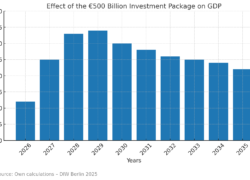
The CDU/CSU and SPD have proposed a €500 billion investment package aimed at addressing Germany’s economic stagnation and deteriorating infrastructure. If implemented, the plan would increase public investment over the next decade, with a projected positive impact on economic growth starting in 2026. According to the German Institute for Economic Research (DIW Berlin), this investment could boost Germany’s economic output by about one percent in 2026 and over two percent annually from 2027 onward.

The German economy has faced years of underinvestment in public infrastructure, with the share of public investment in GDP declining significantly since the 1970s. The proposed package aims to reverse this trend by channeling funds into essential infrastructure projects such as housing, transportation, and digital modernization. The funding would come from special infrastructure funds, allowing for long-term investments without immediate budget constraints.

DIW Berlin’s economic model estimates that the full €500 billion investment would be phased in gradually, reaching its peak impact on GDP by 2030-2031. The initial investment is expected to be around €20 billion in 2026, increasing public investment’s share of GDP by 0.5 percent. Over the following years, investment levels would rise, with the highest impact projected for 2028 and 2029, after which the economic boost would taper off but remain positive.

The anticipated effects include a surge in private investment, improved efficiency in public administration, and better infrastructure to support business activity. Historical data shows that large-scale public investment programs in Germany have previously stimulated economic activity, particularly in areas such as regional development, public housing, and education. DIW Berlin’s analysis suggests that the package could generate a multiplier effect, with public investment leading to a proportional increase in private sector growth.

Concerns about inflationary pressure from such large-scale public spending have been considered. DIW Berlin’s analysis suggests that inflation could rise by an average of 0.5 percentage points per year, a moderate increase that is unlikely to disrupt overall price stability. Financial markets have reacted cautiously to the proposal, with inflation-linked government bond expectations showing only a slight increase in anticipated inflation rates.

The proposed investment package is seen as a potential turning point for the German economy, which has struggled with slow growth, declining infrastructure quality, and administrative inefficiencies. If approved, it could help break the cycle of low public investment and weak economic performance. The economic benefits of the plan are expected to outweigh the risks, providing a much-needed boost to growth while modernizing Germany’s infrastructure for the future.

Source: DW Berlin

ERSTE Real Estate Fund acquires two HelloParks warehouses in Hungary’s largest industrial deal

ERSTE Open-Ended Real Estate Investment Fund has acquired two industrial warehouses from HelloParks in Hungary, marking the largest transaction in the country’s industrial real estate market in the past decade. The PT2 and PT3 buildings, located in the HelloParks Budapest West megapark, offer a total of 84,000 square meters of logistics and industrial space. The deal between ERSTE’s Real Estate Fund and Futureal Group’s industrial property division is notable for its size and significance within the sector.

Each warehouse spans 42,000 square meters and has been developed to meet BREEAM New Construction’s Outstanding rating, a sustainability standard achieved by only a small percentage of buildings globally. The properties also comply with EU Taxonomy regulations, making them unique within Hungary’s industrial real estate landscape. The warehouses are occupied by international logistics firms, including Gebrüder Weiss and Transdanubia, and despite the sale, HelloParks will continue to manage their technical operations.

According to Gábor Futó, founder of HelloParks and Futureal Group, the transaction reflects a renewed investor interest in Hungary’s industrial and logistics sector. He highlighted the strong demand for space and rental growth, driven by nearshoring and industrialization trends, while also noting the limited availability of ESG-compliant facilities. Balázs Pázmány, Chairman of the Board at Erste Alapkezelő Zrt., described the acquisition as part of ERSTE’s strategy to expand its industrial real estate portfolio with high-quality, sustainable properties that offer long-term returns. Rudolf Nemes, CEO of HelloParks, pointed to increasing EU regulatory requirements as a factor driving tenant demand for environmentally sustainable warehouses.

The buildings are equipped with advanced systems to optimize energy use and efficiency. They feature heat pump-based cooling and heating, rooftop solar panels that can eliminate primary grid energy consumption for offices, and an intelligent building management system that monitors and adjusts heating, ventilation, air conditioning, and other utilities. A proprietary mobile app allows tenants to control lighting, ventilation, and temperature while tracking energy usage in real time.

The HelloParks Budapest West megapark, located along the M1 motorway in Budapest’s western agglomeration, is a key logistics hub. The 87-hectare site is planned to accommodate 384,000 square meters of industrial space, with 142,000 square meters already completed and an additional 42,000 square meters expected to be delivered this year. In addition to the newly acquired PT2 and PT3 warehouses, the megapark includes the 58,000-square-meter PT1 facility, the largest contiguous modern industrial building in the Budapest metropolitan area. Across the three completed warehouses, occupancy rates are approaching 90%, supporting approximately 550 jobs.

YIT advances Toivo Roztyly project in Prague with sustainable living and strong sales

YIT has completed the rough construction phase of the first stage of the Toivo Roztyly residential project in Prague 11. This phase includes 88 apartments and is expected to be finished by the end of the year. The second phase, set to begin in 2024, will add another 116 apartments. The development features a minimalist architectural style with ecological elements and green spaces.

The first stage consists of four apartment buildings with load-bearing reinforced concrete structures. Ongoing construction includes work on the roofs, facades, and interior spaces. Infrastructure improvements, such as roads and pedestrian pathways, are also underway. According to YIT, progress is on schedule, and over 70% of the units in the first phase have already been sold.

The entire project will offer 204 apartments, ranging from studios to five-room units, with sizes between 29 and 120 square meters. Many apartments include balconies, terraces, or private gardens. The complex will feature basement storage, a carriage house, and facilities for washing bicycles and pets. Outdoor spaces will include a courtyard, a new street with green areas, and a small park.

Sustainability and energy efficiency are central to the project. Stormwater management systems, LED lighting in common areas, and a controlled ventilation system with heat recovery are designed to reduce energy consumption by up to a third. Triple-glazed windows and external shading preparation will also contribute to energy efficiency. The project includes green roofs, tree planting, and bicycle racks, along with garage parking spaces equipped for electric vehicle charging. Green concrete is being used for structural elements, and some units feature modular bathrooms. The development is co-financed by investment group RSJ.

Located on Komárkova Street, Toivo Roztyly is near the Michelský Forest, which connects to Kunratický and Krčský Forests, providing outdoor recreation opportunities. The site offers good transport links, with the Roztyly metro station just 200 meters away and access to bus routes, the D1 motorway, and Prague’s main road network. Shops, schools, medical facilities, and sports centers are within close reach, making the development well-suited for residents seeking convenience and access to green spaces.

BPI Real Estate Poland and SPEEDWELL partner for new residential development in Gdańsk

BPI Real Estate Poland and SPEEDWELL have formed a joint venture for a new residential development in Gdańsk. The project, located near the Old Town, will introduce approximately 750 apartments across 36,000 square meters of residential space. Designed to integrate with the city’s historic character, the development will provide a modern living environment while maintaining connections to the surrounding urban and cultural landscape.

The location offers views of the city skyline, including St. Mary’s Church, and is near riverside boulevards and pedestrian pathways. The project aims to balance urban accessibility with a green and peaceful setting. The architectural concept, selected through a competition, emphasizes sustainability and functional design. Apartments will range from studios to four-bedroom units, with green spaces incorporated to enhance the quality of life and encourage an eco-friendly lifestyle.

BPI Real Estate Poland has secured the land and is now working with SPEEDWELL to finalize the design and planning phases. Both companies bring extensive experience in residential development, having completed over 20 projects across Poland and Romania. The first phase of construction is scheduled to begin in the second half of the year.

“We believe in the extraordinary potential of Gdańsk, for which we have a special respect and attraction. The project that we will develop together with our partners at BPI Real Estate Poland will reshape the future of a part of this wonderful city. We will do it with passion, respect, and always with the needs of its inhabitants in mind—offering quality, care for the environment, and a sense of well-being that defines true home living,” said Didier Balcaen, CEO and Co-Founder of SPEEDWELL Development.

“This new investment aligns with our long-term strategy of developing high-quality, well-located residential projects that contribute to the dynamic urban landscape of Poland’s key cities. Together with Speedwell, we are committed to delivering a modern, sustainable development that will enhance the Gdańsk skyline and offer future residents an exceptional living experience,” said Béranger Dumont, General Manager of BPI Real Estate Poland.

LATEST NEWS