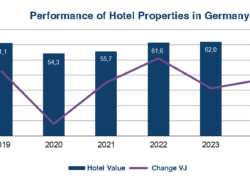
German hotel property market shows signs of recovery, values surpass pre-pandemic levels

The German hotel investment market showed a notable recovery in the first half of 2025, with transaction volumes exceeding those of the previous four years. Investor activity increased among both domestic and international players, supported by improving hotel performance indicators and steady growth in overnight stays. Despite ongoing global economic and political uncertainties, the sector’s fundamentals contributed to renewed confidence.

In 2024, Germany recorded 496 million overnight stays, marking the fourth consecutive year of growth. Rising occupancy rates across the country’s hotel sector were driven by a combination of domestic tourism, major events, trade fairs, and the European Football Championship. However, many hotel operators continued to face financial pressure due to elevated operating costs.

Hotel revenue performance improved considerably in 2024, approaching pre-pandemic levels. This recovery was reflected in the overall value of hotel assets. According to an assessment by Union Investment and bulwiengesa, the value of the investment-relevant hotel portfolio (excluding new developments) rose by 1.5 percent. The average value per hotel room increased to €152,000—surpassing the 2019 pre-pandemic figure of €150,800—for the first time.

The total market value of hotel properties, including both existing stock and completed developments, reached €64.3 billion at the end of 2024. This represents a 3.7 percent increase from the previous year’s estimate of €62.0 billion. Around 450,000 square metres of new hotel space were delivered in 2024, despite a continued decline in construction activity linked to prior delays in project development due to financing and cost concerns.

Much of the new development in 2024 met institutional investment criteria. Approximately 80 percent of newly completed rooms aligned with investor requirements, supported by demand for quality operators and adaptable asset concepts. The 4-star segment, excluding luxury properties, accounted for around 60 percent of completions, partly due to the inclusion of serviced apartments within this category.

Room values varied significantly by segment. The average ranged from €136,500 in the budget/economy sector to €284,000 in the upper-upscale and luxury segments. Properties in the upper-upscale category reported particularly strong gains, underpinned by higher occupancy and increased room revenues.

Serviced apartments emerged as a significant growth area, accounting for roughly 29 percent of all new room completions. These units, which focus on extended stays and digitalised operations, have demonstrated resilience and consistent occupancy. According to Apartmentservice, the average occupancy for serviced apartments reached 81 percent in 2024, with an average daily rate of €91. Operator groups such as Numa, Stayery, Bob W., and Limehome continued their expansion, emphasising automation and operational flexibility.

Conversions played an increasing role in hotel supply in 2024. Around 10 percent of all completed rooms came from change-of-use projects, particularly in urban office-dominated areas. The integration of hotels and serviced apartments into mixed-use developments is being explored as a way to promote neighbourhood diversity. However, the viability of such conversions continues to depend on structural suitability, local demand, and operator interest.

Overall, while challenges persist in terms of costs and construction pipeline, the German hotel property market has regained momentum, with growing investor interest and asset values once again exceeding pre-pandemic benchmarks.


CTP secures €500 million sustainability-linked loan to refinance existing debt

CTP N.V. has signed a five-year €500 million unsecured syndicated sustainability-linked loan facility with a fixed all-in cost of 3.7%. The new facility replaces a previous syndicated loan arranged in 2023 and is expected to deliver meaningful interest savings and reduce the company’s overall cost of debt.

The facility attracted strong interest from the lending market and was oversubscribed by more than two times. A total of 13 banks from Europe and Asia participated in the syndicate, with SMBC and ING acting as Global Coordinators and Sustainability Coordinators.

CTP stated that the financing aligns with its long-term capital structure strategy and supports the company’s sustainability objectives. The terms of the loan include sustainability-linked metrics, reflecting the company’s commitment to improving environmental performance across its portfolio.

Proceeds from the facility will be used to refinance the existing 2023 syndicated loan, enabling the company to optimise its debt profile amid evolving market conditions. The transaction is also expected to enhance liquidity and provide CTP with greater flexibility in managing future investments and operational needs.

As one of the largest logistics and industrial park developers and operators in Europe, CTP continues to focus on maintaining an investment-grade credit profile while integrating environmental, social, and governance (ESG) considerations into its financing strategy.

Fortim Trusted Advisors drives innovation in Property Management in Bucharest

Over the past five years, property management in Bucharest has undergone a profound transformation, shaped by green building standards, technological innovation, and shifting tenant demands. In a Q&A with CIJ EUROPE, Costin Nistor, Managing Director at Fortim Trusted Advisors, outlines how these changes are redefining the role of property managers and how Fortim is positioning itself as a leader in the evolving real estate landscape.

According to Nistor, all new office buildings delivered in Bucharest over the past five years—totaling over 675,000 sqm—have secured green certifications such as BREEAM or LEED, a clear indication of the city’s growing emphasis on quality and sustainability. Rising energy costs and a heightened demand for healthy workspaces, particularly in the aftermath of the pandemic, have compelled owners of older buildings to modernize and align with current expectations.

“The buildings are becoming greener and smarter,” says Nistor. “They are now equipped with advanced tools that not only monitor safety and budgets but also track real-time performance.” This shift has also redefined what clients expect from their property managers—no longer limited to administrative functions, they now seek strategic support to enhance asset value, implement ESG measures, and harness digital solutions for more responsive management.

One of the biggest challenges property managers face today, especially with high-density and mixed-use assets, lies in optimizing data and technology. “What cannot be measured cannot be managed,” Nistor emphasizes. “We need clear strategies and access to accurate data to fully understand and improve building performance.” At the same time, there is increasing pressure to deliver social value by creating healthier, safer, and more resilient tenant communities.

Sustainability is central to Fortim’s approach. The company assists clients in planning their ESG strategies, overseeing modernization projects, and achieving green certifications. Nistor points to successful implementations at America House and Maestro Business Center as examples of how Fortim integrates sustainability into its daily property management operations. These efforts are supported by digitalization tools that streamline operations and improve energy efficiency.

Remote and hybrid work models have further reshaped expectations around office buildings. Nistor notes that employers now seek locations that go beyond functionality to offer lifestyle benefits. “Modern tenants are drawn to buildings that provide dining options, fitness facilities, and cultural programs—places that help employees feel more engaged and motivated to return to the office.”

To support this trend, Fortim has developed a custom mobile app for premium building under its management. These apps allow tenants to manage visitors, access building services, and take advantage of exclusive offers from local businesses. They also serve as a platform for community engagement through charity drives and social events.

Looking ahead, Fortim’s strategy involves expanding its portfolio and strengthening its role as a full-service partner. “Our focus is not only on asset and property management but on being a one-stop shop,” Nistor explains. “We offer everything from leasing and regulatory support to green certifications and marketing. This integrated approach helps boost the market value of our clients’ properties and ensures long-term success.”
As competition intensifies in Bucharest’s commercial real estate market, Fortim Trusted Advisors is embracing innovation and sustainability as cornerstones of its growth strategy. Through a combination of expert management, community engagement, and forward-thinking solutions, the company aims to set a new standard in property management across Romania.

© 2025 www.cijeurope.com

Hungarian real estate faces regulatory shifts in 2025, say experts at Schönherr Hungary

Hungary’s commercial real estate sector is navigating a period of intensified legal and regulatory transformation in 2025. According to legal experts László Krüpl and Gergely Horváth of Schönherr Hungary, a series of new legislative and policy initiatives are redefining the development environment, requiring developers and investors to adopt more adaptive, compliance-focused strategies.

One of the most significant changes this year is the phased rollout of the new electronic real estate register, introduced under the Act on Real Estate Registration (Act C of 2021) and its implementing decree. Designed to modernise property records and transactions, the system aims to increase long-term efficiency but has introduced short-term complexity—particularly for institutional players less familiar with digitalised land administration. The transition coincides with the implementation of the new Act on Hungarian Architecture (Act C of 2023) and the TÉKA decree, reshaping planning and building requirements across municipalities.
“These reforms require time, training and revision of internal processes,” notes Krüpl. “While they offer long-term benefits, certain investment-critical areas remain unclear, and practical application will depend heavily on case law as it develops.”

Environmental and ESG-related compliance is also taking centre stage. The EU’s Corporate Sustainability Reporting Directive (CSRD) and Corporate Sustainability Due Diligence Directive (CSDDD), now being transposed into Hungarian legislation, are beginning to reshape reporting requirements. Large real estate players are under pressure to integrate ESG data collection and monitoring into their project pipelines, contributing to a shift in how investment strategies are structured.

Additionally, a proposed amendment to Governmental Decree No. 143/2018—under discussion since June—could change the permitting process for retail units over 400 sqm. If passed, even the transfer or lease of these properties would require a function change permit, a move that may significantly affect leasing and acquisition practices.

Beyond legal registration, zoning and environmental policy have also evolved. The new architecture law places stronger emphasis on green space protection, affecting how developers approach land selection—particularly in suburban areas. At the same time, a policy preference for brownfield development is becoming more formalised. Measures such as the continuation of reduced VAT rates in designated “rust zones” and priority access to energy grid connections further support redevelopment of underutilised land.

“This shift presents both a challenge and an opportunity,” says Horváth. “Developers who align their strategies with sustainability objectives are likely to be better positioned moving forward.”

In the area of construction law, contract terms are shifting toward more balanced risk-sharing. Recent trends show stronger enforcement of liquidated damages, along with greater contractual detail on force majeure and material price volatility. Meanwhile, alternative dispute resolution mechanisms such as arbitration and mediation are becoming standard practice, especially for cross-border projects, offering greater predictability and confidentiality.

There have also been updates affecting tax and financing. As of January 2025, monument-listed properties are exempt from building tax for up to three years post-acquisition, encouraging redevelopment of historical buildings. The reduced 5% VAT incentive on brownfield residential developments has also been extended. Financing incentives, such as green loans and tax advantages for ESG-certified projects, continue to gain traction, often supported by the Hungarian Development Bank.

Looking ahead to the second half of the year, Krüpl and Horváth caution that while market sentiment is showing signs of stabilisation, key legal risks remain. Although vacancy rates have levelled off, financing remains selective, and concerns persist around regulatory unpredictability. Compliance with new ESG rules, zoning restrictions, and sustainability reporting frameworks will be critical areas for ongoing attention.
“In this evolving landscape, proactive legal planning and risk mapping will be key,” the Schönherr team advises. “Developers and investors who prioritise energy efficiency, regulatory compliance, and long-term adaptability will be best equipped to navigate the current cycle.”

© 2025 CIJ.World

Prima Development’s pragmatic approach to residential living in Bucharest

In a competitive and evolving residential market, Prima Development Group is focusing on practical, design-driven housing solutions. The Prima Vista project in northern Bucharest is a key example of the company’s strategy to adapt to constraints while delivering long-term value. Co-CEO and Partner Adrian Stoichină spoke with CIJ EUROPE about how the company is redefining large-scale housing developments.

Prima Vista was acquired as a partially completed project, with four of the thirteen planned buildings remaining. The new owners could not alter the permitted structure or height of these buildings. Rather than view these limits as restrictive, Prima used them to refine its internal design process. The company ran a competition among architectural firms, evaluating proposals not just through internal review but also by polling potential residents. The question wasn’t about which concept people preferred aesthetically, but which one they would actually choose to live in.

This approach guided decisions at every stage—from façade design to apartment layout and landscaping. Each unit was assessed individually for both function and appeal, based on how buyers typically evaluate properties: through a single visual impression.

Prima Vista’s strategy balanced cost and quality. Rather than compete directly with luxury projects nearby, the company positioned the development at a more accessible price point while maintaining a high standard of workmanship. Apartment sizes range from 38-square-metre studios to 98-square-metre penthouses, aiming to attract a wide range of buyers. According to Stoichină, women tend to lead the selection process based on interior layout, while men often evaluate construction quality and technical details.

The location is also a key asset. Situated in an established residential area with schools, retail, and transport connections nearby, the project appeals to people working in nearby business districts like Pipera. The development’s proximity to Bucharest’s ring road and other infrastructure adds to its practicality for families and professionals alike.

Looking ahead, Prima Development has a pipeline of over 3,000 apartments across multiple Bucharest districts. One upcoming project on Șoseaua Gheorghe Ionescu-Sisești will include 2,000 units with direct lake access and public amenities such as kindergartens, green spaces, and retail. The goal is to create integrated neighbourhoods that function as self-contained communities within a 15-minute radius.

Sustainability is part of the broader plan, though Stoichină acknowledges that environmental considerations are not yet top priorities for most buyers. At Prima Vista, sustainability upgrades were limited due to existing permits, but provisions were made for EV charging infrastructure. In contrast, newer projects like Prima Astera are designed to meet Near Zero Energy Building (NZEB) standards. For Prima, environmental features will become more important as regulation evolves.

Construction quality remains a central concern. Prima acts as its own general contractor, which allows greater control over execution. However, ensuring consistent quality across projects presents challenges. Stoichină notes that the broader market does not always prioritise quality control, so Prima invests in long-term partnerships with contractors who are open to higher standards—even offering financial support to help them grow.
Buyer expectations are also rising. More clients now engage technical consultants during site visits and ask detailed questions about materials and project history. Stoichină views this as a positive development, one that encourages transparency and helps buyers make informed decisions. Prima supports this by directing potential buyers to completed projects to assess quality for themselves.

With projects currently under way in both Bucharest and Oradea, Prima aims to deliver approximately 500 apartments per year in each city. But for Stoichină, growth is not the only metric of success. The company is focused on building a reputation based on trust, consistent delivery, and long-term quality.

Looking to the future, Stoichină envisions residential areas with no surface parking, more shared green spaces, and infrastructure that fosters community life. The objective is to create environments where families can connect and children can safely play outdoors—neighbourhoods built not only for living, but for interaction.
In a market shaped by volatility and shifting expectations, Prima Development Group is prioritising stability, functionality, and thoughtful urban planning—delivering homes that reflect how people actually want to live.

© 2025 www.cijeurope.com

Central Europe reshapes VAT policies: Romania joins regional trend with real estate tax hike

Romania will raise its standard VAT rate from 19% to 21%, eliminating previous reduced rates of 9% in favor of a new flat under EUR 120,000 value. However, a transitional measure allows homebuyers to still access the 9% VAT rate for new residential units under 120 square meters and priced below RON 600,000, provided they sign a pre-contract and pay at least 20% in advance by July 31, 2025, with the final sale contract concluded by July 31, 2026. This change reflects a broader trend among Central European countries to streamline VAT systems and reduce tax exemptions.

In neighboring Slovakia, the government implemented a VAT increase from 20% to 23% at the beginning of 2025, modifying reduced rates as well. The Czech Republic simplified its VAT system in July 2025 by merging its two reduced bands into a single 12% rate, while also introducing new rules that affect how VAT applies to real estate transactions. Hungary, in contrast, has retained its favorable 5% VAT on new residential units, extending this reduced rate through at least the end of 2026 to support housing affordability.

These fiscal adjustments have had mixed effects. In Slovakia and the Czech Republic, higher VAT rates have increased the cost of real estate services, prompting concerns about affordability and sector resilience. Hungary’s strategy to preserve its 5% rate has helped cushion housing prices in a market already grappling with inflation and construction delays. Poland has kept its VAT rates stable but introduced clearer definitions that impact how developers apply VAT to housing, aiming to improve compliance and transparency.

In Romania, the upcoming tax increase is expected to have a significant impact on the residential real estate market. Analysts suggest that the higher VAT could raise the total cost of a standard three- to four-room apartment in Bucharest by tens of thousands of euros, making home ownership increasingly difficult for average buyers. Developers are reportedly exploring ways to fast-track transactions to help customers lock in the lower 9% VAT rate before the deadline. However, the new rate could ultimately slow housing demand and shift the focus of development toward rental properties, a trend that has already gained traction in Poland, Hungary, the Czech Republic, and Slovakia over the past decade.

Overall, the shift in VAT policy across the region is reshaping housing markets. While the goal is often to increase public revenues and simplify tax systems, the outcome in each country depends on how such changes balance fiscal consolidation with housing accessibility and economic growth. Romania’s decision is in line with regional fiscal tightening but could bring significant challenges unless offset by support mechanisms for both developers and buyers.

EU construction production increases in May 2025

Construction production in the European Union increased slightly in May 2025, according to the latest report released by Eurostat. Compared with April 2025, seasonally adjusted production in the construction sector rose by 0.2% in the EU and 0.1% in the euro area. On an annual basis, production was up by 0.7% in the EU and 1.3% in the euro area compared with May 2024.

The modest monthly growth in May was driven primarily by an increase in building construction, which rose by 0.3% in the EU and remained stable in the euro area. In contrast, civil engineering output declined by 0.4% in the EU and by 0.1% in the euro area.

Among the member states with available data, the largest monthly increases in construction production were observed in Slovenia (+5.0%), Slovakia (+4.5%), and Hungary (+3.9%). On the other hand, the biggest declines were recorded in Belgium (-4.2%), Sweden (-3.8%), and France (-1.4%).

Looking at the annual comparison with May 2024, building construction was up by 1.3% in the euro area and 0.9% in the EU. Civil engineering also increased by 1.2% in the euro area and 0.2% in the EU.

The report highlights a continuation of a slow recovery trend in the European construction sector following earlier volatility. However, results vary significantly between member states, reflecting diverse national economic conditions and construction market dynamics.

Austria’s greenhouse gas emissions decrease by 6.4% in 2023

Austria recorded a significant 6.4% year-on-year reduction in greenhouse gas (GHG) emissions in 2023, amounting to a total of 69.9 million tonnes of CO₂ equivalents. This marks a substantial drop from the 74.6 million tonnes recorded in 2022, and places emissions 1.1% below pre-pandemic levels in 2019, according to provisional data published by Statistics Austria.

The reduction in emissions was largely driven by notable declines in the energy supply sector, which cut its emissions by 16.8%, and the industrial sector, which saw a 7.3% decrease. The energy sector’s reduction is attributed primarily to a significant drop in the use of natural gas and coal for electricity and heat production. Industry emissions were impacted by a decline in energy-intensive manufacturing output.

The transport sector, which has historically been the largest source of emissions in Austria, posted a modest 1.6% reduction in 2023. Although this sector still accounts for approximately 30% of total emissions, the drop suggests a slight improvement in fuel efficiency and potentially increased adoption of alternative mobility solutions.

Emissions from households and the services sector fell by 4.5%, reflecting reduced heating requirements due to milder winter temperatures and continued improvements in building energy efficiency. Emissions from agriculture remained relatively stable with a slight increase of 0.3%, while the waste management sector recorded a modest decline of 1.4%.

Austria’s total GHG emissions for 2023 were 3.6 million tonnes below the average level for the years 2015 to 2021, highlighting a potentially sustained downward trend. The data reflect emissions from sectors covered under the EU Effort Sharing Regulation (non-ETS) as well as those subject to emissions trading (ETS), with both contributing to the overall decline.

Source: OECD

Trade tensions weigh on growth prospects for emerging Asian economies

Emerging Asian economies are beginning to feel the impact of escalating global trade tensions, with growth projections revised downward in several countries across the region, according to economic data and policy briefings released in July 2025.

After a period of strong post-pandemic recovery, many of Asia’s developing markets are now contending with slowing exports, weaker investment inflows, and mounting pressure on currency stability. The cooling global demand and increased use of tariffs, particularly by major economies like the United States and China, have disrupted key supply chains and led to rising uncertainty among manufacturers and investors alike.

In its latest regional update, the Asia Development Outlook indicated that while countries such as Vietnam, Indonesia, and the Philippines continue to show positive growth, the pace has moderated compared to earlier forecasts. Economies that are heavily dependent on exports, such as Malaysia and Thailand, are seeing more pronounced effects from reduced international demand and logistical bottlenecks.

One of the key concerns flagged by analysts is the decline in foreign direct investment in sectors tied to global trade. Investment in export-oriented manufacturing has slowed considerably, with multinational firms reconsidering expansion plans due to geopolitical risks and shifting trade policies. Meanwhile, capital flight and pressure on local currencies have forced several central banks in the region to intervene or revise interest rates to stabilize their economies.

The slowdown also affects regional integration efforts and the performance of trade blocs such as the Regional Comprehensive Economic Partnership (RCEP), as member countries attempt to shield domestic industries from external shocks. Despite efforts to diversify trade partners and promote intra-Asian commerce, the overall growth outlook remains fragile amid tightening global financial conditions and an unpredictable policy landscape.

Experts warn that unless the international trade environment stabilizes, emerging Asian economies may need to rely more heavily on domestic consumption and structural reforms to sustain growth. Policymakers across the region are now balancing short-term measures to support export sectors with longer-term strategies aimed at improving resilience and competitiveness.

Food prices continue to rise in Slovakia despite lower VAT on basic items

Food prices in Slovakia continue to climb, even though the value-added tax (VAT) on basic food items was reduced from 10% to 5%. The opposition has raised concerns that the government’s efforts to combat inflation are having limited effect, with consumers still facing higher costs at the checkout.

Drawing on data from the Statistical Office, the opposition highlighted that prices for several staple foods have increased year-on-year. Bread rose by 1.2% in May, cheese by 8.6%, and butter saw a significant 24% increase. Even items subject to the reduced 5% VAT have shown price volatility, while other foods taxed at the standard 19% or 23% rates have also surged. Mineral water rose by 6.1%, and egg prices jumped nearly 30%. New taxes, including a sugar tax, have contributed to sharp rises in fruit prices, with raspberries up between 26.6% and 44.6%.

Although government representatives have claimed that food inflation is under control, the opposition points to both statistical data and everyday consumer experience to argue otherwise. They suggest that new fiscal policies, including the financial transaction tax and higher VAT on many goods and services, may be indirectly contributing to price increases across the retail food sector.

In June, food and non-alcoholic beverage prices were again affected by broader inflationary pressures. Despite assurances from the Ministry of Finance that increased VAT revenues would support the state budget, updated forecasts indicate that tax collection may fall short of earlier expectations.

Critics argue that Slovakia lacks a comprehensive analysis of the food supply chain—from production to retail—which could help identify the true drivers of price increases. With Slovak households spending on average 21% of their budgets on food and beverages, the impact of rising prices is felt most acutely by low-income families.

Source: TERAZ

LATEST NEWS