Monday, 14 September 2026
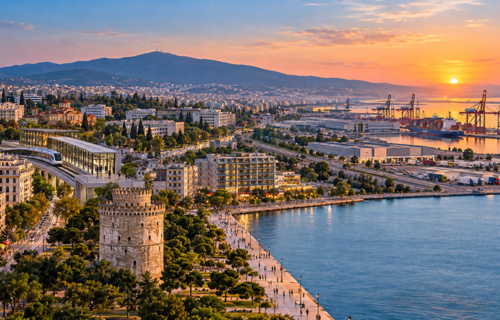
Athens remains the centre of institutional real estate investment in Greece, but developments in Thessaloniki increasingly justify examining the country’s second-largest city as a property market in its own right. Housing demand, new transport infrastructure, logistics development, port investment, tourism and urban redevelopment are creating several distinct investment opportunities within the same metropolitan area. The question is whether those individual markets can eventually become large and liquid enough to support sustained institutional investment rather than occasional acquisitions.
Residential property provides one indication of the city’s momentum. In the second quarter of 2026, residential asking prices in Thessaloniki were approximately 7.7% higher than a year earlier, compared with growth of around 5.3% in Attica. Asking rents in Thessaloniki increased by approximately 6.6% over the same period. These figures measure advertised prices rather than completed transactions, but they nevertheless indicate continued pressure within the housing market. Thessaloniki also benefits from a large university population, providing an important source of rental demand alongside permanent residents. This creates potential for conventional rental housing, renovated apartment buildings and, where the economics support development, professionally managed student accommodation.
Transport infrastructure is simultaneously changing the city’s accessibility. The Thessaloniki Metro began operating in late 2024, ending a lengthy period in which Greece’s second-largest metropolitan centre functioned without an urban rail system. The Kalamaria extension followed in August 2026, adding five stations and extending the network farther into the eastern part of the city. The property consequences will develop gradually. A metro station does not automatically increase the investment value of every surrounding building, and development opportunities depend on planning restrictions, land availability, ownership structures and the condition of existing properties. Improved accessibility can nevertheless influence where residents choose to live and where developers consider residential, commercial and mixed-use projects viable.
The western side of the metropolitan area presents a very different property story. Sindos is one of Greece’s principal industrial and logistics locations. Its importance comes from its relationship with Thessaloniki, regional road connections and the city’s port, providing occupiers with access to northern Greece and routes towards neighbouring Balkan markets. Demand for good-quality logistics space remains healthy, while the availability of modern buildings is relatively restricted. That creates opportunities for new development and refurbishment while giving Thessaloniki an investment sector that is not dependent on the residential market or city-centre tourism.
The Port of Thessaloniki strengthens this position. Investment in the expansion of Pier 6 is intended to increase the port’s ability to handle larger container vessels and greater cargo volumes. The significance for property extends beyond the port itself. Additional capacity and improved freight infrastructure can reinforce demand for warehouses, distribution facilities and industrial property across the wider Thessaloniki region, although domestic retail, manufacturing and distribution remain important independent sources of logistics demand. This combination of port infrastructure and inland industrial property gives Thessaloniki an economic role that differs from that of a conventional regional city. Its location provides a potential gateway between maritime trade, northern Greece and southeastern European markets.
Hospitality adds another investment sector, but the 2026 figures demonstrate why Thessaloniki should not be portrayed as a market in which every segment is expanding at the same speed. During the first half of 2026, hotel occupancy was lower than during the equivalent period of 2025, while average room rates increased. Revenue generated per available room consequently recorded only limited improvement. Thessaloniki therefore continues to attract hospitality investment interest, but hotel performance needs to be assessed carefully rather than simply assumed to be strengthening alongside tourism.
Offices present a similar need for selectivity. Thessaloniki’s office market is considerably smaller than Athens and offers fewer large assets capable of attracting major institutional investors. Building quality, energy performance, accessibility and location are becoming increasingly important considerations for occupiers, while the limited size of the market makes large speculative developments more difficult to justify without clear evidence of tenant demand. This creates opportunities for modernisation but also limits scale. Older commercial buildings can potentially be renovated, repositioned or converted to alternative uses. Residential, hospitality and mixed-use projects may provide viable alternatives where continued office use cannot support the capital expenditure required to bring a building up to contemporary standards.
Redevelopment could consequently become an important component of Thessaloniki’s investment market. The city contains substantial existing building stock, often divided among multiple owners and constructed long before modern institutional property requirements emerged. Consolidating ownership, renovating buildings and creating larger professionally managed assets can potentially transform fragmented local property into investment products capable of attracting larger pools of capital.
For institutional investors, however, having attractive individual opportunities is only the beginning. A mature investment market needs repeatability. Investors need to be able to acquire more than one suitable asset, deploy meaningful amounts of capital and eventually sell those properties to other professional buyers. This is where Thessaloniki still differs significantly from Athens.
An investor can identify a modern logistics facility around Sindos, a hotel in the centre or a residential redevelopment opportunity and make a successful individual acquisition. It is considerably more difficult to construct a large diversified portfolio because the supply of institutional-scale assets remains relatively limited. Exit liquidity is equally important. Funds generally invest with an eventual sale in mind. The greater the number of potential buyers, the easier it becomes to price an asset and execute an exit. Athens benefits from a much broader universe of domestic and international investors. Thessaloniki’s professional buyer pool remains smaller.
The significance of current developments is therefore not that Thessaloniki has already achieved the institutional depth of Athens. It has not. Rather, the city increasingly possesses several of the conditions that could allow a deeper institutional property market to develop. Residential demand provides one foundation, the university population supports the rental market, the metro is improving urban connectivity, Sindos provides an established logistics base, the port is receiving substantial infrastructure investment, tourism supports hospitality, while older buildings create redevelopment opportunities.
These sectors do not need to perform identically for the investment market to deepen. What matters is whether enough institutional-quality assets emerge across several sectors to allow investors to remain active in Thessaloniki over multiple investment cycles. That would represent a significant change for Greek real estate. Instead of institutional investors treating Thessaloniki primarily as a location for exceptional individual opportunities, they could begin viewing the city as a place where capital can be deployed repeatedly across logistics, residential, hospitality, offices and specialist property.
The transition will depend on development volume, transaction activity and the emergence of a larger professional buyer pool. It will also depend on whether new infrastructure produces investible property rather than simply higher expectations for land and existing buildings. Athens will remain Greece’s dominant real estate investment market for the foreseeable future, but Thessaloniki does not need to challenge that position to become considerably more important.
The more meaningful test is whether Greece’s second city can develop sufficient scale, asset quality and liquidity to support diversified institutional portfolios. If it can, Thessaloniki will have moved beyond being simply Greece’s largest secondary property market and established an investment ecosystem capable of attracting capital across several sectors on its own merits.
Source: CIJ.World Research & Analysis Team