Monday, 14 September 2026
Spain’s rapidly expanding data centre industry is changing the way development sites are assessed. A large industrial plot in the right location is no longer enough. Increasingly, the decisive question is whether the electricity infrastructure exists to support what developers want to build.
Madrid remains the country’s largest established data centre market, but the geography of new investment is broadening. Aragón has emerged as a major development location, while Barcelona continues to attract projects supported by its business base, international connectivity and telecommunications infrastructure.
The growth of Aragón is particularly significant because it demonstrates how electricity infrastructure can influence real estate geography. Large technology investments planned for the region have elevated an area previously outside Spain’s dominant data centre cluster into one of the country’s most important locations for future capacity.
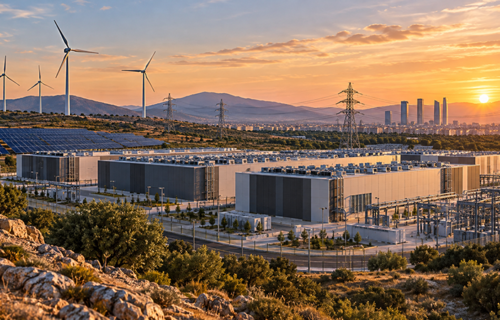
Spain’s expanding renewable energy sector strengthens the country’s attraction for digital infrastructure. However, renewable generation and electricity immediately available to a development site are two very different things. A region may generate substantial amounts of wind or solar electricity while an individual project still faces limitations relating to transmission infrastructure, substations or the capacity of the local network. For developers, the relevant question is therefore not simply how much electricity is produced nearby, but how much can actually reach a particular site and when.
That distinction has significant implications for land. Two neighbouring industrial plots could appear almost identical when judged by conventional property measures. Both might have suitable road access, similar planning status and comparable land values. Yet they can have dramatically different potential for data centre development if one can obtain the required electricity connection within a workable timetable and the other cannot.
This is making electricity due diligence an increasingly important part of site selection. Before committing substantial capital to land, developers need to understand the capacity of nearby substations, the status of grid connections, possible reinforcement works and the likely timetable before electricity can be supplied. Fibre connectivity, planning, environmental requirements and water availability can then be assessed alongside the power question.
Madrid illustrates both the strength and complexity of an established market. Its concentration of businesses, telecommunications infrastructure and existing data centres makes it a natural location for further investment. At the same time, continued development increases competition for sites capable of accommodating large electricity requirements.
Barcelona offers another established digital economy with strong international connectivity. However, as with Madrid, the theoretical availability of development land does not automatically translate into executable data centre projects. Electricity, fibre, planning and technical feasibility all have to align.
Aragón presents a different proposition. Its land availability, renewable generation and location between several major Spanish economic centres have helped make the region increasingly relevant to large-scale digital infrastructure. Major technology investments have reinforced that position and demonstrated that data centre development does not necessarily have to follow Spain’s traditional commercial property hierarchy.
Artificial intelligence is likely to make access to electricity still more important. AI computing infrastructure can require very substantial power capacity, particularly at the largest facilities. As developers plan increasingly powerful campuses, locations capable of supporting those electrical loads become more valuable strategically.
This could gradually alter the economics of industrial land. A site with a realistic route to planning approval, high-capacity electricity and fibre connectivity may attract substantially greater developer interest than conventional industrial land nearby. The precise value difference will depend on the project, location and certainty surrounding the infrastructure rather than any standard price per megawatt.
That makes the development process particularly interesting for property investors. Value can potentially be created well before a data centre is constructed. Identifying suitable land, progressing planning, resolving infrastructure requirements and establishing a credible electricity connection can move a site considerably closer to becoming an executable project.
The process also creates substantial risk. Acquiring land does not guarantee that sufficient electricity will become available on the timetable assumed when the investment was made. Delays to grid infrastructure can therefore affect development programmes, financing and ultimately the economics of the site. Investors consequently need to distinguish between electricity that may become available at some point and capacity that has a credible route towards being delivered.
This distinction could increasingly influence competition for sites. Specialist data centre developers and operators are the obvious participants, but the amount of infrastructure required to prepare large digital campuses may also create opportunities for investors with experience in energy, infrastructure and complex land development.
The boundary between property development and infrastructure investment is therefore becoming increasingly blurred. Traditional industrial developers primarily consider land, access, planning, construction costs and occupier demand. Data centre developers must evaluate all of those factors while also addressing electricity infrastructure and telecommunications requirements that can determine whether a project is technically possible.
For regional Spain, that creates an important opportunity. Areas outside Madrid and Barcelona that combine suitable land, electricity infrastructure, renewable generation and strong fibre connections could become credible locations for future investment. Aragón has already demonstrated how quickly a regional market can gain strategic importance when these factors come together.
That does not mean every location with renewable electricity will become a data centre hub. Large facilities require a much broader ecosystem involving grid capacity, telecommunications, planning, construction capability, environmental considerations and access to specialist services. The winners are likely to be locations where those requirements can be assembled with sufficient certainty to justify billions of euros of long-term investment.
For Spain’s property market, this changes how data centre land should be examined. Plot size and price remain important, but neither tells investors whether a project can actually be delivered. Madrid, Aragón and Barcelona are already demonstrating different versions of this equation. Their future growth will depend partly on how effectively electricity infrastructure can keep pace with the enormous computing requirements being proposed.
As Spain competes for the next generation of European digital infrastructure, the most valuable development sites may therefore not necessarily be those offering the cheapest land. They may be the ones where the electricity is actually ready.
Source: CIJ.World Research & Analysis Team