Monday, 14 September 2026
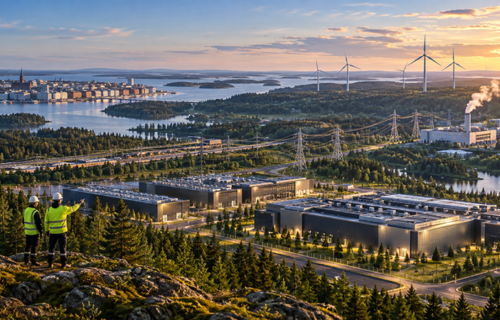
Finland is attracting an extraordinary pipeline of projects that want one thing in increasingly large quantities: electricity. Data centres, battery storage, electric heating, hydrogen production and new industrial processes are creating demand on a scale that would have been difficult to imagine only a few years ago. Finland has many advantages for these investments, including extensive low-carbon electricity generation, a cool climate, strong digital infrastructure and comparatively large development sites.
But the rapid growth of proposed projects is exposing a new constraint. Finding land is one thing. Finding land that can obtain a sufficiently large electricity connection within an acceptable development timetable is becoming something else entirely. For Finland’s property market, that distinction is increasingly important.
Fingrid has received enquiries from electricity-consuming projects representing more than 100 GW of potential demand. More than half of this relates to proposed data centres. The number should not be confused with projects certain to be constructed, since much of the pipeline remains preliminary, but it demonstrates the extraordinary scale of investor interest. Projects that have progressed to connection agreements already represent significant capacity. Data-centre developments covered by such agreements exceeded 3 GW by the end of June 2026 and approached 5 GW by the middle of August.
The speed of that increase shows why electricity infrastructure is becoming an important part of real-estate development strategy. For conventional industrial property, investors traditionally examine planning, road connections, labour availability, construction costs and proximity to customers. Electricity-intensive occupiers require another level of analysis. A development site can satisfy every conventional requirement and still face significant delays if the necessary power cannot be delivered.
The challenge is particularly visible in southern Finland. The Helsinki metropolitan region remains the country’s dominant technology and commercial centre and already contains a significant concentration of data-centre development. However, it is also located within the part of Finland where rapidly growing electricity consumption is placing increasing pressure on network capacity.
Fingrid has identified temporary limitations affecting connections for large new electricity consumers in parts of Uusimaa, Southwest Finland and Häme while additional transmission infrastructure is developed. Reinforcement should progressively improve the situation, but the constraints demonstrate that electricity availability can no longer be assumed simply because an industrial site is well located.
This comes as the scale of proposed computing infrastructure is increasing. Microsoft is developing a major Finnish data-centre programme around Espoo, Kirkkonummi and Vihti. In April 2026, the company confirmed that another construction stage would proceed during the year, expanding a programme already under development in the capital region.
Finland’s next generation of data centres, however, is increasingly spreading beyond Greater Helsinki. In Mäntsälä, Verne began construction in June on the first approximately 70 MW stage of a new campus. Kouvola is emerging as another large-scale location, with atNorth developing a campus capable of expanding to several hundred megawatts.
Western Finland is attracting attention as well. Microsoft signed a preliminary agreement during June to acquire approximately 190 hectares in Vaasa and neighbouring Mustasaari. The land forms part of the wider GigaVaasa industrial area, which has been developed around energy technology and electricity-intensive manufacturing.
The significance of Vaasa goes beyond one potential data centre. Finland has an unusual geographical imbalance between where electricity is generated and where it is consumed. More than 70 percent of generation is located in western and northern Finland, according to Fingrid, while more than half of consumption occurs in southern parts of the country.
That creates an opportunity for the property market. Rather than continually transporting increasing quantities of electricity towards new consumers in the south, some future industrial demand could locate closer to areas where generation is concentrated. Fingrid’s analysis indicates that better geographical alignment between electricity production and major new consumers could substantially increase the amount of demand that the Finnish transmission system can accommodate.
This could strengthen the investment case for cities and industrial regions outside Helsinki. Vaasa is an obvious candidate because of its established energy industry. Oulu also combines technology expertise with northern electricity infrastructure. Pori and Rauma possess established industrial bases, while Tampere occupies a strong position between Finland’s major economic and energy corridors. Kouvola and Mäntsälä demonstrate that locations outside the core Helsinki market can already attract significant digital infrastructure.
The result could be a more geographically distributed development market. This does not mean that Greater Helsinki will lose its importance. The capital region offers a combination of workforce, connectivity, customers and technology businesses that secondary markets cannot easily reproduce. But projects consuming tens or hundreds of megawatts must increasingly weigh those advantages against electricity availability and connection schedules.
For developers and investors, this changes due diligence. A site marketed for a major data centre or industrial project cannot be assessed solely by examining its land area and planning position. Investors increasingly need to understand the electricity connection behind the development: how much capacity is actually available, whether it has been reserved, what network improvements are required and when the connection can realistically become operational.
That distinction is particularly important when evaluating Finland’s enormous announced data-centre pipeline. Artificial intelligence is encouraging investment in computing facilities capable of consuming considerably more electricity than earlier generations of data centres. The existence of land and an announced development concept therefore does not necessarily mean that the full proposed capacity can be delivered.
Some projects already have connection agreements. Others remain at earlier stages. Some will require substantial electricity-network investment, while others may never proceed. Separating these categories could become one of the most important ways of understanding Finland’s real data-centre pipeline.
The competition for electricity is not limited to computing. Finland’s battery-storage market has also expanded rapidly, with connected storage capacity passing 1,000 MW during early 2026. Hydrogen, electric boilers and industrial electrification are creating additional demand, meaning data-centre operators are competing for infrastructure within a much broader transformation of the Finnish economy.
There is also another resource capable of influencing where data centres are built: heat. Large computing facilities produce enormous quantities of surplus thermal energy. Finland’s extensive district-heating networks provide an opportunity to recover part of that energy and use it for homes and commercial buildings.
This is already happening around the Helsinki region. Microsoft and Fortum are integrating heat recovery into the data-centre programme serving Espoo and surrounding municipalities. Once fully developed, recovered energy is expected to make a substantial contribution to the area’s district-heating requirements. Another major scheme is planned in Helsinki, where Helen and OnZero intend to channel surplus energy from a new data centre into the city’s heating network.
This creates a distinctive Finnish development model. The ideal data-centre location may increasingly require several pieces of infrastructure to come together: sufficient electricity, fibre connectivity, development land, planning certainty and potentially access to a district-heating system capable of absorbing surplus heat.
Sites possessing several of those characteristics could become increasingly attractive to developers. Former industrial properties may therefore deserve particular attention. Land near existing substations, power stations, industrial electricity infrastructure or major transmission corridors could have development advantages that are difficult and expensive to reproduce on completely new sites.
Whether this translates into a measurable premium for Finnish industrial land is not yet clear. There is insufficient transaction evidence to conclude that investors are systematically paying higher prices purely because large electricity connections have been secured. But the direction of travel is becoming increasingly visible.
A site with a realistic path to securing 100 MW of electricity has a fundamentally different development proposition from an otherwise similar site where the same connection could require years of network reinforcement. Municipalities may consequently find themselves competing on electricity infrastructure as much as land availability.
For years Finnish cities have promoted industrial sites through land prices, logistics connections, skilled labour and planning flexibility. The next generation of major occupiers may begin discussions with a much simpler question: how much electricity can the location actually provide? That question could help determine where billions of euros of future investment eventually goes.
Finland still has many of the ingredients required to become one of Europe’s important locations for data centres and electricity-intensive industry. But the scale of prospective investment means that national electricity abundance does not necessarily translate into unlimited capacity at every development site.
The Finnish property map is therefore acquiring another layer. Roads matter. Railways matter. Fibre matters. Planning matters. Increasingly, transmission lines, substations and available megawatts matter too. For some of Finland’s largest future developments, the most valuable characteristic of a piece of land may ultimately be not what can be built on it, but how much electricity can reach it.
Source: CIJ.World Research & Analysis Team