Monday, 21 September 2026
Switzerland’s housing market is moving in two directions at once. Residential construction is beginning to strengthen after several subdued years, yet finding an available home is becoming more difficult. The national vacancy rate declined again in 2026, showing that the emerging development recovery has not yet produced enough completed housing to offset the shortage accumulated in recent years.
Only 0.93% of Switzerland’s housing stock was vacant in the latest national survey, extending the decline in availability to a sixth consecutive year. The rental sector is particularly tight, with 34,690 vacant rental apartments recorded at the beginning of June, around 7% fewer than twelve months earlier. In some of the country’s strongest economic centres the shortage is much more severe, with vacancy falling to 0.20% in Zug and 0.31% in Geneva. Fifteen of Switzerland’s 26 cantons now have vacancy below 1%.
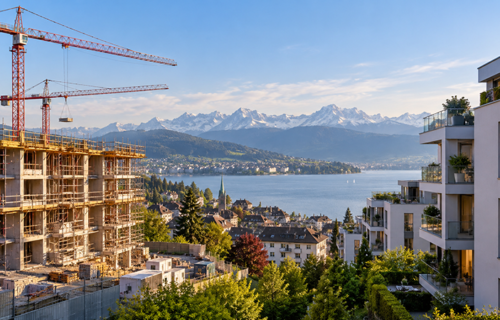
At the same time, evidence from the construction sector is becoming more encouraging. Residential building activity increased by around 4.3% year-on-year in the second quarter of 2026, while improving permit and planning figures suggest that more projects are moving towards construction. Current forecasts indicate that residential development should continue expanding through 2027. The difficulty is timing: homes entering the development process now cannot immediately relieve a market that is already short of available properties.
Increasing supply is also becoming more complicated. Switzerland has limited development land in many high-demand locations, meaning a growing proportion of housing must be created by replacing existing buildings, redeveloping previously used sites or increasing density within established neighbourhoods. These projects can involve longer approval processes and greater technical complexity. Replacement construction can also make headline development numbers look stronger than the actual increase in the housing stock because some new homes simply substitute properties that have been demolished.
The shortage continues to feed through into rents. UBS reported asking rents 2.4% higher year-on-year in the second quarter of 2026, while rents under existing agreements also increased, although more slowly. Other market indicators tracking newly agreed leases similarly point towards continued upward pressure. The persistence of rental growth despite some moderation in immigration suggests that the current imbalance is no longer explained by population growth alone; several years of insufficient additions to the housing stock have left little spare capacity in many local markets.
For investors, these conditions continue to make Swiss residential property attractive. Very low vacancy reduces the risk of empty units, rental growth supports income and favourable financing conditions have helped maintain demand for apartment assets. Yet strong investor appetite for existing properties does not automatically create additional housing. Developers still need suitable sites, viable construction economics and planning certainty before investment can translate into new homes, particularly in the urban markets where shortages are most pronounced.
Switzerland may therefore have reached the beginning of a housing construction recovery without yet reaching the end of its housing shortage. More apartments are expected to enter the market as the stronger development pipeline progresses, potentially providing some relief from 2027 onwards. Until then, declining vacancy and rising rents indicate that supply remains behind demand. The longer-term test will be whether the current improvement becomes a sustained expansion capable of producing enough additional homes rather than simply a temporary rebound from unusually low construction levels.