Wednesday, 16 September 2026
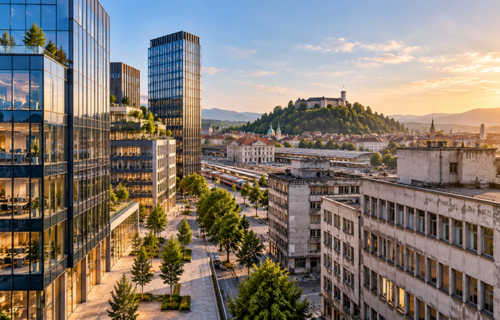
Ljubljana’s office market is approaching an important test. The Slovenian capital contains a substantial amount of office accommodation, but the choice becomes considerably narrower for companies seeking newer buildings with efficient operating systems, contemporary layouts, strong transport connections and the environmental performance increasingly expected by larger occupiers. The result is a market where the amount of office space recorded as available does not necessarily reflect what companies actually want to occupy.
Evidence from the market supports the existence of this quality gap. Industry discussions during 2026 have highlighted limited availability among Ljubljana’s better offices and continued demand from businesses looking for modern premises. The issue is particularly relevant because much of the city’s office stock was developed before the latest generation of energy, sustainability and workplace requirements became important considerations for occupiers.
Official commercial property statistics also show offices behaving differently from some other parts of Slovenia’s property market. During the first quarter of 2026, commercial property prices nationally declined by 0.3% compared with the previous quarter. Prices for retail and service premises fell by 7.4%, while offices recorded a 4.2% quarterly increase and were 16.2% higher than a year earlier. Those numbers should not be interpreted as evidence of a sudden surge in Ljubljana office values because they cover Slovenia nationally and the underlying transaction market remains small. Only 160 commercial properties were sold during the first quarter, representing a combined value of €34.7 million.
Nevertheless, the figures add another dimension to the question of office quality. Demand for newer accommodation is being supported by changes in how companies evaluate buildings. Energy consumption, operating costs, heating and cooling systems, employee comfort, public transport connections and surrounding amenities increasingly influence decisions that were once dominated primarily by location and rent. Larger companies also have increasingly demanding environmental objectives, while modern buildings can offer lower energy consumption and operating costs.
This creates the potential for a widening gap between Ljubljana’s strongest and weakest offices. Modern buildings in good locations can compete for companies willing to pay more for quality, while ageing properties may increasingly have to compete through lower rents, refurbishment or repositioning. An older office can therefore contribute to the city’s vacancy figures while competing only weakly with recently completed accommodation.
The next generation of development should reveal how significant that divide has become. More than 80,000 sqm of new office accommodation is under development across Ljubljana, creating a substantial increase in modern supply over the coming years. Emonika will be one of the most visible additions, with offices forming part of a major mixed-use development around Ljubljana’s main railway and bus connections alongside hotels, apartments, retail and leisure space.
As these projects reach the market, companies occupying older buildings will have more opportunities to relocate. That creates a challenge for landlords whose properties have benefited from the limited availability of newer alternatives. If tenants move into recently completed developments, vacancy could increasingly migrate towards older buildings rather than disappearing from the market.
The response from owners will depend heavily on individual properties. Some buildings may justify substantial refurbishment, particularly where strong locations allow landlords to recover investment through higher rents. Improvements to façades, building systems, energy performance, common areas and internal layouts could allow well-positioned older properties to compete with newer developments.
Other buildings will be more difficult. Structural limitations, inefficient floorplates, high refurbishment costs or weaker locations can make comprehensive modernisation uneconomic. Owners of these properties may eventually have to consider more fundamental changes to how the buildings are used.
Conversion to housing, hotels or other uses could become an option in individual cases, particularly given Slovenia’s housing shortage. However, office conversion should not be considered an automatic solution. Building depth, access to natural light, structural design, planning requirements and construction costs can make conversion complicated or financially unattractive.
Ljubljana could therefore begin experiencing a pattern already visible in larger European office markets, where occupier demand increasingly concentrates in the strongest buildings while weaker properties struggle to maintain their competitive position. Ljubljana is a smaller and less liquid investment market, however, meaning changes in asset values may take longer to become visible through transactions.
The arrival of new office supply will provide the clearest evidence. Leasing activity, achieved rents, tenant relocations and vacancy within older buildings will show whether Ljubljana simply needs additional offices or whether the real imbalance lies in the amount of modern space available.
For developers, a shortage of competitive offices supports new construction. For investors, the implications are broader. New development may create opportunities at one end of the market while simultaneously increasing the capital expenditure required to protect the value of older assets. The most important question may therefore be what happens to the offices companies leave behind. If Emonika and Ljubljana’s other new developments attract tenants from ageing buildings rather than simply accommodating expanding businesses, the city’s next office cycle could expose a much clearer division between properties capable of competing for modern occupiers and those requiring significant investment to remain relevant.
Source: CIJ.World Research & Analysis Team