Thursday, 8 October 2026
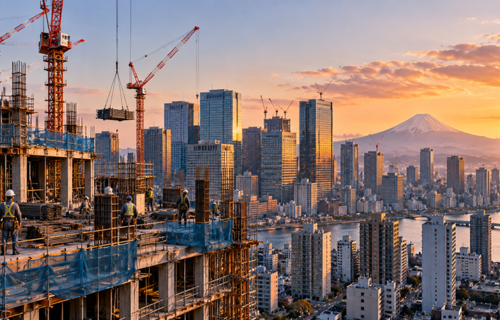
Japan’s real estate development pipeline is coming under increasing pressure as higher building costs, shortages of skilled workers and more expensive financing change the economics of new projects. While demand for modern property remains strong in many markets, developers are becoming more selective about what can be built profitably and when projects should proceed.
The strain is particularly visible in the construction industry. Japan recorded 2,021 construction-company bankruptcies in 2025, 6.9% more than a year earlier. The pressure continued into 2026, with 1,043 construction businesses failing during the first six months of the year.
An even larger number left the industry without entering bankruptcy. Almost 4,900 construction businesses closed or were dissolved during the first half of 2026. Together with bankruptcies, this brought the number of construction-sector exits to close to 6,000 in only six months.
Smaller contractors are among the most vulnerable. They have less capacity to absorb higher wages, expensive materials and longer project schedules, while passing additional costs to clients can be difficult. The loss of these companies also reduces the pool of contractors available to developers, adding further pressure to pricing and delivery schedules.
Japan’s shortage of construction workers is becoming equally important. A large share of the industry’s skilled workforce is approaching retirement, while recruitment of younger workers has not been sufficient to replace those leaving the sector.
Working-time reforms introduced in April 2024 have also changed how projects are delivered. Construction companies are now subject to tighter overtime limits, reducing their ability to compensate for insufficient staffing through longer working hours. While intended to improve employment conditions, the change has increased the importance of productivity and workforce availability when contractors calculate project schedules.
Construction costs remain elevated as a result. Although the exceptionally rapid increases seen earlier in the decade have moderated, developers are now starting projects from a substantially higher cost base. Labour, imported materials, equipment and other inputs remain expensive, while higher interest rates have added another layer to development budgets.
The impact is beginning to appear in Tokyo’s future office supply.
Expectations for office completions toward the end of the decade have been reduced as some projects are delayed, rescheduled or reconsidered. The volume of new space expected during 2028 and 2029 is now lower than earlier projections, reflecting the growing difficulty of delivering large developments under current conditions.
This could have important consequences for Tokyo’s existing office stock.
Vacancy among Grade A offices was below 1% during the second quarter of 2026, while rents continued to rise. If fewer developments are completed over the next several years, competition for the best available buildings could remain intense.
For landlords, the construction problem can therefore become an advantage. Higher replacement costs and limited new supply increase the value of existing modern buildings, particularly when those assets are located in districts where companies continue competing for space.
The same pressures are spreading beyond offices.
Residential developers must balance higher land and construction costs against what households can afford to pay. Rising mortgage costs make that calculation more difficult, particularly outside the strongest urban markets. Financial pressure among smaller homebuilders suggests that parts of the residential construction industry are already struggling with that equation.
Hotel developers face similar decisions. Japan continues to experience strong tourism demand, creating a need for additional accommodation, but new hotels are increasingly expensive to build. Projects that appeared attractive several years ago can produce very different returns when construction and financing assumptions are updated.
Logistics development is also becoming more selective following several years of rapid expansion. Developers increasingly need sufficient rental growth and strong locations to compensate for higher land, construction and financing costs.
The result could be a greater difference between Japan’s strongest and weakest development markets.
Central Tokyo and other locations capable of supporting substantial rental increases may continue to attract new projects despite higher costs. Developments in areas where rents are less flexible could become increasingly difficult to justify.
Rising replacement costs may also encourage investors to look more closely at existing properties. Refurbishing, repositioning or converting an older building can become more attractive when constructing an equivalent new property requires significantly more capital.
Large Japanese developers have an advantage in this environment because strong balance sheets allow them to postpone projects, alter designs or wait for more favourable conditions. Smaller developers and contractors have fewer options, increasing the likelihood of further consolidation within the industry.
Japan is therefore not facing a shortage of ideas for new development or necessarily a shortage of demand. The more important constraint is becoming the ability to turn those plans into financially viable buildings.
That could fundamentally alter the next stage of the property cycle. Reduced construction may restrict the supply of new offices, homes, hotels and other properties, supporting rents and values for existing assets even as development becomes more difficult.
For investors, this creates an unusual dynamic. The same cost pressures weakening the case for new construction could strengthen the position of owners whose buildings are already completed and generating income.
Japan’s construction challenge is therefore becoming a real estate supply story. As labour becomes harder to secure and projects become more expensive to finance and build, the market is likely to become increasingly divided between developments capable of supporting today’s costs and those that no longer add up.
Source: © CIJ.World Japan Research & Analysis Team