Monday, 19 October 2026
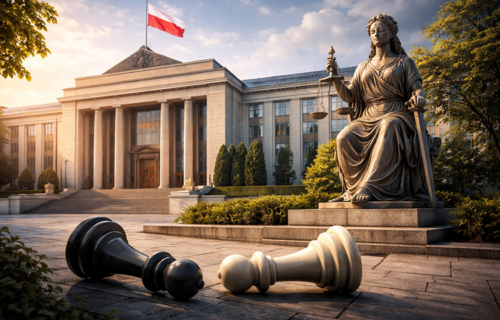
The latest tensions surrounding Poland’s Constitutional Tribunal point to a longer-running challenge within the country’s legal framework, where disputes over judicial appointments continue to intersect with political change.
Recent efforts by parliament to fill positions on the court have been accompanied by questions over procedure and timing. Legal observers and political opponents have raised concerns about how vacancies were addressed and whether established steps were fully respected. The situation has also drawn attention to the role of the President of Poland, whose involvement is required before judges can formally take up their roles, adding another layer of uncertainty to the process.
The roots of the issue trace back to 2015, when the outgoing Civic Platform-PSL government moved to appoint several judges shortly before losing power. The incoming Law and Justice administration challenged those decisions and advanced its own nominations, setting off a dispute that would reshape the court’s position within the state. Subsequent rulings confirmed that some of the earlier appointments were valid while others were not, leaving a contested institutional legacy that has carried through to the present.
European institutions have since examined the situation more closely. The Court of Justice of the European Union has highlighted concerns about how judicial appointments were handled, indicating that certain irregularities could affect the court’s independence. Similarly, the Venice Commission has pointed to risks for democratic safeguards when disputes over constitutional bodies remain unresolved. In addition, the European Court of Human Rights has addressed individual cases in which the composition of judicial panels raised questions about whether they met the required legal standards.
Following the 2023 elections, the current governing coalition has taken a critical view of the Tribunal’s present structure. This has included decisions not to recognise certain rulings, reflecting a continuation of institutional friction seen in earlier years. While the court has continued to function, its standing within the legal system remains a matter of debate among policymakers and legal experts.
Research into the evolution of the dispute suggests that what began as a disagreement over appointments has developed into a broader issue concerning the balance of power between institutions. The ongoing uncertainty highlights how changes in political leadership can have lasting effects on bodies intended to remain independent.
The consequences extend into the economic sphere. For investors, confidence in the legal environment plays a central role in decision-making, particularly in markets that rely on long-term planning and regulatory stability. Questions over how consistently laws are interpreted and applied can influence perceptions of risk and, in turn, investment activity.
As the situation continues to evolve, the challenge for Poland lies in reinforcing the credibility of its institutions. Restoring clarity around the functioning of the Constitutional Tribunal will be an important step in strengthening both legal certainty and broader confidence in the country’s governance framework.
Source: WEI