Sunday, 4 October 2026
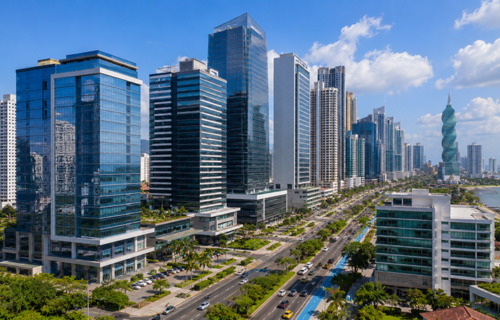
Panama City’s office market is continuing to rebalance in 2026, with availability falling to 23.73% in the first quarter from more than 30% earlier in the decade, while positive absorption and a limited development pipeline gradually reduce the supply surplus accumulated during the city’s previous construction cycle. The improvement is measurable, but the market remains favourable to occupiers in many locations. More than one fifth of monitored office stock is still available, giving companies considerable choice and limiting landlords’ ability to increase rents uniformly across the city.
At the end of the first quarter of 2026, Panama City’s monitored office inventory stood at approximately 1.83 million square metres, according to Newmark. Net absorption during the quarter reached around 8,788 square metres, while average advertised rents were approximately USD 16.86 per square metre per month. These figures extend an improvement already visible during 2025. At the end of the second quarter last year, the market contained approximately 1.83 million square metres of office space, with an availability rate of 24.76%. Quarterly net absorption reached 7,609 square metres, compared with 2,895 square metres during the first three months of 2025, while average advertised rents stood at USD 15.23 per square metre per month.
By the third quarter of 2025, availability had declined further to approximately 24.6%, while inventory remained essentially unchanged. No significant new office supply was under construction at that stage, meaning the improvement was being driven primarily by absorption of existing space rather than the arrival of new buildings. The first-quarter 2026 availability rate of 23.73% therefore represents another step towards a more balanced market.
Viewed over a longer period, the change is more pronounced. Panama City’s office availability stood at approximately 30.9% in 2021, when earlier speculative development combined with the disruption caused by the pandemic to leave a substantial amount of space without occupiers. By 2023, the rate had fallen to approximately 25.2% and has subsequently continued to decline. Panama City has therefore absorbed a meaningful portion of the surplus accumulated during the previous development cycle, although current availability remains substantial.
A crucial feature of this adjustment is the absence of significant new speculative supply. Office inventory has remained close to 1.83 million square metres since at least the first half of 2025. With no substantial speculative pipeline currently adding to inventory, positive absorption is gradually reducing available stock rather than being offset by major new completions. This supply constraint could become increasingly important if leasing activity remains positive through the remainder of 2026. However, the effects are unlikely to be distributed evenly because Panama City contains a diverse office stock ranging from modern corporate buildings to older properties facing considerably stronger competition for tenants.
The difference was already visible between individual submarkets during 2025. Costa del Este recorded an availability rate of approximately 19.6% in the second quarter, with average advertised rents of about USD 17.78 per square metre per month. Santa María was considerably tighter at approximately 12.7%, with rents around USD 16.47. Punta Pacifica, by comparison, recorded availability above 30%, while the traditional banking district stood at approximately 26.4%. The banking district remains by far the largest concentration of offices in the city, accounting for close to 953,000 square metres of Newmark’s monitored inventory.
These differences illustrate why the citywide availability rate does not fully describe current market conditions. Companies searching for modern space in a specific location, building category or floor configuration can encounter substantially less choice than the overall 23.73% figure suggests. At the same time, owners of older or less efficiently configured properties continue to compete in a market where occupiers retain numerous alternatives.
This divergence is becoming increasingly important as companies reconsider both the quantity and quality of office space they require. Lease events are providing opportunities for businesses to consolidate operations, upgrade their premises or move into buildings better suited to changing workplace requirements. Efficient floorplates, flexible layouts, technology, accessibility, parking, energy performance and surrounding amenities are becoming increasingly important factors in leasing decisions. The result is a gradual concentration of demand in stronger properties rather than a uniform recovery across the entire office stock.
This follows a broader pattern visible in Latin American office markets, where occupiers have increasingly favoured well-located and higher-quality buildings even in cities where overall availability remains elevated. Panama City is particularly exposed to this trend because the legacy of earlier development continues to provide companies with a broad range of alternatives. As availability declines, however, that negotiating advantage could gradually narrow for the most competitive properties.
Average advertised rents increased from approximately USD 15.23 per square metre per month in the second quarter of 2025 to USD 16.86 in the first quarter of 2026. The movement is consistent with a tightening market, although it should not be interpreted as a direct measure of rental growth. Changes in the composition and quality of available properties can affect average asking rents between reporting periods. Nor does the increase indicate that landlords have regained unrestricted pricing power. Availability of almost 24% remains substantial, while individual lease negotiations can differ significantly from advertised rates. Incentives, fit-out contributions, rent-free periods and contractual flexibility can materially alter the effective cost paid by an occupier.
For owners, the changing market is placing greater emphasis on the competitiveness of individual buildings. As companies gain opportunities to upgrade their premises without necessarily expanding their overall footprint, landlords of older stock face increasing pressure to modernise assets, improve commercial terms or accept longer periods without tenants. Prime and recently upgraded buildings in established business locations are likely to benefit first as availability declines, while secondary properties could take considerably longer to recover where floor layouts, mechanical systems, energy performance or amenities no longer meet corporate expectations.
Costa del Este is well positioned within this process. The district combines relatively modern office stock with residential development, retail, hotels and corporate infrastructure and has established itself as one of Panama City’s principal business locations outside the traditional financial centre. The banking district remains significantly larger and continues to accommodate financial institutions, professional services companies and corporate headquarters. Its scale and varied building stock, however, produce considerably different performance between individual properties. Punta Pacifica combines office and residential uses but its comparatively high availability shows that landlords continue to face substantial competition, while Santa María, although a much smaller office market, demonstrates the stronger position that limited, higher-quality supply can achieve.
The broader Panamanian economy provides a supportive backdrop for continued office absorption. The IMF expects real GDP growth of approximately 3.8% in 2026. Panama remains strongly oriented towards services, trade, logistics, finance and international business, sectors closely connected with demand for corporate premises. Panama City’s position as a regional headquarters location is particularly relevant, with international air connectivity, logistics infrastructure, the banking system, Panama’s dollarised economy and its position between North and South America helping establish the city as a base for multinational companies overseeing activities across Central America, the Caribbean and parts of South America.
This international corporate presence provides office demand beyond domestic economic expansion, although investment and business growth remain sensitive to international conditions and Panama’s own fiscal environment. For the office market, the current economic outlook points towards continued gradual recovery rather than rapid expansion. Limited new construction reduces the risk of another immediate supply shock, while economic growth provides existing buildings with an opportunity to absorb remaining space. However, with almost one quarter of monitored stock still available, market conditions remain some distance from those normally required to support another broad wave of speculative office development.
If availability continues to decline without a meaningful increase in new supply, competition for modern Grade A offices could tighten even while older and less competitive buildings retain substantial vacant space. This possibility reinforces the emerging division between stronger and weaker assets. For investors, acquiring office property simply because it appears inexpensive relative to replacement cost may not be sufficient if substantial capital expenditure is required to attract modern corporate occupiers. Buildings capable of being upgraded or repositioned could, however, benefit as overall availability continues to fall. Income stability, tenant quality, lease duration, operating efficiency and future refurbishment requirements are consequently becoming increasingly important considerations alongside acquisition price.
For existing landlords, asset management is therefore becoming one of the principal determinants of performance in 2026. Properties that have been modernised, offer competitive amenities and can accommodate changing occupier requirements are better positioned to capture companies relocating within the city. Buildings that have received limited investment risk becoming increasingly disconnected from improvements in the wider market.
The changing conditions also have implications for occupiers. Panama City remains broadly tenant-friendly, but the decline in availability from above 30% earlier in the decade to below 24% means companies searching for the strongest offices have fewer options than several years ago. This is particularly relevant for larger occupiers requiring substantial amounts of contiguous space, as headline availability can overstate the amount of accommodation capable of satisfying a large corporate requirement within a single building.
The central story of Panama City’s office sector in 2026 is therefore not a dramatic rise in rents or a return of speculative construction, but the continuing absorption of the supply surplus created during the previous development cycle. Inventory remains broadly unchanged, net absorption is positive and availability continues to decline. Together, these conditions are gradually restoring balance to a market that spent years working through the consequences of rapid development.
Yet availability approaching 24% means recovery should not be confused with scarcity. Companies still have considerable choice and landlords of less competitive properties continue to face pressure. Instead, Panama City is increasingly developing into a two-tier office market in which quality, location and asset management determine which buildings participate most strongly in the recovery.
If positive absorption continues while development remains constrained, 2026 could mark an important stage in Panama City’s transition from a market defined by excess office supply towards one where competition for the best corporate properties becomes progressively stronger. For owners and investors, the performance of individual buildings is therefore likely to matter considerably more than movements in the citywide average rent alone.
Source: © CIJ.World Research & Analysis Team