Friday, 16 October 2026
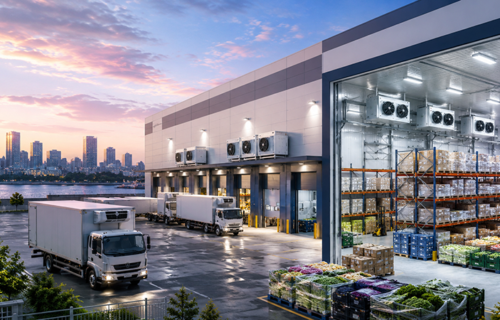
Japan’s logistics property market is opening to a more specialised form of investment as demand for modern refrigerated warehousing begins to outpace the capabilities of much of the country’s existing stock. Changing food consumption, an ageing logistics network, higher technical standards and growing demand for temperature-controlled distribution are creating opportunities for a new generation of cold-chain facilities.
For many years, refrigerated warehouses in Japan largely operated outside the mainstream institutional property market. Facilities were commonly developed or controlled by food producers, wholesalers and specialist logistics businesses for their own operational requirements. That structure is gradually changing as developers introduce modern facilities designed for several occupiers, potentially bringing cold storage closer to the investment model already established in Japan’s conventional logistics sector.
The age of Japan’s warehouse stock is one reason this transition is gaining momentum. More than half of the country’s logistics buildings are over 30 years old, while a relatively small proportion has been delivered during the past decade. This matters particularly for refrigerated facilities, where older cooling equipment, weaker insulation and outdated building systems can translate into higher electricity consumption, greater maintenance requirements and lower operational efficiency.
At the same time, Japan’s food distribution system is changing. Frozen and prepared foods have become an increasingly important part of household consumption, supported by demand for convenience, changing household structures and the popularity of products that can be stored for longer periods. Supermarkets, convenience stores, restaurants and food manufacturers consequently require increasingly reliable networks capable of maintaining different temperatures throughout storage and transportation.
Japan’s demographic structure reinforces some of these trends. A large elderly population, significant numbers of people living alone and the prevalence of households where adults have limited time available for cooking all contribute to demand for convenient and prepared meals. This supports not only food production but also the logistics infrastructure required to move chilled and frozen products efficiently through major metropolitan markets.
Digital retail is adding another dimension. Although Japan’s online grocery sector remains less developed than some areas of conventional e-commerce, home delivery of food and direct-to-consumer distribution require more sophisticated handling than standard parcel logistics. Maintaining product temperatures through distribution centres and the final stages of delivery increases the importance of well-located refrigerated facilities around major population centres.
Cold-chain requirements are also extending beyond food. Pharmaceutical products, vaccines, biologics and other temperature-sensitive healthcare products require carefully controlled storage and transportation. As Japan develops its pharmaceutical, biotechnology and life sciences industries, specialist logistics infrastructure will increasingly form part of the supporting real estate required by those sectors.
Environmental performance is becoming equally important. Refrigerated warehouses have substantial energy requirements, meaning inefficient cooling systems can materially affect operating costs. Changes affecting older refrigerants, together with pressure to improve energy efficiency, strengthen the case for replacing or extensively modernising older properties rather than continually maintaining obsolete equipment.
Labour pressures are accelerating the need for modernisation as well. Japan’s logistics industry continues to face shortages of drivers and warehouse employees, while changes to truck-driver working conditions have forced operators to reconsider distribution efficiency. New facilities incorporating automation, improved loading systems and more efficient internal layouts can allow occupiers to process greater volumes with fewer manual operations.
For the property industry, however, perhaps the most important development is the emergence of purpose-built leased cold storage.
A growing pipeline of multi-occupier projects indicates that developers are beginning to see refrigerated logistics as a property product in its own right. Industry research indicates that approximately 141,000 tsubo of new multi-tenant cold-storage space could be delivered during 2027, demonstrating how rapidly the sector is beginning to develop from its comparatively small institutional base.
New projects are also appearing in established logistics locations. Osaka’s Nanko district, for example, is seeing development of a fully refrigerated and frozen multi-tenant facility of around 21,000 sqm scheduled for completion in late 2026. The project demonstrates the type of modern building entering the market, combining different temperature environments with specifications capable of accommodating several logistics and food-sector occupiers.
The multi-tenant model could significantly alter the economics of the sector. Smaller food companies, retailers and third-party logistics providers can access modern refrigerated infrastructure without committing large amounts of capital to constructing their own facilities. Developers, meanwhile, can spread occupational exposure across several tenants rather than depending upon a single specialist user.
Cold storage nevertheless presents substantially greater development challenges than conventional warehousing. Refrigeration equipment, insulation, power infrastructure and specialist building systems increase construction costs, while occupier requirements can differ considerably. A facility designed around one temperature range or product category may require substantial modification for another user.
Power availability and energy costs are also critical considerations. A conventional logistics building may primarily compete on location, accessibility, specification and rent, whereas the viability of a refrigerated facility can depend much more heavily on electricity capacity and long-term operating efficiency. These characteristics make development expertise and careful assessment of occupier demand particularly important.
Yet the same complexity creates barriers to new supply. Modern cold-storage buildings are expensive and technically difficult to reproduce, while a substantial portion of Japan’s existing logistics infrastructure is approaching an age where redevelopment or replacement becomes increasingly necessary.
This combination is creating an unusual property opportunity. Demand is supported by essential consumer industries rather than discretionary warehouse expansion, while the existing supply base contains large numbers of older facilities requiring modernisation. At the same time, developers are introducing a leasing model capable of making the sector more accessible to institutional capital.
Japan’s next major logistics story may therefore be less about adding another generation of enormous dry warehouses and more about upgrading the infrastructure hidden behind the country’s food and healthcare supply chains. As ageing facilities meet increasingly sophisticated distribution requirements, cold storage is moving from a specialist operational necessity towards a potentially significant new segment of Japan’s institutional real estate market.
Source: © CIJ.World Japan Research & Analysis Team