Saturday, 24 October 2026
India’s commercial real estate market is beginning to confront a risk that cannot be measured simply through rents, vacancy rates or development pipelines. Rising temperatures, heavier rainfall, flooding, water pressure and greater strain on urban infrastructure are increasingly relevant to the long-term financial performance of buildings.
For investors, this changes the climate discussion considerably. Environmental considerations have traditionally centred on reducing energy consumption, obtaining building certification and meeting corporate sustainability objectives. Those factors remain important, but physical exposure to a changing climate raises a different set of questions. A property can consume relatively little energy and still be vulnerable to flooding. An efficient office can become temporarily unusable when surrounding roads are inundated. A logistics facility can have modern environmental credentials but still suffer operational disruption if transport infrastructure fails during extreme rainfall. Environmental efficiency and physical resilience should therefore not be treated as interchangeable measures of building quality.
This is becoming particularly important in India because many of the country’s largest commercial property markets face increasing environmental pressure. Heat represents one of the most widespread challenges. Research published in 2025 indicated that approximately 57% of Indian districts, containing around three quarters of the population, faced high or very high heat risk.
For commercial real estate, hotter conditions can translate directly into higher cooling requirements and greater pressure on electricity consumption. The impact is particularly relevant to older offices. Buildings with outdated cooling equipment, poorly performing façades and inefficient mechanical systems can require considerably more energy to maintain comfortable internal temperatures. As temperatures increase, the difference in operating performance between newer and older buildings could become increasingly important to occupiers.
The problem extends beyond individual properties. Dense urban districts can experience substantially higher temperatures than surrounding areas because of the concentration of buildings, paved surfaces, traffic and limited vegetation. This means the location of a building can affect its future operating requirements even when the asset itself has been constructed to a high standard. Higher temperatures also increase electricity demand across cities, placing greater pressure on power infrastructure when offices, homes, shopping centres and other buildings require additional cooling simultaneously.
For certain types of commercial property, reliable electricity becomes particularly important. Data centres require continuous power and cooling, industrial facilities may depend on uninterrupted electricity for production, while retail centres and offices need functioning cooling systems to remain comfortable and operational. Climate exposure therefore has the potential to affect commercial property differently depending on the building’s use.
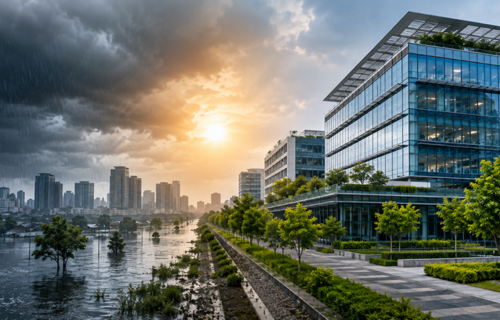
Flooding presents another major challenge. Mumbai, Chennai and other important Indian commercial centres have repeatedly experienced severe rainfall and urban flooding. For real estate owners, the risk is considerably broader than water entering a building. Flooding can disrupt roads, electricity, public transport and access for employees. Basements containing electrical equipment, parking facilities or building systems can also become vulnerable.
A property may escape serious structural damage but still become unusable because employees cannot reach it or surrounding infrastructure is not functioning. This can be particularly damaging for businesses that depend on continuous operations. It also means climate risk needs to be examined at a much more detailed geographical level than simply deciding whether an entire city is vulnerable.
Within the same metropolitan area, buildings can have very different exposure depending on elevation, drainage, surrounding development, road access and proximity to waterways or coastal areas. As investors gain access to better environmental data, these differences could increasingly enter acquisition decisions.
Commercial property underwriting has traditionally concentrated on tenant quality, lease duration, rental growth, occupancy, development supply and financing costs. Physical climate exposure adds another dimension. An investor examining an office building may increasingly need to consider the efficiency of its cooling equipment, the position of critical electrical infrastructure, the capacity of drainage systems and the reliability of water supply.
The condition of infrastructure outside the building can be equally important. An individual property owner can improve drainage and protect electrical equipment, but cannot independently prevent surrounding roads from flooding or guarantee the reliability of a city’s electricity network. Climate resilience is consequently both a property issue and an infrastructure issue.
That has implications for valuation. A building does not necessarily need to suffer a major climate event before its value is affected. Investors can begin incorporating expected future expenditure into acquisition prices long before physical damage occurs. If a property requires substantial investment in cooling, waterproofing, drainage, water management or electrical systems, a potential buyer may deduct those costs from the amount it is willing to pay.
Climate exposure can therefore appear in valuations through anticipated capital expenditure rather than immediate physical losses. This is particularly relevant to India’s ageing office stock. Hundreds of millions of square feet of commercial buildings are now old enough to require significant modernisation, and many were constructed when environmental performance and extreme-weather adaptation received considerably less attention than they do today.
Some of these buildings occupy excellent locations and can justify major refurbishment. Others may face a more difficult calculation. Replacing cooling equipment, improving façades, upgrading water systems and strengthening flood protection can require substantial investment. Carrying out these improvements in an occupied building can also create disruption for existing tenants.
Owners therefore need to decide whether the future income generated by a property justifies the cost of upgrading it. This could gradually divide India’s commercial property market into buildings that can economically adapt and those that become increasingly difficult to modernise.
The consequences may already be emerging through occupier behaviour. Green-certified Grade A offices account for a large proportion of leasing in India’s leading commercial markets, with certified buildings representing roughly three quarters or more of office demand during recent periods.
Some Indian cities have also recorded meaningful rental differences between certified and non-certified Grade A stock. These figures should not be interpreted as a direct price for climate resilience. Modern certified buildings are frequently newer, better located and constructed to higher specifications than older competing properties. Nevertheless, the direction of demand is significant.
Major occupiers increasingly prefer buildings offering lower operating costs, efficient systems and modern environmental performance. Physical resilience could become another component of that preference. A multinational occupier evaluating two comparable offices may increasingly consider not only energy consumption but also water reliability, flood exposure, backup electricity and the ability of the building to remain operational during extreme weather.
That could reinforce the existing movement of tenants toward higher-quality assets. For owners of older buildings, the greater risk may therefore be declining competitiveness rather than immediate physical destruction. This creates the possibility of a widening discount for assets requiring substantial future expenditure.
The issue is particularly relevant for institutional investors. REITs, pension capital, sovereign investors and large property funds typically approach real estate with longer investment horizons than many private owners. A commercial building purchased in 2026 may remain within an institutional portfolio well into the 2030s.
Climate conditions expected over that period consequently become relevant to today’s investment decision. An investor does not need to predict precisely what the temperature or rainfall will be in 2040. It needs to understand whether the property can adapt economically if operating conditions become more difficult.
This turns climate resilience into a question of future capital requirements. A building capable of being upgraded relatively easily may remain competitive, while an asset requiring extensive reconstruction could face a substantially different investment outlook.
Insurance introduces another consideration. Commercial property insurance pricing depends on numerous factors, including construction, location, claims history, insurance-market capacity and catastrophe exposure. It would therefore be misleading to suggest that every climate-resilient building automatically receives cheaper insurance.
However, repeated physical losses can influence underwriting. Properties that regularly experience flood damage or other weather-related losses may eventually face more restrictive conditions, greater deductibles or higher costs than better-protected assets. For property investors, the long-term question is therefore not simply the cost of insurance today but whether adequate insurance remains readily available throughout the holding period.
The banking system has similar reasons to pay attention. Indian financial regulators increasingly recognise that extreme weather can affect borrowers, collateral and financial stability. Commercial buildings frequently support substantial amounts of secured lending.
If a property suffers repeated operational disruption, requires large amounts of unplanned capital expenditure or becomes less attractive to tenants, its income and collateral value can weaken. Climate exposure can consequently become credit risk. This creates another pathway through which environmental conditions could eventually influence property pricing.
Buildings considered more vulnerable may face closer scrutiny from lenders, insurers and institutional investors even before occupiers change their behaviour. The strongest financial case for upgrading buildings currently comes from operational performance rather than speculative rental increases.
Indian green-building frameworks indicate that substantial reductions in electricity and water consumption are possible through better building design and modernisation. These savings can lower service charges and operating expenditure. In a hotter climate, energy efficiency becomes even more valuable because cooling requirements are likely to increase, while water efficiency may become similarly important in cities where supply is already under pressure.
Yet climate adaptation requires buildings to go beyond ordinary efficiency. A property designed to use less water during normal operations still needs sufficient resilience when water supplies are interrupted. A building with efficient cooling still requires reliable backup systems during power disruption. A property with strong environmental certification still needs effective drainage if extreme rainfall overwhelms surrounding infrastructure.
This is why climate resilience is likely to become increasingly asset-specific. Different property sectors face different vulnerabilities. For offices, cooling efficiency, water availability and employee access may be particularly important. For data centres, electricity reliability, cooling capacity and water security can become fundamental investment considerations.
For industrial property, climate disruption can affect both production and supply chains. For logistics facilities, access to functioning roads is essential. Retail properties depend on transportation, customer access and reliable building services. There is consequently no single resilience solution that can be applied across the entire commercial property market.
The characteristics of the building, its occupiers and its location determine which risks matter most. This has implications for development as well as investment. New buildings can incorporate resilience relatively efficiently when these requirements are considered during planning, while retrofitting them later can be considerably more expensive.
Developers may therefore increasingly need to examine future heat exposure, drainage capacity, water availability and infrastructure reliability when acquiring development sites. Sites that appear attractive because of current land values or transport connections may carry hidden long-term costs if they are particularly exposed to flooding, water shortages or infrastructure pressure.
Climate information could consequently become another layer of real estate due diligence. Location has always determined property value, but climate exposure could change how location itself is assessed. Investors may increasingly compare micro-locations within cities according to drainage, heat exposure, water security and infrastructure reliability alongside conventional measures such as transport connectivity and surrounding amenities.
Municipal investment will also have an important influence on private property values. Individual developers can improve their buildings, but the resilience of commercial districts ultimately depends on drainage networks, electricity grids, roads, public transport and water infrastructure.
Cities capable of improving these systems may protect the competitiveness of their commercial property markets. Those that fail to adapt could place an increasing burden on individual property owners.
This makes climate resilience much more than an ESG reporting exercise. It is becoming a question of which buildings will remain economical to operate, attractive to tenants, acceptable to lenders and suitable for institutional ownership.
India’s commercial real estate market has already experienced a pronounced movement toward newer, higher-quality and environmentally certified buildings. Physical climate risk could accelerate that divide. The next stage of the market may therefore be characterised not simply by a premium for the best buildings but by increasing discounts for assets that require substantial investment to remain competitive.
Climate change does not need to destroy a building to reduce its investment performance. Higher electricity consumption, repeated maintenance, water problems, disrupted access, rising capital expenditure and weaker tenant demand can gradually erode returns.
The properties most at risk may consequently be those whose future adaptation costs are underestimated today. As India’s institutional real estate market grows, those costs will become increasingly difficult to ignore.
The question facing investors is shifting from whether a building meets today’s environmental expectations to whether it can continue generating competitive income under tomorrow’s operating conditions. That is when climate resilience stops being simply a sustainability issue and becomes a property valuation issue.
Source: © CIJ.World India Research & Analysis Team