Wednesday, 9 September 2026
England’s retail parks are undergoing a significant change in how they are viewed by property investors. Once regarded primarily as defensive collections of large-format stores, the strongest assets are increasingly combining rental growth, exceptionally limited vacant space and restricted development supply with something potentially more valuable: large sites capable of generating additional income beyond conventional retail.
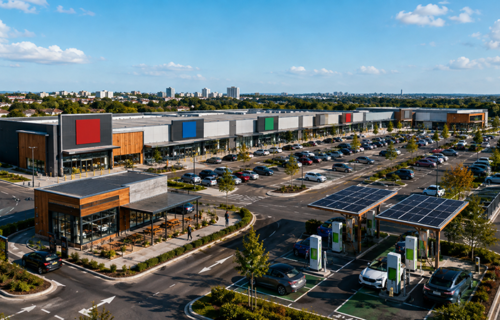
Institutional capital is returning as the occupational fundamentals strengthen. Grocery stores, restaurants, gyms and leisure operators are broadening the traditional tenant mix, while drive-through units and electric-vehicle charging are creating income from parts of sites that previously contributed relatively little. At the same time, extensive surface parking and low-density development give some parks longer-term redevelopment potential. The result is a property sector that increasingly looks less like a collection of retail sheds and more like an income-producing land platform.
Occupational conditions provide the foundation for this change. Retail-warehouse vacancy remained exceptionally low during the second quarter of 2026, with different market surveys placing availability at only a few percentage points of existing stock. Available retail-park accommodation has also fallen significantly compared with a year earlier.
The lack of space is particularly striking because Britain’s retail sector has recently experienced several major business failures. The collapse or restructuring of retailers including Homebase and Carpetright released millions of square feet of large-format accommodation onto the market. In an oversupplied property sector, that amount of vacant space could have taken years to absorb. Instead, a substantial proportion has been rapidly taken by expanding retailers.
B&M has acquired numerous former Homebase stores, while Aldi, M&S, Next, Superdrug and other operators have taken space released by failed or restructuring businesses. Rather than leaving permanent holes in retail parks, many of these closures have allowed landlords to introduce financially stronger or faster-growing tenants.
More than 7.5 million sq ft of retail-warehouse space was absorbed by occupiers during 2025, according to market estimates. Against this, the development pipeline contains only around 2.4 million sq ft expected across several years. That imbalance is becoming one of the most important characteristics of the sector. Retailers want space considerably faster than developers are creating it.
Planning restrictions are partly responsible. For decades, UK planning policy has sought to protect town centres by limiting major new out-of-town retail development. High construction and financing costs provide another obstacle. Even where occupier demand exists, creating an entirely new retail park can therefore be difficult. Existing parks consequently benefit from a form of structural protection. Competitors cannot simply respond to rising rents by building large amounts of new space nearby.
Rental performance increasingly reflects that scarcity. Prime retail-park rents have recovered beyond their pre-pandemic levels in some market measures, distinguishing the sector from weaker parts of British retail property. Landlords are also reporting new leases being agreed above previous rents on well-performing schemes.
The strongest portfolios are close to full occupancy. British Land’s retail parks have been operating at approximately 99% occupancy, while other major owners are also reporting high levels of occupation and positive leasing spreads. These conditions are attracting investment capital.
One of the clearest signals came during the second quarter when Realty Income acquired eight UK retail parks from Tristan Capital for approximately £260 million. The portfolio included properties in locations such as Birmingham, Rotherham, Warrington and Luton and was purchased at a reported initial yield approaching 8%.
The transaction is important beyond its size. A large US-listed property investor committing hundreds of millions of pounds to British retail parks demonstrates how dramatically perceptions of the sector have changed. Other institutional and specialist investors are also targeting retail warehousing. Competition is particularly strong for dominant parks with established catchments, credible rents, high occupancy and opportunities to improve the asset.
This does not mean every out-of-town retail property has suddenly become an institutional investment. Secondary parks with weak locations, poor tenant mixes or limited spending power within their catchments can still struggle. The revival is increasingly selective.
The most valuable properties tend to be parks capable of supporting several different reasons to visit rather than relying on occasional purchases of furniture, electronics or DIY products. Grocery is particularly important.
Aldi and Lidl continue expanding their British networks, while M&S is directing more investment towards larger food stores, including out-of-town locations. Supermarkets can fundamentally alter the economics of a retail park because food shopping generates frequent repeat visits. A customer might buy a sofa once every decade, but groceries are purchased every week. That regular traffic can benefit surrounding shops, cafés, pharmacies, restaurants and service businesses. Grocery therefore provides landlords with both rental income and an anchor capable of increasing activity throughout the wider property.
The same diversification is occurring through food and beverage. Restaurants that previously concentrated on high streets and shopping centres are increasingly considering retail parks. During 2026, Wingstop agreed seven units across British Land’s portfolio, including locations such as Reading Gate and New Mersey Shopping Park. Several of those properties had previously been occupied by Pizza Hut, demonstrating another important characteristic of the sector: units can frequently be recycled between operators without requiring complete redevelopment.
Leisure is adding another dimension. Gyms, cinemas, children’s entertainment, restaurants and family attractions are increasingly being incorporated into larger parks. Some landlords are undertaking substantial repositioning projects that introduce leisure alongside conventional retail and grocery.
This changes how the property operates. A traditional retail park might have generated its strongest traffic during daytime shopping hours and weekends. Leisure, gyms and restaurants can extend activity into evenings while creating additional reasons for customers to remain at the property. Longer visits can support higher spending and make the overall destination more attractive to retailers.
Drive-through restaurants and coffee shops provide another opportunity, particularly because retail parks frequently contain extensive road frontage and large parking areas. A small portion of underused land can potentially accommodate a drive-through unit without interfering significantly with the main retail buildings. Because such units occupy relatively small plots but can generate strong rents, they can improve the overall return from the site.
Electric-vehicle charging is beginning to apply the same principle to car parks. For decades, large surface parking areas were necessary infrastructure but produced little direct property income. The transition towards electric vehicles is beginning to change that calculation.
Retail parks have several natural advantages as charging locations. They are accessible by car, already contain large parking areas and attract customers who may remain on site long enough to charge their vehicles. Major landlords are installing additional charging infrastructure across their estates, in some cases partnering with specialist operators that fund and operate the equipment while paying the property owner for access to the site.
The significance goes beyond environmental targets. A parking space can become an income-producing asset. Charging can also encourage customers to spend longer at the property, potentially benefiting cafés, restaurants and shops while their vehicles remain connected.
This illustrates a broader change in how investors can evaluate retail parks. The income potential no longer necessarily stops at the front door of the stores. Buildings produce rent. Restaurants can occupy peripheral plots. Charging operators can use parking areas. Advertising, parcel collection, storage and other services can generate further income. Larger sites may also support additional development.
This is where the investment case becomes particularly interesting. Retail parks are generally extremely inefficient users of land compared with most modern urban development. Single-storey buildings are surrounded by extensive surface parking, servicing areas and access roads. In locations where surrounding land values have increased substantially, particularly around London and other large English cities, the underlying site can potentially be worth considerably more than its existing use initially suggests.
Residential development creates the most obvious alternative in high-value urban locations. Some retail parks occupy large sites close to transport infrastructure and established residential communities where housing demand is substantial. However, redevelopment does not necessarily require removing the retail use entirely.
Owners can pursue gradual densification instead. Additional retail units can be constructed on underused parts of a site. Restaurants and drive-throughs can occupy perimeter plots. Leisure buildings can increase density. EV infrastructure can monetise parking. In suitable locations, longer-term masterplans could potentially combine retail with residential, logistics or other commercial uses.
This gives investors something increasingly valuable: optionality. A warehouse generally produces income from the warehouse. An office produces income from its workspace. A well-located retail park can potentially generate income from its shops, restaurants, leisure facilities, parking areas and development land while retaining the possibility of more substantial redevelopment in the future.
That optionality becomes particularly valuable when the existing retail income is already performing strongly. An investor does not necessarily need to redevelop immediately. Rental income can continue while planning and development options are explored over a much longer period.
The shortage of new retail-warehouse development reinforces this position. Britain’s current development pipeline is extremely small compared with recent occupier demand. If retailers continue expanding while very little new space is constructed, landlords controlling existing parks should retain considerable negotiating power.
This does not remove investment risk. Consumer spending remains vulnerable to economic conditions, and individual retailers can still fail. Operating costs and business rates remain important considerations. Rising investment demand can also push acquisition prices higher and reduce the yield advantage that initially attracted capital.
The sector’s growing popularity therefore creates its own challenge. Investors entering after values have already recovered need to identify where future income growth will come from rather than simply relying on further yield compression. That places greater emphasis on active asset management.
The strongest opportunities may be parks where rents remain below current market levels, where weaker tenants can eventually be replaced, where grocery or leisure can be introduced, where surplus parking can generate additional income or where planning allows further development.
In those circumstances, investors are effectively acquiring two assets simultaneously. The first is the existing retail property producing income today. The second is the land and development potential beneath and around it.
That combination helps explain why retail parks are once again attracting institutional capital. The investment case is no longer based simply on the survival of physical retail after the growth of e-commerce. The sector has demonstrated that consumers continue to value accessible stores with convenient parking, particularly when shopping can be combined with groceries, food, leisure and services. Retailers have responded by competing for the limited space available in the strongest locations.
At the same time, the physical characteristics that once made retail parks appear inefficient, large plots, extensive parking and low-density buildings, are becoming part of their investment appeal. Those characteristics create flexibility.
England’s best retail parks are therefore evolving into something broader than conventional shopping destinations. They are becoming scarce pieces of income-producing urban land capable of accommodating changing consumer behaviour and potentially supporting substantially greater development over time.
For institutional investors, that may ultimately be the most important reason the sector has returned to favour. They are not simply buying shops. Increasingly, they are buying land with several different ways of producing value.
Source: CIJ.World UK Research & Analysis Team