Sunday, 25 October 2026
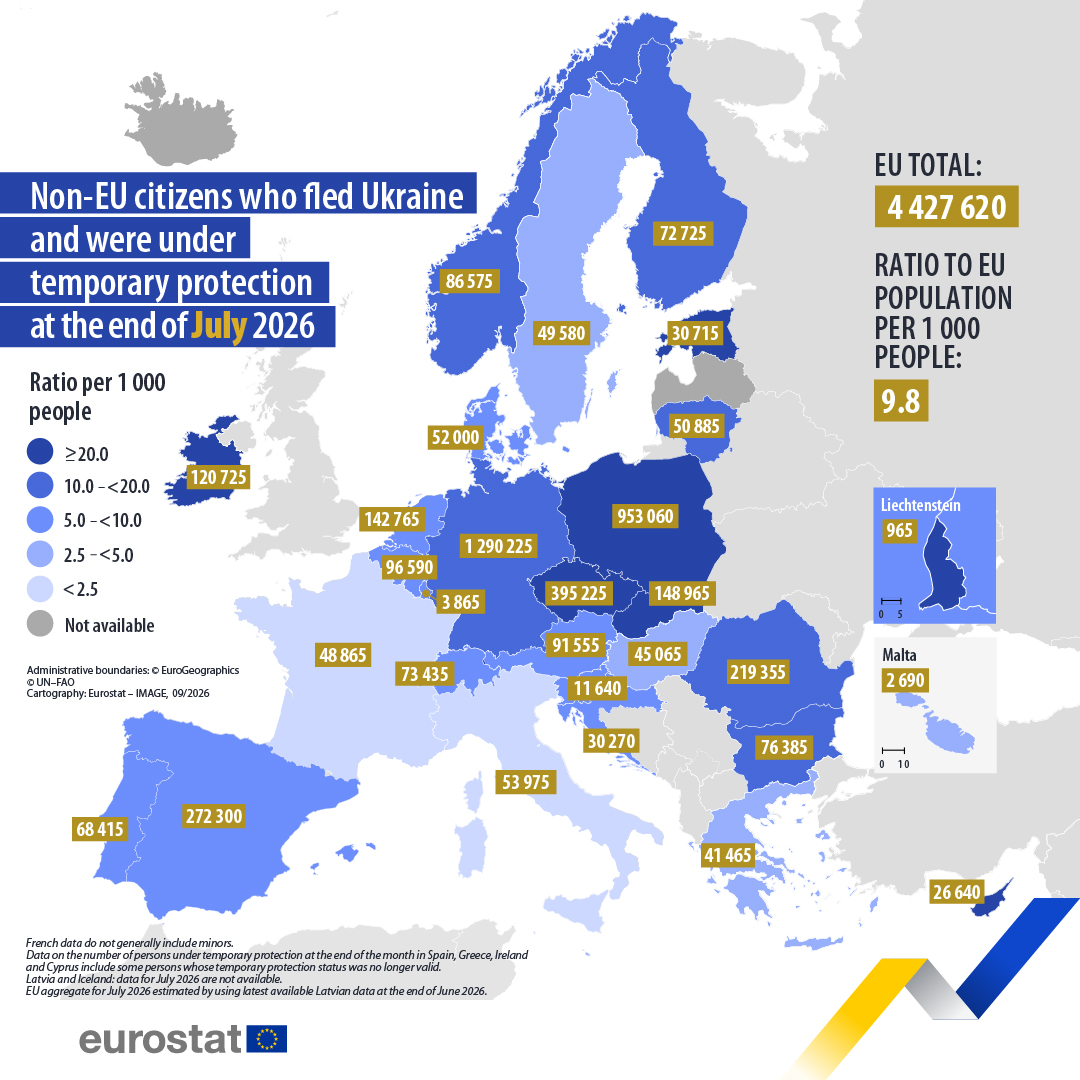
The number of people displaced from Ukraine and living under temporary protection in the European Union reached 4.43 million at the end of July 2026, keeping housing and public infrastructure requirements elevated more than four years after the start of Russia’s full-scale invasion.
The EU total increased by 19,945 people during July, or 0.5% compared with the end of June. Germany continued to accommodate the largest population, with 1.29 million beneficiaries, representing 29.1% of the EU total. Poland followed with 953,060 people, or 21.5%, while Czechia was home to 395,225, equivalent to 8.9%.
Poland’s registered population declined by 8,110 during the month, a decrease of 0.8%. France recorded a reduction of 475 and Cyprus 110. Eurostat cautions, however, that countries use different procedures for removing people from temporary-protection registers, meaning monthly declines should not necessarily be interpreted as equivalent movements in the resident population.
Elsewhere in Central and Eastern Europe, the number continued to increase. Czechia recorded an additional 4,415 beneficiaries during July, an increase of 1.1%, while Romania added 4,055, or 1.9%. Germany’s total increased by 3,995.
The figures become particularly significant for real estate when measured against national populations. Czechia had 36.2 temporary-protection beneficiaries for every 1,000 residents, the highest proportion in the EU. Slovakia followed at 27.5 per 1,000 and Cyprus at 26.7, compared with an EU average of 9.8.
For residential markets in Central Europe, the scale and duration of this population presence means Ukrainian households are increasingly relevant to longer-term housing requirements rather than only emergency accommodation. Poland alone continues to accommodate close to one million people under the scheme, while Czechia’s much smaller population gives it considerably greater exposure on a per-capita basis.
The demographic composition adds another dimension to the housing question. Ukrainian citizens represented more than 98.5% of people covered by temporary protection across the EU. Adult women accounted for 43.4%, adult men for 27.1%, while minors represented 29.4%. The large proportion of children means the implications extend beyond residential accommodation to education, childcare, healthcare, public transport and other local infrastructure.
For property markets, however, the Eurostat figures do not establish how many beneficiaries rent privately, live with relatives, own homes or use other forms of accommodation. They therefore cannot be used to calculate the amount of additional housing demand directly attributable to temporary protection.
Nevertheless, the duration of the protection arrangements is making this population increasingly relevant to residential investment and development decisions. Temporary protection for people displaced from Ukraine has been extended through 4 March 2027, maintaining their ability to remain in EU member states under the protection framework.
Poland, Czechia and Slovakia consequently face somewhat different housing implications. Poland has by far the largest beneficiary population of the three, creating significant absolute housing requirements, while Czechia and Slovakia carry much greater concentrations relative to their populations.
More than four years after the initial displacement, Ukrainians under temporary protection have become an important demographic factor in many Central European cities. For residential developers, rental-housing operators and local authorities, the question is increasingly shifting from how to accommodate a temporary migration surge towards how much of this population will remain and what type of housing and urban infrastructure will be required over the longer term.