Sunday, 4 October 2026
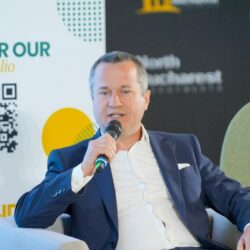
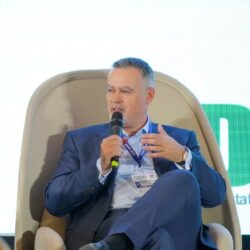
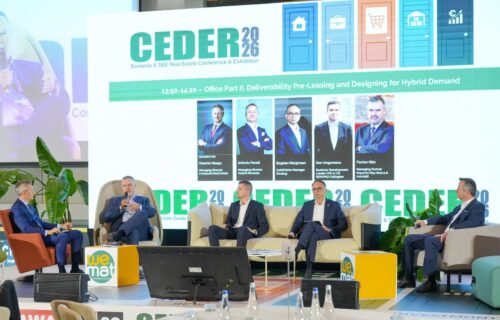
Industry experts participanting in the second Office panel held at CEDER 2026 suggest that successful projects in the future 12- to 24-month timeframe will be defined by their ability to integrate technology, ensure deliverability, and prioritize the human experience over mere square footage.
According to Antoniu Panait, Managing Director of Vastint Romania, the rapid pace of technological evolution is now a fundamental divider. He argues that staying ahead of the curve on sustainability is no longer optional but a primary competitive advantage: “Evolution of technology in the last years, it’s exponential, it’s mind blowing how quickly it evolves everything and it starts to be applicable also in real estate. I think it’s all about getting as soon as possible carbon neutral, Paris-proof, and implementing as quick as possible new technologies. (…) I think this will be the differentiator between the old buildings and the new buildings”.
Practical execution is the second major differentiator. Bogdan Mărginean, Technical Subdivision Manager at Strabag, notes that the market is moving away from being impressed by “theoretical” beauty. Success will instead go to developers who can guarantee that a project is viable and sustainable in the long term: “I’m absolutely sure nobody or the market will (…) reward renderings, very attractive renderings. It will reward performance and performance from the predictive delivery of the project, first of all, of efficient leasing and sustainable operation”.
Dan Ungureanu of Renomia Gallagher emphasizes that mature risk management is what will attract cautious lenders. He suggests that the projects that move forward will be those led by teams that “have a very open mindset” and “a mature way of thinking”.
Finally, Florian Nițu, Managing Partner at Popovici, Nițu, Stoica & Asociații, points out that the most successful projects will treat office space as a service designed to foster employee happiness. He observes: “The most important element is that [of] office as a service, that delivers the so-called occupier wellbeing. And by occupier wellbeing you mean the happiness of the employees and partners of your tenant. If that’s in and if that wellbeing is combined with higher ethics, social responsibility undertakings (…) I’m absolutely convinced that this will be the successful project”.
Ultimately, the projects that succeed in the coming years will be those that transition from providing a commodity to delivering a high-performance, ethically grounded product.