Sunday, 4 October 2026
Carbon Tool and CIJ Europe continued their collaboration at the 2026 edition of the CEDER Conference & Exhibition and HOF Awards, reinforcing a shared commitment to transparency, measurable sustainability performance and more responsible event planning within the real estate industry.
Held at the Radisson Hotel in Bucharest, the 19th edition of CEDER once again brought together developers, investors, consultants, occupiers and service providers from across the market for a full day of discussions, networking and business opportunities, with sustainability remaining a central theme throughout the event.
As part of this partnership, CarbonTool calculated and analysed the carbon footprint generated by the event, helping transform sustainability objectives into measurable environmental data and actionable insights.
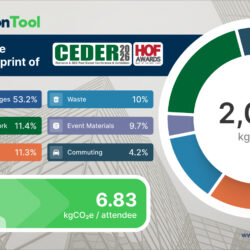
The total carbon emissions generated by the 2026 CEDER & HOF Awards reached 2,049 kgCO₂e, corresponding to an average of 6.83 kgCO₂e per attendee.
Here’s the breakdown of emissions by category:
• Food and Beverages: 1,090 kgCO₂e (53.2%)
• Commuting & CIJ Team Effort: 321 kgCO₂e (15.67%)
• Event Materials: 199 kgCO₂e (9.71%)
• Waste: 206 kgCO₂e (10.05%)
• Electricity: 233 kgCO₂e (11.37%)
As in previous editions, catering and transportation remained the largest contributors to the overall footprint, highlighting the importance of mobility choices and procurement strategies in the environmental performance of large-scale business events.
Attendees were invited to submit their commuting method through a dedicated QR-code-based system, helping create a more accurate picture of transport-related emissions and participant mobility patterns.
The results showed a strong preference for lower-impact commuting methods — around 28% of attendees submitted their commuting data, and of those participants, more than 76% chose lower-impact transport methods. This is particularly encouraging considering that, compared to last year, the event welcomed a higher number of international participants, which naturally increases the likelihood of higher transport-related emissions. The results reflect growing awareness around mobility choices and a stronger openness toward more sustainable ways of traveling to professional events.
The ongoing collaboration between Carbon Tool and CIJ Europe demonstrates how carbon measurement and environmental accountability can become part of major industry events without compromising business value or participant experience.
While reducing the environmental impact of events remains a complex challenge, initiatives like these show that progress starts with data, awareness and the willingness to continuously improve.
For more information on how Carbon Tool supports organizations in measuring, managing and reducing carbon emissions, visit CarbonTool.