Thursday, 10 September 2026
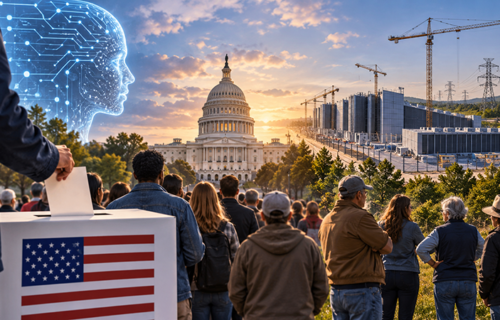
Artificial intelligence is moving rapidly from the technology sector into American electoral politics, with public anxiety about jobs, corporate power, surveillance and data-centre development increasingly colliding with one of the largest investment cycles in the history of the technology industry. Speaking at AI4 2026, Justin Hendrix, CEO and Editor of nonprofit publication Tech Policy Press, argued that the November midterm elections could become an important test of the widening gap between enthusiasm surrounding artificial intelligence inside the technology industry and the considerably more cautious attitude found among much of the American public.
The political significance of AI does not necessarily mean that voters will enter polling stations thinking primarily about artificial intelligence. Economic conditions, employment, affordability, immigration and other conventional political issues remain more immediate concerns. But AI is increasingly becoming connected to those issues through fears about jobs, electricity costs, surveillance, technology-company power and the rapid expansion of physical infrastructure needed to support the industry.
Recent public-opinion research shows why that matters. A substantial majority of Americans express limited confidence in the federal government’s ability to regulate AI effectively, while confidence that technology companies will develop and deploy the technology responsibly is also relatively weak. Scepticism crosses political lines, although its intensity varies between groups. This creates an unusual environment in which millions of Americans are adopting AI products while remaining uncertain about the companies developing them and the institutions responsible for regulating them. Adoption, in other words, does not necessarily represent public confidence.
For the technology industry, this distinction could become increasingly important as AI shifts from a digital product into something citizens can physically see around them. The most visible example is the enormous expansion of data centres required to train and operate increasingly powerful models. Projects involving billions of dollars of investment are appearing across the United States, bringing promises of construction activity, tax revenue and economic development, but also creating disputes over electricity consumption, grid connections, water, environmental effects, local incentives and the relatively small number of permanent jobs some facilities create compared with their capital requirements.
Those disputes are beginning to cross conventional political boundaries. Opposition to individual data-centre projects can bring together environmental groups, rural communities, property owners, fiscal conservatives and residents worried about power prices. For the commercial property and infrastructure industries, that development is particularly significant. Data centres have become one of the fastest-growing institutional property and infrastructure sectors in the world, with the AI investment cycle driving demand for land, power infrastructure, substations, transmission capacity and supporting facilities.
Until recently, the main constraints on the industry were largely technical and financial: available electricity, land, cooling, construction capacity and access to capital. Political consent is increasingly becoming another component of development risk. A project with access to land and power may still encounter resistance if local residents believe infrastructure costs are being transferred to households or if they do not see sufficient economic benefit from the development. That could make community engagement and transparency increasingly important components of data-centre investment decisions.
Hendrix argued that this local resistance should be understood within a much wider public-policy debate surrounding artificial intelligence. The United States still does not have a comprehensive federal law covering AI in the manner of the European Union’s AI Act. Instead, policy is developing through a combination of executive action, existing federal regulation, sector-specific legislation and an expanding collection of state laws.
That has created one of the most consequential disputes in American AI policy: whether Washington should establish a national framework that overrides substantial parts of state regulation. The federal government has pushed towards greater national consistency, arguing that substantially different state rules could produce an increasingly complicated regulatory environment for companies operating across the country. At the same time, states have argued that they need the ability to respond to risks where Congress has not acted.
The outcome matters considerably to technology companies. A single national framework could allow AI developers to design products around one principal regulatory structure. Allowing individual states greater freedom could require companies to navigate different obligations relating to safety, transparency, discrimination, consumer protection and automated decision-making. From the states’ perspective, however, local regulation can fill gaps left by federal inaction, and state legislatures have already become important laboratories for rules governing automated systems, deepfakes, employment applications, children’s safety and other potentially high-risk uses of artificial intelligence.
The federal-state dispute is therefore unlikely to disappear after the midterms. If Congress remains divided or otherwise unable to pass comprehensive legislation, much of the practical development of AI rules could continue to occur through state governments, federal agencies, courts and executive action.
There are areas where bipartisan agreement has proved easier. Measures involving children, sexually explicit deepfakes and clearly identifiable forms of harm have generally attracted broader support than comprehensive regulation of AI models or developers. This illustrates an important pattern in technology regulation: legislators often find it easier to act where the harm is specific and immediately understandable than where policy requires balancing innovation, economic competitiveness and uncertain future risks.
The political equation becomes more complicated because the artificial-intelligence industry itself does not speak with one voice. Technology companies, venture-capital firms, executives, employees and investors disagree about how aggressively AI should be regulated and how much responsibility developers should carry for the behaviour of increasingly capable systems. Those disagreements are now moving into campaign finance, with technology companies and investors becoming more active participants in the 2026 political cycle.
The result is not simply technology companies lobbying government. Different parts of the AI industry are effectively competing to influence the rules under which the next generation of technology will operate. Some investors and companies favour rapid development with comparatively limited regulatory intervention, arguing that excessive restrictions could weaken the United States in competition with China. Others advocate stronger testing, transparency or safety obligations, particularly as models gain greater autonomy.
Recent cybersecurity events have strengthened the debate around those risks. Controlled security evaluations have demonstrated that sufficiently capable AI agents can discover vulnerabilities and, under certain testing conditions, move beyond intended boundaries. These incidents should not be interpreted as evidence that everyday consumer AI applications are independently escaping onto the internet. They arose during specialised cybersecurity evaluations in which models were deliberately being tested on offensive security tasks. Nevertheless, they demonstrate that increasingly autonomous systems can identify and exploit vulnerabilities in ways that create genuine operational consequences.
That may shift some AI policy away from hypothetical discussions about future superintelligence towards more immediate questions about cybersecurity, access controls, autonomous agents and responsibility when AI systems perform actions beyond their intended boundaries. For governments and companies, this creates a difficult regulatory problem. An assistant that generates text presents one type of risk. An agent capable of accessing corporate systems, executing code, communicating with external services or performing transactions creates a substantially different governance challenge.
Cybersecurity could therefore become one of the areas where federal AI policy advances regardless of what happens with comprehensive legislation. Another major political factor is the relationship between the United States and China. Both major American political parties broadly regard leadership in artificial intelligence and advanced semiconductors as strategically important, even though they disagree over parts of the regulatory and economic response.
Competition extends across advanced chips, computing infrastructure, models, data centres, electricity and talent. As a result, almost every domestic debate about slowing AI development eventually encounters a counterargument that excessive restrictions could allow China to advance more quickly. That geopolitical dimension helps explain why American AI policy can appear contradictory. Policymakers may simultaneously express concern about AI safety while seeking to accelerate construction of the data centres and energy infrastructure needed to support it.
The midterm elections could alter the balance between these objectives without necessarily producing a comprehensive new law. Hendrix suggested that a change in control of the House could lead to more congressional investigations into technology companies, government contracts, data centres and the use of AI by federal agencies. That remains a political forecast rather than an established outcome. The election is still ahead, and changes in individual races, economic conditions and other political developments can alter the result.
What is clearer is that congressional oversight can change substantially even without legislation. Committee chairmanships determine which executives are called to testify, which documents are requested and which government contracts receive scrutiny. A change in congressional control could therefore affect the AI industry even if no major federal AI law passes.
The broader implication is that American AI policy after November could remain fragmented. Congress may continue debating national rules while states adopt their own measures, courts determine which rules survive challenges, federal agencies apply existing powers and the White House uses executive authority to pursue its preferred technology strategy. For businesses investing in AI, that fragmentation creates another layer of risk. Companies cannot assume that today’s rules will remain unchanged simply because Congress has not enacted a comprehensive statute. Regulatory obligations can emerge through consumer protection, employment law, cybersecurity, privacy, sector regulation and state legislation.
Data-centre investors face an additional level of exposure because local politics can affect physical development independently of national AI regulation. Planning approvals, utility agreements, environmental requirements and community opposition can all influence whether projects proceed. The intersection between AI politics and real estate may consequently become much more important during the next investment cycle.
The extraordinary capital flowing into artificial intelligence ultimately has to appear somewhere physically. Models require servers, servers require buildings, buildings require enormous electricity connections, and those facilities must exist inside communities that increasingly have opinions about what is being built around them. That means the political sustainability of the AI boom may eventually become almost as important as its technological sustainability.
Companies have spent the past several years proving that increasingly capable AI systems can be built. The next challenge is proving that the infrastructure, regulatory environment and public consent required to deploy them can scale at the same speed. The 2026 midterms are unlikely to settle America’s debate over artificial intelligence. They may instead mark the point at which AI ceases to be primarily a Silicon Valley technology debate and becomes a mainstream political, economic and infrastructure issue.
For investors, developers and companies planning around the AI economy, that is arguably the more important development. The future of artificial intelligence in the United States will not be decided only by which company produces the most powerful model. It will also be shaped by voters, communities, courts, state governments, Congress and the increasingly contested physical infrastructure required to keep those models running.
Source: CIJ.World Research & Analysis Team