Tuesday, 13 October 2026
There was a time when arriving at an airport meant finding a taxi, negotiating with a driver who had apparently studied economics under a Sicilian pirate, and hoping the meter wasn’t connected to the national debt. Fortunately, technology has rescued us from such primitive inconveniences. Today, we simply open an application, select our destination and watch a little car move across a screen. The future has arrived, complete with satellite navigation, artificial intelligence and the remarkable ability to make a vehicle disappear while insisting it is standing directly in front of you.
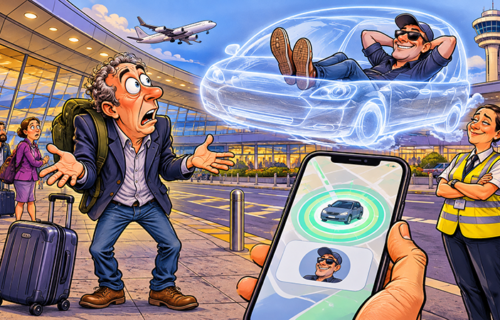
This particular adventure began at Bucharest’s Henri Coandă International Airport, where a traveller ordered a car through the wonderfully mysterious world of Abracadabra Mobility. The application cheerfully announced that the driver had arrived. Splendid news, except for one minor administrative detail: there was no car. The passenger searched the collection area, examined the surrounding roads and wandered around with the determination of an archaeologist looking for a lost Roman settlement. Nothing. Not a bumper, not a windscreen, not even a suspicious-looking exhaust pipe. Somewhere in the digital universe, however, the driver was apparently waiting with the patience of a Buddhist monk.
Eventually, the driver decided that enough was enough. Having successfully avoided the inconvenience of collecting his customer, he cancelled the booking and declared the passenger a no-show. This was a remarkable achievement. The passenger was physically present, the driver was nowhere to be found, yet technology concluded that the missing individual was the person standing at the airport. It was rather like a restaurant charging you for failing to eat a dinner that the chef had forgotten to cook. Whether the driver had genuinely reached the correct location remains unknown, but the application had already delivered its interpretation of reality.
A little investigation suggests that Bucharest is not alone in hosting this particular magic show. Passengers in Lisbon, London and other European cities have reported comparable adventures involving vehicles that exist confidently on mobile screens but prove considerably more elusive in the physical world. At Lisbon Airport, travellers have described searching designated collection points while drivers apparently waited somewhere in another dimension. In London, complaints have included disputed charges for cars that customers say never appeared. One begins to suspect that Europe’s ride-hailing industry has quietly developed a new transport category: the imaginary chauffeur service.
The economics are equally fascinating. Drivers can receive compensation when passengers fail to appear after a specified waiting period, which is perfectly reasonable when the driver actually turns up. But imagine the entrepreneurial possibilities if the system mistakenly rewards someone who never reaches the correct location. No passengers to collect, no luggage to load, no traffic to negotiate and no uncomfortable conversations about the weather. Just wait, cancel and potentially receive compensation. Of course, there is no evidence that every missing driver is operating such a scheme, but the theoretical business model would surely attract the attention of anyone who has ever dreamed of earning money by doing absolutely nothing.
Airports provide an especially convenient stage for these misunderstandings. A driver might be on the wrong level, behind a barrier, across a multi-storey car park or somewhere near a roundabout that only the airport architect understands. According to the application, the vehicle is practically close enough to shake hands with. In reality, reaching it might require a passport, climbing equipment and permission from air traffic control. Satellite navigation can identify geographical proximity, but it has yet to master the more complicated human concept of being somewhere that another person can actually find you.
Naturally, the transport platforms have rules. Drivers are supposed to reach the correct location, wait appropriately and make reasonable efforts to contact their customers. Passengers can challenge questionable charges, and the companies have access to location records that may establish what happened. The difficulty is that the passenger has a mobile telephone and a rapidly declining sense of humour, while the platform possesses the electronic evidence. One party remembers standing outside an airport looking for a car. The other has a computer suggesting that the car was there. In the modern world, the computer frequently gets the first opportunity to explain itself.
Perhaps the solution is to introduce a new technological breakthrough called looking out of the window. Before declaring a passenger missing, the driver could confirm that the vehicle is actually at the agreed collection point. The passenger might then be allowed to identify something revolutionary, such as a registration plate attached to a real automobile. For particularly advanced operators, an optional feature could require the driver and passenger to occupy approximately the same physical location before either is blamed for disappearing. It sounds ambitious, but humanity has already managed to put people on the Moon.
There is, of course, a serious issue beneath the comedy. Disputed airport collections waste time, create frustration and can leave travellers facing charges for journeys they never received. There is no verified evidence that an organised European network of invisible drivers exists, and many failed pickups are undoubtedly genuine misunderstandings. Nevertheless, repeated complaints suggest that the systems determining responsibility deserve closer attention. When a driver claims to have arrived and a passenger insists that no vehicle was present, the answer should come from examining the evidence rather than automatically assuming one party has vanished.
As for our traveller in Bucharest, he eventually discovered that the most impressive feature of modern transportation is not the electric motor, the smartphone or the satellite orbiting above Romania. It is the extraordinary ability to be standing exactly where you are supposed to be and still be officially declared missing. Somewhere out there, perhaps, an invisible car is waiting for its invisible passenger, while a very real cancellation fee considers making an appearance. Welcome to the future of airport travel, where the only thing guaranteed to arrive on time is the notification telling you that you weren’t there.
Author: Mitzilinka (Turning grim reality into comic relief-without losing the truth)