Tuesday, 13 October 2026
Once upon a time, business class was where respectable people travelled in comfort, ate something recognisable and occasionally received a smile without having to request one in writing. Today, European business class has become a fascinating experiment in how much money passengers will pay to experience economy with a superiority complex. You receive a curtain, a different boarding pass and the comforting knowledge that your disappointment has been professionally upgraded. My latest adventure began on a Monday morning at Warsaw Chopin Airport, heading to Bucharest aboard a Boeing 737 MAX 8. Having booked business class, I naturally expected a touch of luxury. Nothing unreasonable. I wasn’t demanding a personal butler, a foot massage or a flight attendant calling me Sir Reginald of Warsaw. A comfortable seat, edible lunch and sufficient legroom to prevent my knees from becoming permanent fixtures of the aircraft would have been perfectly acceptable.
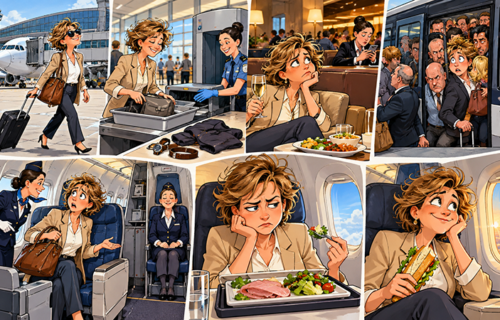
Security provided the first miracle. Brand-new scanning equipment allowed laptops, cosmetics and other possessions to remain inside hand luggage. After decades of airport security resembling a compulsory suitcase-emptying competition, civilisation had finally arrived. Unfortunately, the miracle applied exclusively to luggage. I still had to remove my jacket, belt, watch and everything from my pockets, leaving me dressed like a man who had been unexpectedly evicted from a gentlemen’s club. There was also the possibility of being selected for additional inspection, involving a swab of hands and clothing. Apparently, technology can see through a suitcase, but a businessman attempting to keep his trousers up remains a national security mystery.
The airport lounge promised refuge. The first welcome was pleasant, suggesting that hospitality might still exist somewhere within the building. Unfortunately, the next reception appeared to operate under a different management philosophy: customers should neither disturb nor distract staff from their mobile telephones. The receptionist was deeply involved in her screen, possibly coordinating international diplomacy, although I suspect somebody’s weekend photographs were proving more urgent. Meanwhile, the hot-food counter resembled a school canteen that had survived three generations without changing its menu. The food wasn’t necessarily dangerous, but it certainly looked as though it had been introduced to enthusiasm only briefly.
Then came boarding, an activity that European airlines have transformed into a competitive contact sport. Our aircraft was parked away from the terminal, meaning everyone was herded onto a bus. Business passengers, economy passengers and anyone unfortunate enough to be standing nearby were compressed together with the precision of industrial vacuum packaging. Personal space became a distant memory. Somebody’s elbow occupied my ribs, another passenger’s suitcase attempted to adopt my shoes, and I became sufficiently familiar with a stranger’s aftershave to identify it in a police line-up. For additional entertainment, the bus remained stationary for approximately fifteen minutes while escorted passengers were accommodated. There may have been perfectly legitimate reasons, but those already aboard were left to enjoy the full benefits of compulsory human closeness. The remarkable thing was how effectively the experience eliminated social inequality. Everyone stood together, sweating democratically. The only difference was that business-class passengers had paid considerably more to discover what it feels like to be a sardine with a corporate expense account.
Upon entering the aircraft, I discovered that my original first-row seat had apparently been requisitioned for cabin crew use. This was unfortunate because the first row offered the extra legroom I had been anticipating. A crew member subsequently occupied the seat, while the nearby jump seat appeared to be enjoying a quieter journey in the company of her belongings and paperwork. There may have been perfectly sensible operational reasons, but it was difficult not to admire the arrangement. My legs had been downgraded, the paperwork was travelling comfortably, and everybody seemed satisfied except the person who had purchased the ticket. At almost two metres tall, legroom is not a luxury. It is a humanitarian requirement. My replacement seat offered the familiar dimensions of European economy, with the additional privilege of being closer to the cockpit. The seat was comfortable enough if one happened to possess the legs of a garden gnome. Unfortunately, mine were manufactured to a rather more ambitious specification.
Lunch arrived with considerable promise. The printed menu described roasted chicken with cherry tomatoes, curry sauce and a salad accompanied by yoghurt dressing. It sounded perfectly respectable, perhaps even enjoyable. What appeared before me, however, resembled cold cuts and salad. Somewhere between the printing department and the aircraft galley, the roasted chicken had apparently resigned. Perhaps it missed its connecting flight. Perhaps the chef had interpreted the menu as a work of fiction. Either way, I was left contemplating a culinary mystery that would have challenged even Hercule Poirot. The experience made me wonder whether I should have booked economy and spent the savings on a proper lunch in Bucharest. At least in a restaurant, when one orders roasted chicken, there is a reasonable expectation that a chicken has encountered an oven. Business class, apparently, now offers the additional excitement of discovering whether the menu and the meal have ever met.
This peculiar arrangement is hardly unique to one flight. Across Europe, many airlines have perfected the art of selling business class without necessarily providing a fundamentally different seat. The premium frequently consists of an empty middle seat, additional baggage, airport privileges and a meal with a more ambitious description. The aircraft remains the same, the seat often remains the same, and the passenger is invited to appreciate the enormous financial significance of nobody sitting immediately beside them. It is a brilliant business model. Imagine visiting a restaurant where the expensive table comes with an empty chair, the same furniture and a slightly different sandwich. The management then explains that the additional charge represents privacy, exclusivity and enhanced personal space. One would probably leave. In aviation, however, we fasten our seatbelts and congratulate ourselves on being sophisticated travellers.
Of course, business class can offer genuine advantages. Flexible tickets, additional luggage allowances, lounges and priority services are valuable to many passengers. But for someone primarily seeking physical comfort, an economy exit-row seat can sometimes provide more useful legroom than the supposedly superior cabin. The person paying less may actually be sitting more comfortably, which is a rather magnificent achievement in modern marketing. Then there is the disappearing art of manners. During the journey, pointing fingers occasionally replaced spoken requests, while some passengers seemed to believe that occupying a window seat entitled them to command the aisle passenger to stand through the power of facial expression alone. Perhaps airlines should introduce a new loyalty programme based on politeness. Five hundred points for saying please, a thousand for thanking the crew, and lifetime Platinum status for completing a flight without reclining one’s seat into another passenger’s dental work.
My return journey from Bucharest is approaching aboard a smaller aircraft with two seats on either side of the aisle. This promises an entirely new chapter in premium aviation. With no middle seat available to leave empty, I am fascinated to discover precisely what business class will offer. Perhaps the airline will provide an imaginary vacant seat, a slightly more enthusiastic sandwich or a complimentary certificate confirming that I am indeed sitting somewhere near the front. Despite everything, I remain optimistic. Aviation is an extraordinary achievement, and transporting passengers safely between European capitals deserves recognition. But safety is a basic responsibility, not an expensive optional extra. Business class should provide something noticeably better than economy, rather than requiring passengers to use their imagination to identify the difference.
My Warsaw–Bucharest experience delivered a modern security scanner, indifferent lounge hospitality, a bus journey resembling an overcrowded livestock auction, a disappearing first-row seat and a roasted chicken that apparently never made it aboard. Yet the aircraft arrived safely, my luggage survived, and I emerged with enough material to write another column. Perhaps that is the true luxury of European business class. You pay a premium, endure the experience and receive a complimentary collection of stories that nobody would believe if you hadn’t witnessed them yourself. As for my return flight, I have developed a sensible strategy. I shall lower my expectations, protect my knees and bring a sandwich. Preferably one containing the chicken that went missing on the outward journey.
Author: Mitzilinka (Turning grim reality into comic relief-without losing the truth)